


Featured Summary:
- AISCA is entering African AI compute race as startups and AI researchers struggle with limited GPU access and rising cloud costs.
- Foreign-owned platforms still power much of Africa’s AI development, increasing dependence across startups and research institutions.
- AI deployment across banking, healthcare, telecoms, logistics, and digital commerce is expanding faster than local processing capacity.
- Rwanda tech investments are placing Kigali closer to East Africa’s growing competition over AI infrastructure and digital influence.
African artificial intelligence push is accelerating on systems the continent still does not control.
African developers remain heavily dependent on foreign-owned GPUs, external cloud providers, and offshore processing infrastructure to build and scale AI products.
Compute power increasingly determines who can train models, process local data, deploy commercial systems, and retain strategic influence inside the next phase of the digital economy.
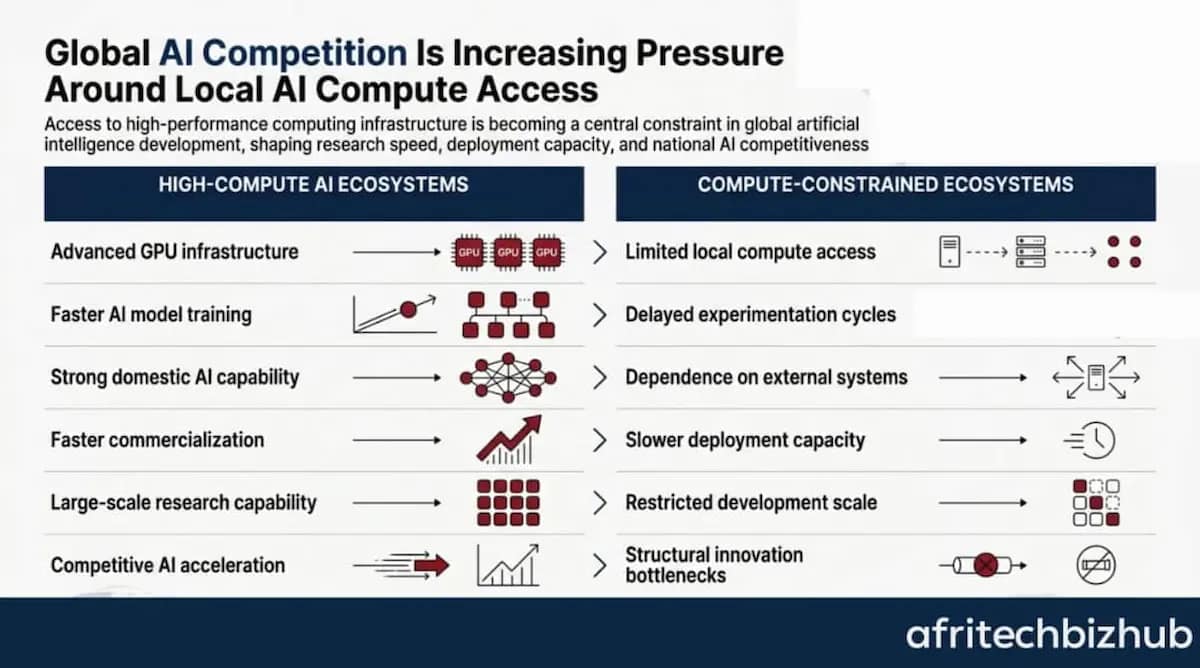
GPU Access Constraints Continue Slowing Parts Of African AI Development
Africa’s AI researchers and startups continue facing severe GPU shortages as demand for machine-learning systems rises across finance, healthcare, education, agriculture, and logistics.
Access costs remain high, commercial availability remains limited, and many smaller developers still lack the processing power required to train competitive models locally.
The result is widening imbalance inside African AI development.
Startups with access to foreign cloud credits and external technical partnerships continue moving ahead, while smaller local builders struggle to scale beyond prototype level.
The continent is no longer short of AI ambition. It is short of the computing strength required to industrialize that ambition.
Dependence On Foreign Cloud Infrastructure Is Raising New AI Sovereignty Concerns
The global AI race is increasingly becoming a battle over who controls the systems underneath the models.
African developers may build local applications, but much of the digital backbone supporting those products still sits inside infrastructure owned abroad.
That dependence carries financial and strategic consequences, as African AI interests and future remain externally influenced.
Foreign-controlled platforms shape pricing, access conditions, storage rules, and long-term scalability for many African startups and research institutions.
The deeper risk is structural. Regions that fail to control their own computing layer increasingly weaken leverage over the industries built on top of it.
Africa risks building an AI market it does not fully govern.
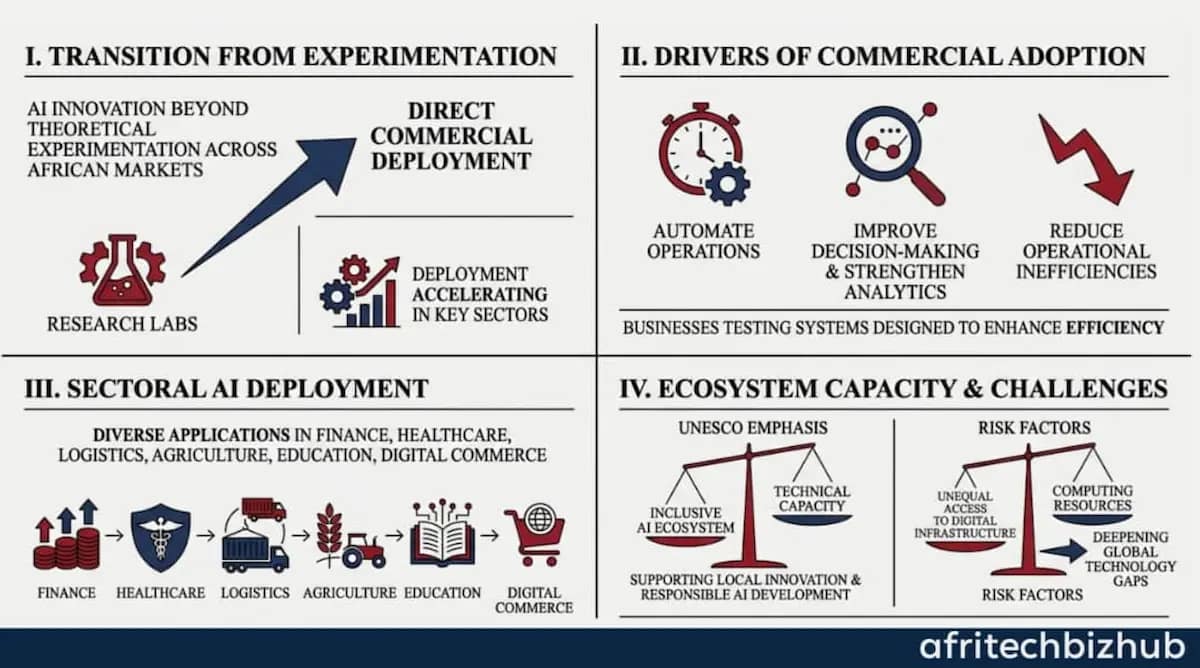
Commercial AI Deployment Is Increasing Pressure On Africa’s Compute Capacity
AI innovation across African markets is moving rapidly into commercial deployment as banks, telecom operators, logistics firms, healthcare providers, and digital platforms adopt automation, predictive analytics, fraud monitoring, and language-processing systems at larger scale.
UNESCO has warned that unequal access to digital capabilities and AI infrastructure risks widening technological inequality between countries with stronger computing capacity and those dependent on external systems.
As AI deployment expands across African markets, pressure is increasingly shifting toward access to compute, cloud infrastructure, and long-term digital capability.
Rwanda’s Digital Infrastructure Push Is Pulling More Attention Around Regional AI Development
Rwanda is moving deeper into East Africa’s technology competition as governments position for influence over cloud investment, data systems, AI partnerships, and regional digital coordination.
Kigali’s long-running focus on connectivity, digital governance, and technology policy is now placing the country closer to Africa’s broader compute debate.
The next phase of African AI development is unlikely to spread evenly across the continent.
Countries investing early in energy reliability, cloud infrastructure, data systems, and research capacity are positioning themselves to attract larger shares of AI talent and commercial deployment.
Others risk becoming users of AI systems developed elsewhere rather than centers of value creation.


Recent Comments