


Featured Summary:
- Nigeria AI moved beyond strategy documents and into frontline public service delivery through GovGuide
- Government access is shifting from portals toward conversational interfaces
- AI chatbot systems are becoming part of digital government infrastructure
- Long-term adoption will depend on trusted data and service execution
Government access across Africa is beginning to move away from portals and toward conversational interfaces as states search for faster ways to connect citizens with public services.
The challenge is no longer only digitizing government records. It is reducing the friction between public information and public action.
Nigeria’s launch of GovGuide on May 21, 2026, through the Federal Ministry of Communications, Innovation and Digital Economy alongside Meta, Publica AI, and the National Centre for Artificial Intelligence and Robotics places the country inside that transition.
Supporting English, Hausa, Igbo, and Yoruba, the platform signals a shift from digital government as infrastructure toward digital government as interface.
How is Nigeria AI Transforming Public Sector Access?
Nigeria AI is reducing the distance between citizens and government information. Public access has historically depended on navigating separate ministries, fragmented websites, unclear processes, and physical offices.
GovGuide reorganises that first interaction layer into one conversational interface that responds through voice and text rather than forcing users to search government structures manually.
The shift matters because government adoption is increasingly becoming an interface competition.
Citizens already expect instant search, direct responses, and mobile-first access. Public institutions that remain document-driven risk becoming harder to use even when services exist.
Nigeria AI is entering that gap through service discovery rather than administrative replacement.
Can digital Government Close Africa’s Public Service Gaps?
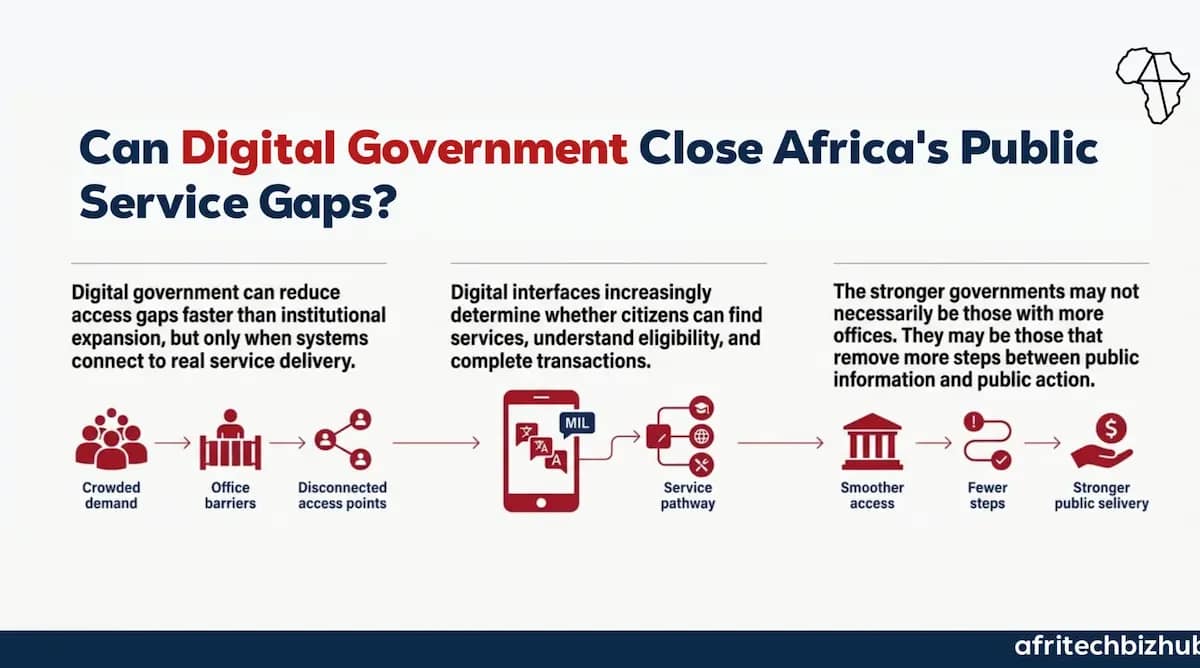
Digital government can reduce access gaps faster than institutional expansion, but only when systems connect to real service delivery.
Across Africa, governments continue to face pressure from population growth, urban expansion, and rising expectations for public responsiveness.
Building more offices alone does not solve that pressure. Digital interfaces increasingly determine whether citizens can find services, understand eligibility, and complete transactions.
Nigeria’s approach matters beyond one country because it reflects a broader continental direction: government access is moving toward mobile, multilingual, and lower-friction delivery.
The stronger governments may not necessarily be those with more offices. They may be those that remove more steps between public information and public action.
Why is AI chatbot improving government services delivery?
AI chatbot systems improve government services when they reduce information friction. Most public-sector service friction does not begin at execution.
It begins earlier when citizens cannot identify the right agency, understand requirements, or locate verified information.
AI chatbot systems compress those steps into a single interaction layer and reduce the cost of first contact.
The World Bank’s digital government framework identifies digital platforms, trusted data systems, and digital public infrastructure as key enablers of stronger service delivery and state capability.
Nigeria AI becomes more valuable if GovGuide evolves into infrastructure that connects information access with execution capacity.
Government chat interfaces do not replace institutions. They expose whether institutions can respond.
How Do Conversational Interfaces Simplify Government Access?
Government access changes when information moves into channels citizens already understand and use naturally.
GovGuide was launched as a multilingual voice and text assistant rather than a portal-first experience.
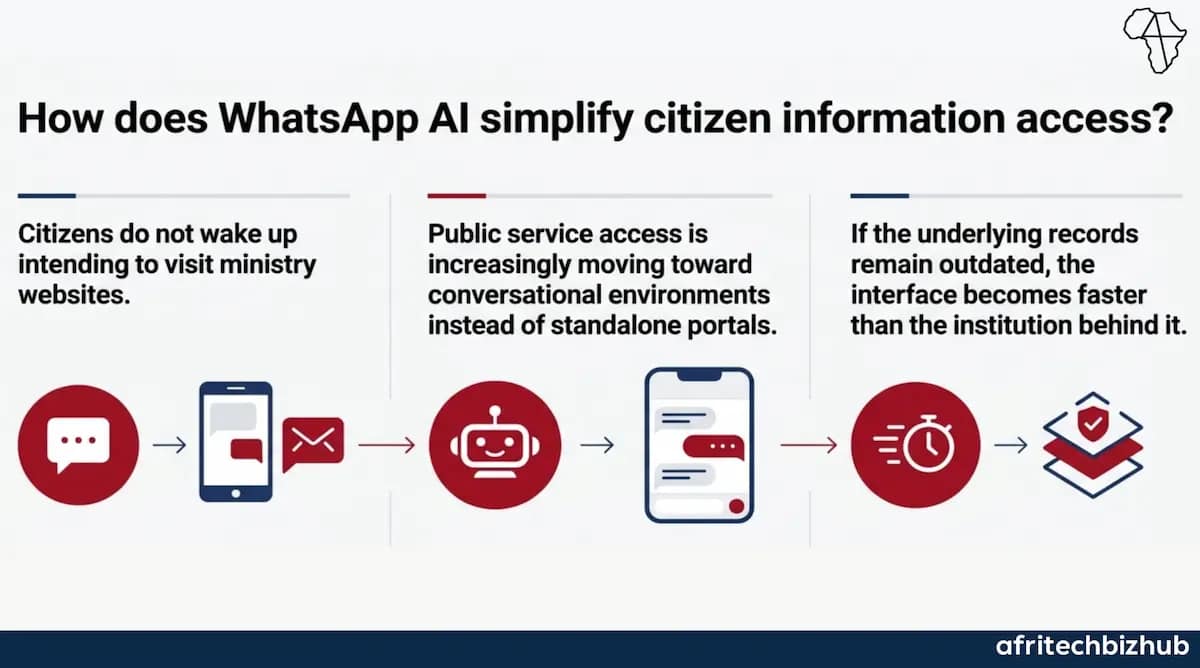
The direction is becoming clearer across digital government systems: access increasingly moves toward conversational environments instead of standalone government websites.
That shift changes adoption economics. Citizens do not wake up intending to visit ministry websites. They ask questions where they already communicate.
If government information becomes available inside familiar messaging behaviour, discovery costs fall and access expands.
If the underlying records remain outdated, the interface becomes faster than the institution behind it.
Nigeria AI now enters its harder phase. Building access is easier than proving institutional responsiveness through it.


Recent Comments