

Last updated: January 28, 2026
How Climate Tech Startups in Africa Are Driving Powerful, Positive Adaptation Across the Continent
Featured Summary:
- Climate tech startups in Africa are building powerful adaptation solutions for drought, flooding, food insecurity, and rising climate risks across the continent.
- Africa’s climate-tech sector now attracts billions in climate finance, with major funding flowing into water security, desert agriculture, carbon projects, and climate-smart farming.
- New climate-tech accelerators and funds—including Catalyst Fund, AfDB climate finance, and global climate resilience programs—are backing adaptation startups at scale.
- These innovations form Africa’s strongest adaptation wave yet, helping governments, SMEs, and communities respond to climate challenges and build long-term resilience.
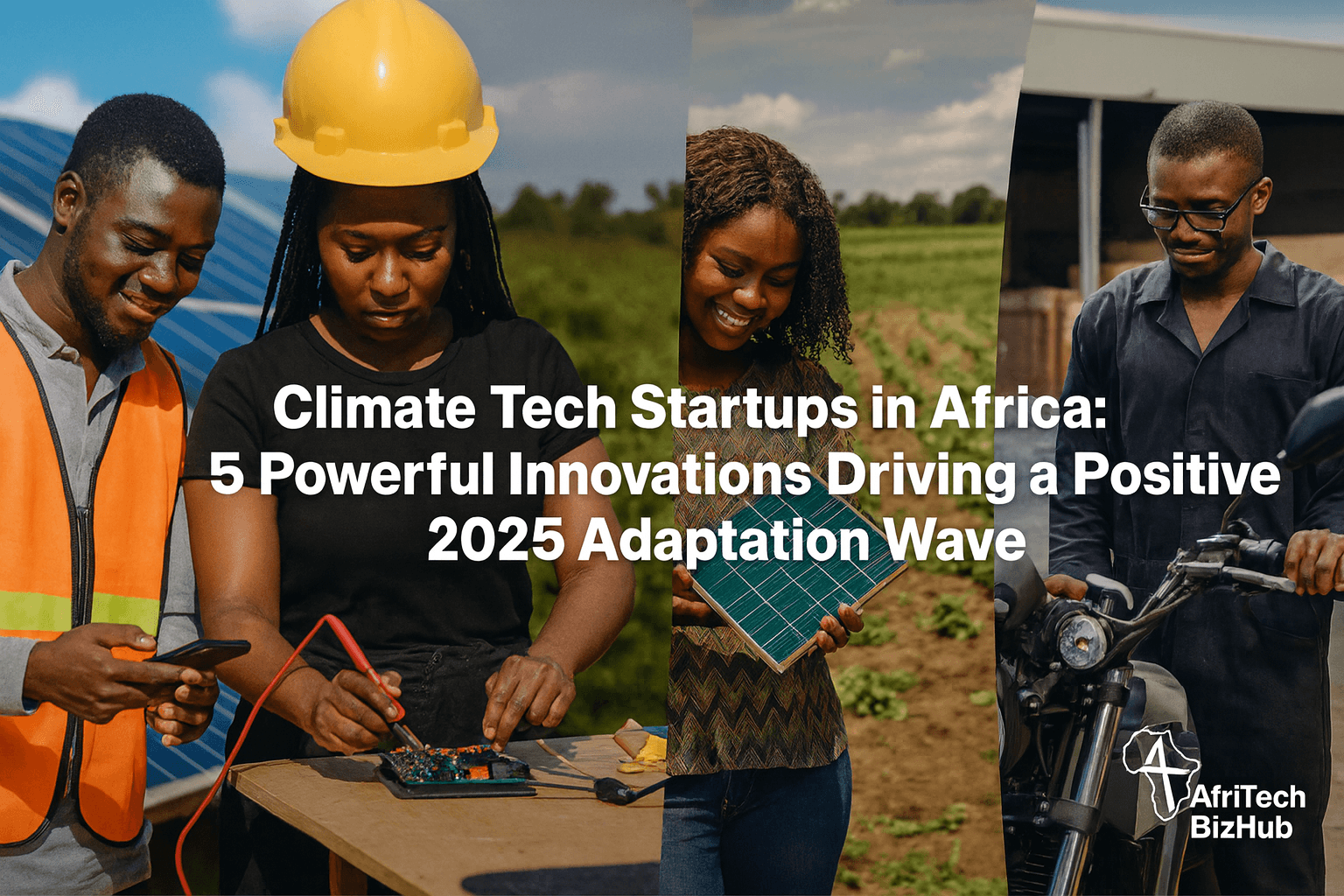
Climate tech startups in Africa are entering their most significant growth phase as rising climate risks accelerate demand for adaptation and resilience solutions. From drought-resistant farming to water innovation and carbon projects, new climate technologies are reshaping how the continent responds to climate change. Backed by expanding climate finance, Africa’s climate-tech sector is now driving a powerful adaptation wave.

Gain a decisive edge with our deep analysis on “Africa Tech 2025: 4 Sectors Powering the Continent’s Digital Leap”—a strategic breakdown every global reader should understand.
The Core Issue: Africa’s Climate Risks Are Forcing a Powerful Adaptation Shift
Climate tech startups in Africa have emerged as a necessity, not a trend, as climate shocks intensify across the continent. Africa warms 1.5 times faster than the global average, according to the IPCC, pushing governments and investors to adopt new adaptation solutions. This pressure has accelerated innovation in water systems, climate-smart agriculture, and carbon-resilience technologies, mirroring the rapid transformation highlighted in Africa’s Tech Leap.
Africa’s rising climate exposure—ranging from prolonged droughts in East Africa to destructive flooding in West and Southern Africa—has made adaptation technologies urgent. The African Development Bank estimates that climate impacts already cost African economies $7–15 billion annually, a figure expected to rise sharply without resilient technology systems. This is the major shift pushing startups into the center of Africa’s adaptation strategy.
The startup landscape has changed dramatically as climate finance expands. Climate tech startups in Africa attracted more than $1.04 billion in disclosed funding in 2023, according to Briter Bridges, with early 2024 reports showing climate tech capturing over 45% of all African startup investment. This marks a major shift from the fintech-dominated years discussed in Africa’s Tech Leap, signaling that climate resilience is now Africa’s fastest-growing innovation frontier.
Across key sectors—water innovation, desert agriculture, drought-resistant farming, carbon removal and monitoring, and nature-based resilience—startups are stepping into roles once filled only by governments and NGOs. These solutions are no longer experimental; they are scaling across borders through accelerators, climate funds, and adaptation programs. This transformation has created a unified innovation wave powering Africa’s adaptation and mitigation agenda.
Get a commanding insight into how Starlink is reshaping Africa’s connectivity. Read “Starlink and Africa’s Digital Shift: The New Internet Powering 2025” to understand the transformation shaping the continent’s digital future.

Continental Leaders in Climate Tech Startups in Africa: The Countries Driving the Adaptation Wave
Africa’s climate-tech transformation is not happening evenly, a few countries now lead the continent in adaptation innovation, investment, and scalable climate solutions. This section highlights the nations powering the strongest climate-tech breakthroughs and shaping Africa’s regional resilience strategy.
Kenya: Climate Tech Startups in Africa Driving Energy, Mobility & Water Innovation
- Renewable Energy & Solar Irrigation: Kenya leads in solar-powered climate solutions through SunCulture, which deploys IoT-enabled solar irrigation adopted across East Africa, helping farmers reduce diesel dependency and improve water efficiency. This positions Kenya as a core hub for solar-driven climate adaptation.
- E-Mobility & Clean Transport: Startups like BasiGo and Roam are pioneering electric buses and motorcycles, cutting transport emissions and scaling EV adoption across Nairobi and Kigali. Kenya’s EV transition is now part of its national climate strategy.
- Water Innovation & Climate Resilience: Kenyan utility-tech companies and irrigation startups are reducing climate-driven water stress by enabling predictable water use for drought-prone regions, strengthening adaptation outcomes across East Africa.
Nigeria: Climate Tech Startups in Africa Transforming Waste, Energy & Food Systems
- Waste & Circular Economy: Nigeria’s Scrapays digitizes waste collection networks, enabling households and SMEs to trade recyclables. It is driving the largest formal waste-to-value transformation in West Africa.
- Clean Energy & Micro-Utilities: Startups like Rensource and other decentralized energy companies are powering SMEs with solar micro-utilities, reducing reliance on diesel and improving resilience during grid stress.
- Climate-Smart Storage & Food Resilience: Climate innovations such as Zebra CropBank use solar-powered cold storage to prevent post-harvest losses, critical as Nigeria faces rising temperature shocks and food instability.
South Africa: Climate Tech Startups in Africa Leading Grid Stability, Solar & Carbon Innovation
- Large-Scale Solar & Hybrid Energy: South Africa is a major climate-tech market, with companies like Wetility deploying rooftop and hybrid systems that mitigate the country’s chronic grid load-shedding, a key driver of climate-resilient energy adoption.
- Carbon & Industrial Efficiency: Startups in carbon and energy-efficiency solutions—as seen in South Africa’s climate-tech rankings—support emissions reduction and industrial decarbonisation, helping Africa’s highest-emitting economy shift toward cleaner systems.
- E-Mobility Scaling: South Africa’s electric mobility initiatives support both logistics and public transit, expanding the continent’s EV footprint beyond East Africa.
Senegal: Climate Tech Startups in Africa Driving Precision Agriculture & Water Efficiency
- Satellite & AI-Based Agriculture: Senegal’s Tolbi uses satellite imagery, AI and IoT sensors to optimize irrigation, predict yields, and reduce water waste, positioning Senegal as West Africa’s strongest climate-smart agriculture hub.
- Water Efficiency & Drought Resilience: AI-powered irrigation helps farmers adapt to drought cycles and rising temperatures, supporting national climate-resilience plans.
- Regional Climate-Agri Data Leadership: Senegal’s agri-tech ecosystem now supports cross-border adoption of climate data tools across Mali, Cote d’Ivoire, Burkina Faso and Ghana.
Egypt: Climate Tech Startups in Africa Advancing Desert Farming, Solar & Climate Infrastructure
- Desert Solar & Off-Grid Energy: Egypt hosts major solar innovators like KarmSolar, which builds large-scale solar plants powering desert agriculture, industrial zones and off-grid communities, central to Africa’s renewable expansion.
- Desert-to-Farm Greentech & Resilience: Egyptian and North African climate startups develop technologies for desert reclamation, water-efficient farming and heat-resilient infrastructure, vital in one of the world’s most climate-vulnerable dry regions.
- Clean Infrastructure & Climate Scaling: Egypt is part of Africa’s “Big Four” climate-tech investment markets, attracting significant climate finance for renewable and adaptation projects.
Across Kenya, Nigeria, South Africa, Senegal and Egypt, climate tech startups in Africa have moved from early pilots to market-shaping adaptation engines. They are now backed by region-wide climate finance, accelerators, satellite data, electric mobility, and distributed energy systems. This marks the first coordinated continental shift toward climate resilience powered by innovation instead of external aid.
Gain a decisive understanding of how Apple is positioning Africa at the heart of its next innovation frontier. Read “Apple’s Africa Connection: The New Frontier of Global Innovation” to grasp the strategic shift reshaping the continent’s tech landscape.

Opportunities in Climate Tech Startups in Africa: The Emerging Jobs, Businesses, and Investment Pathways Transforming 2025
Africa’s climate tech surge has unlocked practical, high-value opportunities for individuals, businesses, and global investors. From new green jobs and SME productivity gains to scalable investment pipelines across solar, mobility, water, and carbon markets, the sector is now creating real economic mobility and long-term competitive advantage across the continent.
Real Opportunities for Individuals in Climate Tech Startups in Africa
- Solar Installation & Solar Technician Jobs (Huge Demand Across Africa): This is the biggest individual opportunity, especially in Nigeria, Kenya, Uganda, Ghana, Rwanda.
Examples:
- Sun King, M-KOPA, Bboxx, d.light, and Rensource recruit thousands of local installers.
- Nigeria alone sees over 30,000 new solar installations monthly, creating steady demand for technicians.
- In Kenya, solar jobs are projected to grow by 70% between 2024–2030 as per GOGLA insights.
- Climate Startup Agent Jobs (Sales Agents & Field Officers): Climate tech companies rely on local agents.
Examples:
- M-KOPA and Sun King employ over 30,000 sales agents across East and West Africa.
- These agents earn commissions selling solar home systems, PAYGo devices, clean cookstoves, and EV solutions.
- Waste Collection & Recycling Income (Nigeria, Kenya, South Africa, Ghana): A major opportunity for low-income earners.
Examples:
- Scrapays (Nigeria) lets individuals collect and exchange waste for money through its digital platform.
- Coliba (Ghana) and Mr. Green Africa (Kenya) pay individuals for plastic collection.
- Regenize (South Africa) pays households with ecocurrency points redeemable as cash.
- EV Charging & Battery Swapping Micro-Entrepreneurship (Rwanda, Kenya, Nigeria): Electric bike adoption is exploding in East Africa.
Examples:
- Ampersand, BasiGo, Roam, Alpha Mobility, and SPIRO ($100M funded) are expanding rider networks.
- Rwanda and Kenya have set up battery swapping stations, many run by local micro-entrepreneurs.
- Climate-Smart Agriculture Income (Kenya, Senegal, Nigeria): Startups now support farmers with data, irrigation and drought protection.
Examples:
- Apollo Agriculture (Kenya) increases yields by over 30% using seeds + advisory + credit.
- Tolbi (Senegal) lets small farmers use satellite irrigation insights to cut water costs and boost yields.
- Zebra CropBank (Nigeria) provides solar cold rooms to reduce post-harvest losses.
- Mini-Grid & Off-Grid Energy Jobs (Nigeria, Kenya, Tanzania): Projects like Husk Power and PowerGen electrify rural communities.
Examples:
- grid operators
- mini-grid technicians
- customer support
- meter readers
- maintenance staff
- Carbon Credit Micro-Earnings (Kenya, DRC, Mozambique): Nature-based climate tech startups allow individuals to earn through carbon projects.
Examples:
- Komaza (Kenya) tree-farming micro-forestry program allows farmers to earn long-term carbon credit income.
- Evergreen REDD+ projects (Congo Basin) pay communities for forest protection.
- Clean Cooking Distribution Income: Startups like BioLite, Koko Networks, and BURN Manufacturing are creating thousands of distribution jobs.
Examples:
- Individuals make money selling clean stoves, ethanol fuel, briquettes and saving families from expensive LPG or charcoal.
- Tech & Digital Skills Jobs Created by Climate Startups: Startups now hire:
Examples:
- UI/UX designers
- app developers
- drone pilots
- data analysts
- IoT technicians
- customer support
- logistics agents
Step into the new era of Africa’s SME growth and cross-border expansion with our authoritative analysis of AfCFTA’s 2025 opportunities.
Real Opportunities for Businesses & SMEs Created by Climate Tech Startups in Africa
- Reliable, Cheaper Energy for SMEs (Solar Mini-Grids & Solar Rooftop Systems): Climate tech startups in Africa provide SMEs with stable solar power through mini-grids and rooftop systems, allowing businesses to run longer hours without diesel fuel. Companies like Husk Power, PowerGen, Daystar, Rensource, and SolarNow help small businesses reduce energy costs by 30–60% while avoiding productivity losses from grid outages.
- Solar-Powered Cold Storage for Agribusinesses (Nigeria, Kenya, Senegal): Startups such as Zebra CropBank, ColdHubs, and Solar Freeze give farmers and food SMEs access to solar cold storage to prevent spoilage. In Nigeria alone, solar cold rooms have helped reduce post-harvest losses by up to 50%, increasing revenue for markets, food processors and agricultural cooperatives.
- Precision Agriculture & Yield Improvement Tools (AI, Satellite, Irrigation Tech): Climate tech startups in Africa like Apollo Agriculture (Kenya), Tolbi (Senegal) and Acquahmey (Ghana) help agricultural SMEs use AI, satellite imagery and climate insights to predict crop yields, optimize irrigation and reduce losses. This boosts farm SME productivity by 20–40% in many cases.
- Waste-to-Value Business Models (Recycling & Circular Economy SMEs): Companies such as Scrapays (Nigeria), Coliba (Ghana), Regenize (South Africa) and Mr. Green Africa (Kenya) enable small waste-collection businesses to build profitable recycling micro-enterprises. SMEs earn from collecting plastics, metal, glass and carton, something that was previously informal and unstructured.
- EV Transport & Logistics Efficiency (Kenya, Rwanda, Nigeria): Electric mobility startups like BasiGo, Roam, Ampersand, Alpha Mobility, and SPIRO ($100M funded) are lowering transport costs for logistics SMEs by offering electric bikes, electric buses and battery-swap models. Delivery and transport SMEs save 30–50% on fuel and maintenance.
- Water Management & Drought Mitigation Tools for Agribusinesses: Water-tech startups such as HydroIQ (Kenya) and Irrigreen (Africa pilot) help SMEs optimize water use with smart meters, leak detection and precision irrigation. This reduces water bills and improves resilience in drought-prone regions across East and West Africa.
- Cleaner Cooking & Energy for Restaurants & Street Food SMEs: Climate tech companies like Koko Networks (Kenya) and BURN Manufacturing (Kenya; operating across East & Southern Africa) supply affordable clean cooking stoves and ethanol fuel. Restaurants, street food vendors and home-based food SMEs save 20–40% on daily cooking energy.
- Carbon Credits for Agribusiness & Forestry SMEs: Carbon removal companies such as Komaza (Kenya) allow agro-SMEs to plant trees and earn revenue from carbon credits. Forestry SMEs gain long-term earnings while improving soil quality and resilience.
- Digital Tools and IoT Systems for SME Efficiency: Climate tech startups in Africa offer smart meters, IoT energy monitoring, climate-risk dashboards, and farm-to-market digital tools. These improve SME operational planning, reduce wastage, and open new market channels.
See the Top 10 Business Opportunities in Africa 2025 in our latest evidence-based breakdown.
Real Opportunities for Investors in Climate Tech Startups in Africa
- Africa Has Become One of the Fastest-Growing Climate-Tech Investment Markets: Climate tech attracted over $1 billion in disclosed funding in 2023, making it one of Africa’s strongest investment categories, overtaking sectors like logistics, e-commerce and even challenging fintech in some regions. Investors now see Africa as a top frontier market for climate adaptation finance.
- Massive Multi-Billion-Dollar Climate Funding Gap = Huge Investor Upside: Africa needs $52–$68 billion annually for climate adaptation alone (UNEP), but receives less than 12% of that. This gap creates high demand for private capital, blended finance, climate funds and debt instruments to scale startups, offering long-term, high-impact investment opportunities.
- High-Growth Sectors With Scalable Unit Economics: Investors are gaining from fast-scaling business models in: Solar home systems (PAYGo), Mini-grids & rooftop solar, E-mobility (EV motorcycles, buses, battery swapping), Precision agriculture (AI, satellite irrigation), Waste-to-value & recycling platforms, Carbon removal & agroforestry. These sectors have strong revenue potential and predictable market demand.
- Investor Appetite Supported by Climate Funds, Blended Finance & DFIs: Africa now benefits from a rising roster of climate-focused investors, including: Catalyst Fund (Africa climate-tech early stage), Satgana, AfricaGoGreen Fund, AfDB Climate Fund, FSD Africa Climate Capital, European climate investment vehicles expanding into Africa. This gives private investors risk-mitigation and co-investment pathways.
- E-Mobility Offers Exceptional Scale Potential (Kenya, Rwanda, Nigeria): The EV two-wheeler market is a standout opportunity. SPIRO’s $100M raise (2023) and BasiGo’s rapid scale prove EV business models are commercially viable in African cities. Investors entering now gain early-market advantage before mass adoption accelerates.
- Renewable Energy Remains Africa’s Strongest Investment Bet: Solar and mini-grid startups are growing exponentially due to: Rising diesel prices, Chronic grid instability (Nigeria, South Africa, Kenya), Government incentives for clean energy. Investors gain from stable, long-term infrastructure returns and high repayment rates in PAYGo models.
- Carbon Markets & Nature-Based Solutions Are Expanding Rapidly: Africa hosts over 30% of the world’s carbon-removal potential, especially through: Forestry, Mangrove restoration, Soil carbon, Regenerative agriculture. Investors in carbon projects gain exposure to a rapidly rising global carbon credit market projected to hit $100B by 2030 (McKinsey).
See how Africa’s new climate-tech momentum is strengthening regional trade systems by reading “How Local Currency Payments Africa Is Triggering a Major Trade Breakthrough for 2025.”

Data, Trends, and Future Outlook for Climate Tech Startups in Africa (2025–2030)
Africa’s climate tech sector is accelerating faster than any other innovation vertical on the continent, driven by rising climate risks and increasing investor attention. According to the Global Innovation Index, Africa recorded one of the world’s fastest-growing climate-adaptation patent activities in emerging markets, signalling a structural shift toward resilience technologies.
Key Predictions for 2025, 2027, and 2030
- 2025: Climate tech investment in Africa is projected to exceed $3 billion, led by solar, water-tech and climate-smart agriculture, up from roughly $1.5 billion in 2021 according to World Bank Climate Investment Reports
- 2027: Over 40% of new rural electrification projects are expected to be powered by decentralized solar and battery storage solutions, surpassing Latin America’s projected adoption rate over the same period.
- 2030: Africa is predicted to host over 2,000 operational climate tech startups, nearly doubling Southeast Asia’s current climate-tech ecosystem size as regional climate financing expands according to UNEP Emissions Gap Report
Continental Trends Compared Globally
Africa’s climate-tech growth is rising from necessity: drought frequency has tripled in the Horn of Africa, and Africa warms 1.5 times faster than the global average. In contrast, Asia and Latin America face slower warming rates, making Africa the world’s most urgent adaptation market. This urgency is accelerating adoption of drought-tech, desalination systems, waste-to-energy platforms and e-mobility solutions at a pace unmatched in other emerging regions.
Future Outlook (2025–2030)
By 2030, Africa is projected to become a global testbed for climate adaptation technologies, with climate-smart farming, micro-solar grids, and low-carbon mobility forming the three biggest growth pillars. International climate funds — including the Green Climate Fund and Adaptation Fund — are increasingly directing capital to African-led solutions, positioning the continent to outperform Latin America in adaptation technology deployment by the end of the decade.
See how Africa’s new climate-tech momentum is strengthening regional trade systems by reading “Cross-Border Payments in Africa 2025: The Powerful Breakthrough Boosting Local Currency Trade.

How Climate Tech Startups in Africa Are Powering the Continent’s Tech Leap and 2025 Digital Transformation
Africa’s climate tech surge is now one of the strongest engines driving the continent’s wider technology revolution. As climate adaptation, clean energy, and smart agriculture scale across regions, they are accelerating the same infrastructure shifts that underpin Africa’s fintech rise and digital economy boom.
Climate Tech Startups in Africa are expanding distributed solar, IoT farming tools, clean mobility networks, and water intelligence systems, the same backbone enabling e-payments, e-commerce, and real-time digital services. These sectors are merging: solar-powered connectivity is reducing digital exclusion, electric mobility fleets are feeding fintech micropayments, and agritech sensors are creating new data economies across rural markets.
This integration is why Africa’s digital leap (2022–2025) has been faster than Latin America’s and closer to Southeast Asia’s, where green innovation also powered economic resilience. Climate Tech Startups in Africa are not just responding to climate threats; they are actively shaping future-ready infrastructure, enabling millions to access energy, finance, and digital tools that were previously impossible.
Read “Africa’s Digital Economy In 2025: The Powerful Shift Already Here” to grasp the transformation redefining the continent’s future.
Opportunities Ahead for Climate Tech Startups in Africa
Climate Tech Startups in Africa are entering a decade defined by scale, investment depth, and continental transformation. As adaptation technologies expand across energy, agriculture, mobility, and water systems, Africa is positioning itself as a global hub for climate-resilient innovation. The next wave of growth will be led by African solutions solving African climate realities, and these breakthroughs will anchor the continent’s economic opportunity for years to come.
Read “Green Tech Investment in Africa: Why Renewables & Climate Tech Are Attracting Global Capital in 2025” to see why global investors are moving into Africa’s fastest-growing sector.


Recent Comments