

Last updated: December 12, 2025
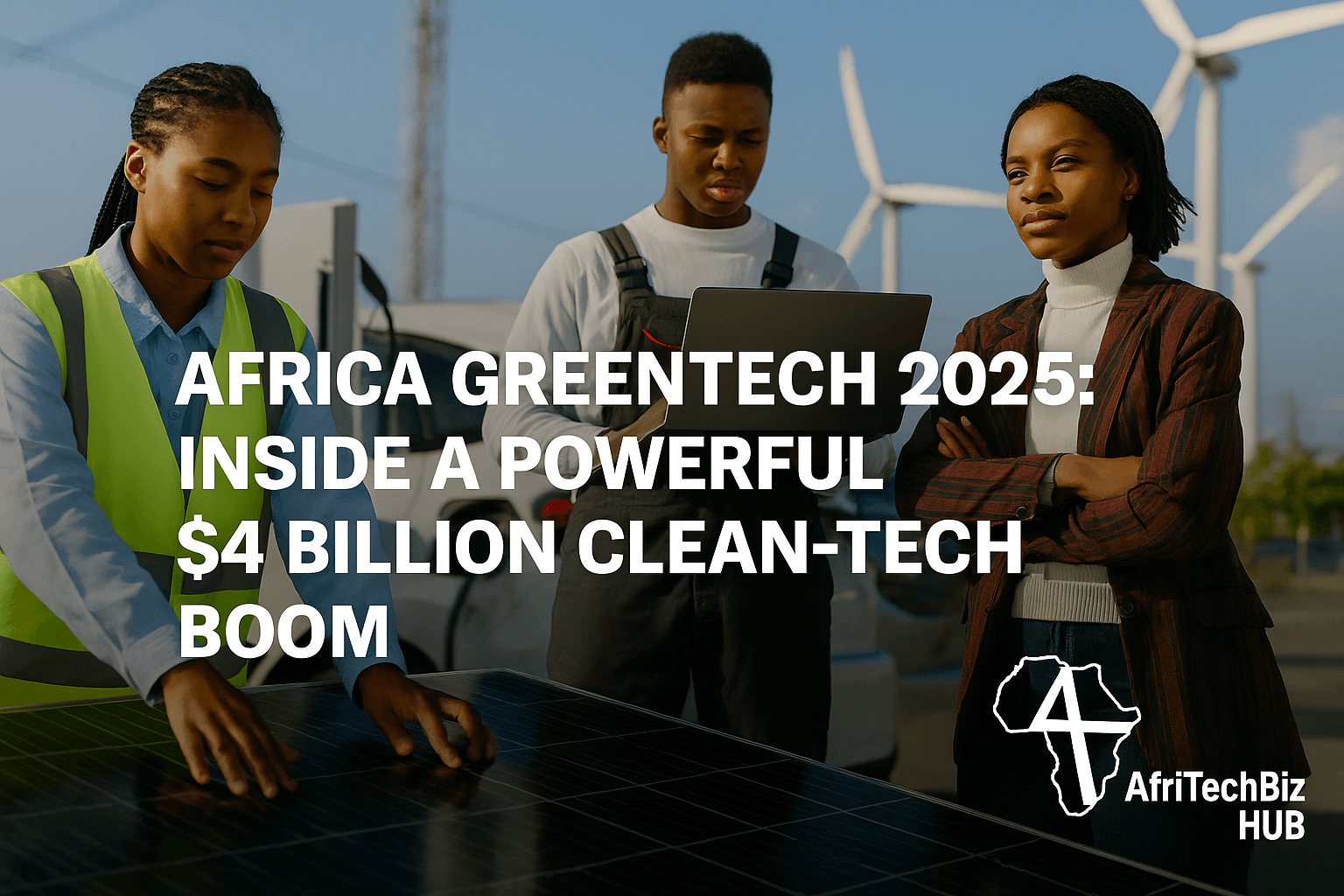
6 Powerful Trends Driving a Positive Shift in Africa Greentech 2025
Featured Summary:
- Africa is entering a decisive greentech shift, driven by solar adoption, e-mobility expansion, recycling innovation, and water-tech solutions, positioning the continent as a rising global force in clean technology.
- The continent’s green economy is currently valued in the single-digit billions, but investment needs are accelerating fast: the International Energy Agency (IEA) projects Africa will require US$190 billion in annual energy investment by 2026–2030, with two-thirds flowing into clean energy.
- Africa holds 60% of the world’s best solar resources, yet captures less than 3% of global clean-energy investment, a massive market gap now drawing global attention from investors, climate funds, and U.S.-based innovators.
- This article breaks down “Africa Greentech 2025”, the sectors driving the boom, why the shift matters globally, and where individuals, startups, and investors can unlock emerging opportunities across solar, e-mobility, recycling, water-tech, sustainable materials, and green infrastructure.
Africa Greentech 2025 is quickly becoming one of the biggest clean-energy shifts shaping global markets. With the IEA projecting over $190 billion in annual energy investment needs by 2030, Africa’s solar, e-mobility, and recycling sectors are accelerating fast. The insight: Africa is emerging as a major player in the world’s green-technology race.
For a deeper look into Africa’s fast-rising green revolution, continue with our full climate-tech analysis here.

Major Shift: Africa Greentech 2025 Is Accelerating a Clean-Tech Transformation Reshaping Global Markets
The Core Issue Explained
Africa Greentech 2025 is accelerating because the continent is shifting from energy scarcity to large-scale clean-tech innovation at a pace attracting global market attention.
Why This Shift Is Happening Now
Over the past three years, Africa’s clean-energy landscape has undergone a structural shift powered by off-grid solar adoption, e-mobility expansion, and fast-growing recycling systems. High fossil-fuel costs and grid instability have pushed consumers and businesses toward decentralized energy solutions built for resilience. Startups are creating technology tailored for African realities: affordable, durable, and scalable. What was once a regional adaptation is now a global clean-tech signal reshaping investment flows and climate strategies.
Discover how Africa’s wider tech leap is powering this greentech revolution—read our full Africa Tech Leap analysis next.
The Key Drivers Behind The Shift
- Severe grid pressure fueling off-grid adoption
- Surging e-mobility demand across major cities
- Circular-economy innovation converting waste into value
The Data Confirms The Acceleration
Africa holds 60% of the world’s highest-quality solar potential, yet receives under 3% of global clean-energy investment (UN ECA). The IEA estimates $190B per year is needed by 2030, with two-thirds directed to clean technologies.
Why This Shift Matters
Africa is becoming one of the world’s most important clean-tech frontiers, opening new opportunities for U.S. investors, climate-tech companies, EV manufacturers, and global sustainability partners. The continent’s acceleration is not peripheral; it is influencing future energy markets, supply chains, and climate-innovation pipelines that directly intersect with U.S. strategic interests.
Explore the breakthroughs driving Africa’s digital rise—continue with Africa Tech 2025: 4 Sectors Powering the Continent’s Digital Leap.

Continental Perspective: How Africa Greentech 2025 Is Taking Shape Across the Continent
Africa Greentech 2025 is not a single industry trend, it is a continent-wide transformation driven by diverse regional strengths across solar adoption, e-mobility, recycling, water-tech innovation, sustainable materials, and modern green infrastructure. Each sector is emerging from different clusters of African countries, creating a powerful, interconnected clean-tech map.
A. Solar Energy in Africa: Where Solar Growth Is Accelerating Fastest (Kenya, Nigeria, South Africa, Morocco)
- Kenya leads East Africa in off-grid and pay-as-you-go solar penetration, driven by companies like M-KOPA, Bboxx, Sun King, and d.light, supported by mobile-money integration enabling instant payments.
- Nigeria’s solar market is expanding rapidly due to diesel costs and chronic grid outages, creating one of Africa’s fastest-growing mini-grid markets with companies such as Husk Power Systems, Lumos Nigeria, and Engie Energy Access.
- South Africa maintains the continent’s largest utility-scale solar installations, supported by private-sector procurement models and major developers like Scatec, Red Rocket, and Sola Group.
- Morocco anchors North Africa with mega-projects like Noor Ouarzazate, one of the world’s largest solar complexes and a global model for concentrated solar power.
Regional dynamic:
- East Africa dominates decentralized solar.
- West Africa drives mini-grids and household solar.
- North Africa leads utility-scale solar.
- Southern Africa advances hybrid solar-industrial systems.
B. E-Mobility in Africa: The Fastest-Growing Electric Motorcycle and EV Markets (Kenya, Rwanda, Uganda, Nigeria)
- Kenya has emerged as Africa’s leading e-mobility hub, with companies like Roam (formerly Opibus), Ampersand, and Kiri EV scaling electric motorcycle fleets and charging infrastructure.
- Rwanda offers EV-friendly incentives and charging infrastructure backed by national policy, enabling players like Ampersand, Fika Mobility, and Safewheels to expand.
- Uganda is expanding battery-swapping networks through growing firms like Boda Electric Uganda and Ecoboda.
- Nigeria is becoming West Africa’s largest EV two-wheeler market, supported by its massive informal transport economy and led by Spiro, which secured US$100 million in new investment—one of Africa’s largest e-mobility funding rounds.
Regional dynamic:
- East Africa is Africa’s e-mobility innovation center.
- West Africa leads in market size potential due to population density and motorcycle-based transport.
C. Recycling & Circular Economy in Africa: Where Waste-to-Value Is Scaling (Ghana, Nigeria, South Africa, Egypt)
- Ghana is home to some of the continent’s strongest plastic recycling ecosystems, including Accra’s circular hubs and active players like Nelplast Ghana and Plastic Punch.
- Nigeria is scaling community-based recycling through companies like RecyclePoints, Wecyclers, and Kaltani, supplying recycled plastics for local and international manufacturing.
- South Africa has the continent’s most formalized recycling sector, with strong regulatory support and leading companies like PETCO, Mpact Recycling, and Astron Energy’s recycling partnerships.
- Egypt is expanding waste-to-energy programs backed by foreign partnerships and active companies like Green Tech Egypt and Empower.
Regional dynamic:
- West Africa drives community-led recycling models.
- Southern Africa leads formal recycling systems.
- North Africa scales industrial waste conversion and waste-to-energy.
Dive into how mobile money is powering Africa’s next billion-dollar transformation — read the full 2025 analysis here.
D. Water-from-Air & Water Tech Adoption in Africa (Ethiopia, Kenya, South Africa, Morocco)
- Ethiopia is deploying atmospheric water generation (AWG) systems to support rural communities through new pilot installations.
- Kenya hosts growing water-tech startups like Majik Water, leading solar-powered purification and atmospheric water solutions.
- South Africa is adopting AWG technology, driven by recurring drought cycles and supported by private vendors and municipal resilience programs.
- Morocco is piloting national-scale desalination and large-scale water innovation through public-private partnerships such as the Chtouka Desalination Plant.
Regional dynamic:
- East Africa leads small-scale community systems.
- North & Southern Africa deploy large-scale industrial and municipal solutions.
E. Sustainable Materials in Africa: Leading Markets for Eco-Building and Bio-Based Materials (Kenya, Rwanda, South Africa, Cameroon)
- Kenya is a pioneer in bamboo construction and eco-friendly material production, driven by companies like Bamboo Ecologic and GreenPot Enterprises.
- Rwanda is scaling sustainable housing developments using low-emission materials, supported by national green-building standards.
- South Africa has the continent’s largest manufacturing capacity for eco-construction materials, with growing firms in green cement, carbon-neutral bricks, and eco-panels.
- Cameroon is expanding bamboo cultivation for bio-materials, supporting both local construction and regional exports.
Regional dynamic:
- East Africa leads in bamboo and bio-material innovation.
- Southern Africa anchors industrial-scale production.
F. Green Infrastructure in Africa: Building Modern, Sustainable Urban Systems (South Africa, Kenya, Egypt, Morocco)
- South Africa leads with renewable-powered industrial districts, advanced green building codes, and solar-powered commercial sites.
- Kenya is building clean-tech industrial parks, green logistics hubs, and solar-powered tech campuses.
- Egypt is accelerating green infrastructure through mega-projects like the New Administrative Capital, which includes extensive renewable-energy integration.
- Morocco is investing in green mobility networks, renewable-energy corridors, and sustainable city projects linked to national climate goals.
Regional dynamic:
- Southern Africa focuses on industrial infrastructure.
- East Africa targets tech parks and logistics hubs.
- North Africa expands national-scale sustainable development.
Continental Frameworks Accelerating Greentech Adoption
Pan-African institutions are reinforcing this trend:
- AfCFTA enables cross-border clean-tech supply chains and regional manufacturing.
- PAPSS simplifies payments for distributed solar and cross-border tech services.
- Smart Africa Alliance drives harmonized digital and energy standards.
- ECOWAS, EAC, and SADC create shared energy policies, mobility regulations, and sustainability frameworks.
Momentum Indicators
- Africa needs $190 billion per year in energy investment by 2030, with two-thirds for clean energy (IEA).
- E-mobility demand in Africa’s motorcycle market could reach 5 million electric units by 2030.
- Africa has 60% of the world’s best solar potential, yet receives less than 3% of global clean-energy investment (UN ECA).
Unlock the full story behind Africa’s digital economy surge — read the 2025 deep-dive now.

Opportunities: Where Individuals, Businesses, and Investors Can Win in Africa Greentech 2025
Africa Greentech 2025 is unlocking a powerful wave of new opportunities across solar, e-mobility, circular economy, water-tech, sustainable materials, and green infrastructure. As demand for clean energy, mobility, and climate-resilient systems grows, Africa is creating one of the world’s highest-potential markets for skills, entrepreneurship, and long-term investment, reshaping livelihoods, powering new industries, and redefining the continent’s economic future.
Opportunities for Individuals: What Green Careers Are Growing Fast in Africa 2025?
- Solar installation & maintenance careers — Kenya, Nigeria, Ghana, and South Africa are experiencing strong demand for PAYGo solar technicians as household and mini-grid solar expands.
- EV & battery-swapping technicians — Rwanda, Kenya, and Nigeria need skilled technicians to support rapid e-motorcycle adoption and Spiro’s expansion.
- Recycling & circular-economy operators — Ghana, Nigeria, and South Africa are scaling plastic recycling hubs that require sorting, processing, and material recovery talent.
- Water-tech field operators — Kenya, Ethiopia, and South Africa are hiring for AWG deployments, purification systems, and community water-service models.
- Eco-construction support roles — Rwanda, Kenya, and Cameroon need builders familiar with bamboo, bio-materials, low-carbon bricks, and eco-panels.
Data point:
Africa’s green economy could create 2 million+ new climate-tech jobs by 2030, driven by solar, mobility, and recycling demand.
Opportunities for Businesses: What Greentech Startups & SMEs Can Build in Africa Right Now?
- Solar distribution & financing models — High growth across Nigeria, Kenya, and Tanzania for PAYGo solar, mini-grid development, and SME solar leasing.
- Battery-swapping & EV fleet services — Kenya, Rwanda, Uganda, and Nigeria need scalable stations and fleet-management startups to support e-motorcycle adoption.
- Waste-to-value manufacturing — Ghana, Nigeria, and South Africa present markets for plastic recycling, recycled pellets, composting, and upcycled materials.
- Water-tech solutions & solar-powered purification — Kenya, Ethiopia, and Morocco offer opportunities in AWGs, smart irrigation tech, and rural clean-water systems.
- Eco-material production — East Africa and Southern Africa are creating new markets for bamboo boards, bio-packaging, green cement, and eco-bricks for construction.
Data point:
Africa’s climate-tech startup ecosystem attracted over $400 million in venture funding in 2023–2024, with solar and mobility leading the deals.
Opportunities for Investors: Where Are the High-Growth Greentech Investment Windows in Africa?
- Utility-scale and distributed solar projects — Morocco, South Africa, Kenya, and Nigeria offer strong returns through PPAs, mini-grids, and hybrid solar systems.
- E-mobility expansion — Backing companies like Roam, Ampersand, and Spiro (which secured $100M) as demand for electric two-wheelers accelerates.
- Recycling infrastructure & green manufacturing — High ROI across Nigeria, Ghana, and South Africa as governments push for local material recovery.
- Water-tech and climate-resilience infrastructure — Morocco, South Africa, and Kenya are scaling desalination, AWG networks, and water-efficiency technologies.
- Green industrial zones & sustainable real estate — Egypt, Kenya, and South Africa offer long-term opportunities in renewable-powered logistics hubs and eco-industrial districts.
Data point:
Africa requires $190B per year in energy investment by 2030, two-thirds of which is tied to clean energy, signaling massive investment headroom.
Across individuals, entrepreneurs, and global investors, Africa Greentech 2025 represents a rare convergence of rising demand, youthful innovation, and transformative market potential, setting the foundation for the continent’s next decade of economic and climate resilience.
Analyze the breakthrough business opportunities emerging through AfCFTA — read the full 2025 breakdown now.

Africa’s Green Tech Growth: Latest Data, Emerging Trends, and 2025–2028 Outlook
What the Latest Data Reveals About Africa Greentech 2025
Recent data show Africa’s green-tech sector is entering a rapid scaling phase, with clean-energy investment needs more than doubling by 2030 and green-job forecasts reaching millions. According to the International Energy Agency (IEA), Africa will need to more than double total energy investment by 2030, with over two-thirds directed to clean technologies.
The evidence: while still under-capitalized compared to global norms, the investment gap is creating a massive growth opportunity in Africa Greentech 2025.
Key Trends Shaping Africa’s Green Tech Momentum
- Rapid climate-adaptation technologies: Extreme weather and grid instability are forcing adoption of off-grid solar, micro-grids, atmospheric water generation (AWG) and smart irrigation, behaviour shifts toward resilience and decentralisation.
- Renewable energy infrastructure expansion: The driver is falling technology costs and improved financing; the shift is measurable—Africa’s clean-energy investment must rise at ~7 % CAGR from 2025 to 2050 (per OECD).
- Electric mobility acceleration: Rising urbanisation and mobile-first transport economies are driving e-motorcycles, battery-swap networks and EV fleets, opening measurable growth in units and infrastructure.
- AI-driven sustainability tools & digital integration: Smart-monitoring, blockchain for carbon credits, predictive maintenance for mini-grids are being adopted, enabling measurable cost reductions and project scalability.
- Carbon markets & environmental finance emergence: Africa’s participation in carbon-credit schemes, green bonds and ESG capital flows is rising, shifting investor behaviour and measurable finance inflows.
How Africa’s Growth Compares to Asia and Latin America
Africa’s green-tech adoption is gaining traction globally, but its context and scale differ significantly from Asia and Latin America.
- Africa vs Asia: Asia has more mature infrastructure, larger manufacturing base and earlier policy frameworks; Africa’s speed of leap-frogging (off-grid solar, e-mobility) is higher in some niches, though total investment remains far smaller.
- Africa vs Latin America: Latin America leads in utility-scale renewables and carbon-markets infrastructure; Africa is behind in investment-flow and infrastructure scale today but has stronger growth potential given younger population and abundant renewable resources.
- Investment flow & infrastructure growth: While Asia attracts the bulk of clean-energy investment, Africa still receives ~ 2-3 % of global clean-energy financing despite its resource endowment.
- Population-driven demand: Africa’s rapidly growing urban population and informal transport sectors create unique opportunity vectors (e-mobility, mini-grids) that differ from Asia and Latin America.
Predictions for 2025, 2026, and 2027
Based on current momentum, policy shifts and investment needs, the next three years will deliver defined milestones for Africa Greentech 2025.
- 2025 Prediction:
Solar and mini-grid deployment across East and West Africa will cross a threshold of 10 GW total installed clean-capacity, driven by off-grid solutions and corporate PPAs, signalling transition from pilot to scale. - 2026 Prediction:
Electric-mobility ecosystems (e-motorcycles, battery-swap networks) will expand significantly in Kenya, Nigeria and Rwanda, with at least one major continent-wide vehicle-fleet deal announced; regulatory frameworks across EAC and ECOWAS will mature. - 2027 Prediction:
A regional manufacturing cluster for sustainable materials (bamboo, bio-plastics, eco-bricks) will emerge in East and Southern Africa, linked into green-infrastructure corridors under AfCFTA trade rules, integrating Africa into global supply chains.
The Data That Verifies These Trends
- According to the IEA’s Clean Energy Investment for Development in Africa report, Africa will need US $600 billion by 2030 in clean-energy investment to meet universal access and climate goals.
- A report by FSD Africa forecasts up to 3.3 million new green-jobs across the continent by 2030, primarily in solar energy and related sectors.
- Clean-energy investment growth in Sub-Saharan Africa must average 7.3 % annually from 2025 to 2050 to align with transition scenarios.
What This Outlook Means for Africa’s Development
Africa’s green-tech trajectory is not just about renewable energy, it is about economic transformation, industrial growth, and global competitiveness. As the continent builds infrastructure, businesses, and human capital around solar, mobility, waste-to-value and water-resilience systems, new market opportunities emerge for entrepreneurs, technology firms and global investors. The next wave of growth will embed Africa deeper into global supply chains, climate-financing networks and digital infrastructure, making Africa a key player in the global greentech ecosystem.
Advance to the Top 10 Business Opportunities shaping Africa’s 2025 market landscape — read the full breakdown next.

Connecting the Dots: How Africa Greentech 2025 Links to the Continent’s Larger Transformation
Africa Greentech 2025 is not moving in isolation, it is rising alongside Africa’s tech leap, fintech revolution, digital economy expansion, and cross-border integration. Together, these forces are shaping one of the most important structural transformations of the decade.
How Africa’s Tech Leap Fuels the Green Tech Acceleration
Africa’s rapid tech leap — driven by mobile-first adoption, cloud infrastructure, and digital ID systems — is enabling greentech to scale faster than any previous industrial wave. Digital platforms make it possible to monitor energy usage, automate payments, and integrate climate technologies into everyday life.
With over 570 million mobile-money users (GSMA), Africa has the digital rails to support mass adoption of solar, e-mobility, and water-tech systems.
How the Digital Economy Boom Supports Green Tech Expansion
Africa’s digital economy — projected to surpass $180 billion by 2025 (Google & IFC) — provides the digital backbone for renewable energy, EV deployment, climate mapping, and recycling platforms. Countries like Kenya, Nigeria, South Africa, Rwanda, and Egypt are leading both digital and green innovation, creating integrated markets where energy, mobility, and data ecosystems reinforce one another.
This acceleration allows greentech companies to scale with lower friction and faster consumer adoption.
How Mobile Money Is Powering Green Tech Adoption
Mobile money is the financial engine behind Africa’s solar and e-mobility revolution. Pay-as-you-go (PAYG) solar financing, EV rentals, and micro-installation loans depend on instant mobile transactions. Platforms like M-KOPA, Sun King, Spiro, and Bboxx use mobile money to deliver renewable energy and EVs to millions.
PAYG financing has already enabled over 10 million solar home system installations across Africa (GOGLA).
How Africa’s Fintech Revolution Is Driving Climate Innovation
Fintech platforms are unlocking new financial models for solar adoption, EV fleet financing, micro-carbon credits, and climate-risk insurance. Countries such as Ghana, Kenya, and Nigeria are becoming hubs where fintech meets climate innovation.
Key linkages include:
- Digitized carbon market wallets and micro-credits
- Embedded climate financing in payment apps
These tools allow greentech solutions to reach lower-income and underserved markets at unprecedented scale.
How AfCFTA and Cross-Border Systems Strengthen Green Tech Growth
AfCFTA is creating the single-largest continental market for renewable energy, EV manufacturing, and climate-tech distribution. PAPSS reduces cross-border payment delays, Smart Africa harmonizes digital standards, and regional blocs shape mobility and energy regulations.
Regional advantages:
- West Africa: fintech-driven e-mobility growth
- East Africa: digital ID + high solar adoption
- North Africa: manufacturing + utility-scale renewables
- Southern Africa: energy markets + EV component industries
This integration lowers costs, expands market size, and accelerates greentech commercialization.
How AI, Data, and Emerging Tech Elevate Africa’s Climate Solutions
AI, IoT sensors, drones, and satellite systems are strengthening Africa’s climate resilience, from smart irrigation to predictive grid management. Rwanda, Kenya, South Africa, and Egypt lead in AI research clusters, climate-data platforms, and digital agriculture systems.
Compared to Latin America, Africa is advancing faster in AI-enabled mobile solutions, while Asia still leads in hardware-scale manufacturing.
The Continental Momentum: What This Convergence Means for Africa’s Future
Africa’s greentech rise is merging with digital innovation, fintech expansion, mobility systems, and cross-border integration, creating a unified engine for long-term competitiveness. This convergence will shape new industrial sectors, attract global manufacturing, reduce energy deficits, and position Africa as a major contributor to global sustainability solutions.
The coming decade belongs to nations that can integrate energy, technology, finance, and data, and Africa is building that future now.
Navigate the trends steering Africa’s fintech rise — see the full strategic overview.
What This Means for Africa’s Future in Africa Greentech 2025
The Opportunities Ahead for Africa’s Next Chapter
Africa Greentech 2025 is unlocking a new era of opportunity where technology, climate resilience, digital finance, and mobility are converging to reshape economic potential. The continent is entering a phase where green innovation will drive millions of jobs, new industries, and large-scale investments across energy, mobility, and sustainable infrastructure. This transformation positions Africa as one of the most important emerging markets in the global shift toward clean and digital economies.
Why This Moment Matters for Individuals, Businesses, and Investors
Africa’s greentech acceleration is a defining moment because it creates unprecedented pathways for participation across every economic layer.
- Individuals gain access to new careers in solar installations, EV maintenance, water-tech operations, and digital climate services.
- Businesses can scale cross-border through AfCFTA, leveraging digital payments, energy-tech tools, and mobility platforms to grow faster than ever.
- Investors now have access to fast-growing markets in renewables, e-mobility, sustainable materials, carbon finance, and climate-smart logistics, sectors with strong long-term returns due to rising demand and structural need.
This collective evolution marks one of the most inclusive growth windows Africa has experienced in decades.
The Road Ahead: Africa’s Trajectory Over the Next 3 Years
Over the next three years, Africa will deepen its technological maturity through stronger digital rails, AI-driven climate solutions, and mobile-first financial systems that support mass adoption of green products. Emerging technologies will accelerate EV growth, renewable energy penetration, circular-economy models, and data-driven climate resilience across both cities and rural communities.
By 2026, AfCFTA’s trade harmonization, PAPSS payment expansion, and regional energy policies will give greentech companies continental-scale access, reducing friction and improving affordability. By 2027, Africa Greentech 2025 will evolve into a unified ecosystem powered by interoperable fintech systems, cross-border EV markets, distributed solar networks, and smart infrastructure built on cloud, IoT, and AI systems.
Africa’s trajectory is clear: the continent is becoming a central player in the global clean-energy transition, digital innovation marketplace, and climate-resilient development model shaping the next decade.
Africa is stepping into a new era of transformational leadership — and Afritech Biz Hub will continue to illuminate the opportunities shaping the continent’s rise.
Examine how fast cross-border payments are redefining Africa’s financial landscape — access the full insight next.


Recent Comments