

Last updated: December 12, 2025
How Cross-Border Payments in Africa 2025 Are Creating a Powerful Breakthrough That Reduces Costly Trade Barriers
Featured Summary:
- Cross-border payments in Africa 2025 are becoming faster and cheaper as new systems like PAPSS and regional currency-settlement frameworks remove costly trade barriers.
- Local currency settlement now enables businesses in different African regions to trade directly without relying on the US dollar, making cross-border trade more accessible for SMEs.
- Regional blocs such as COMESA, ECOWAS, and the AfCFTA are integrating digital payment rails that allow countries to trade with one another more easily, securely, and in real time.
- Global readers should know that Africa’s new payment infrastructure finally allows merchants, exporters, and SMEs to send and receive money across borders with lower fees, fewer delays, and greater transparency.
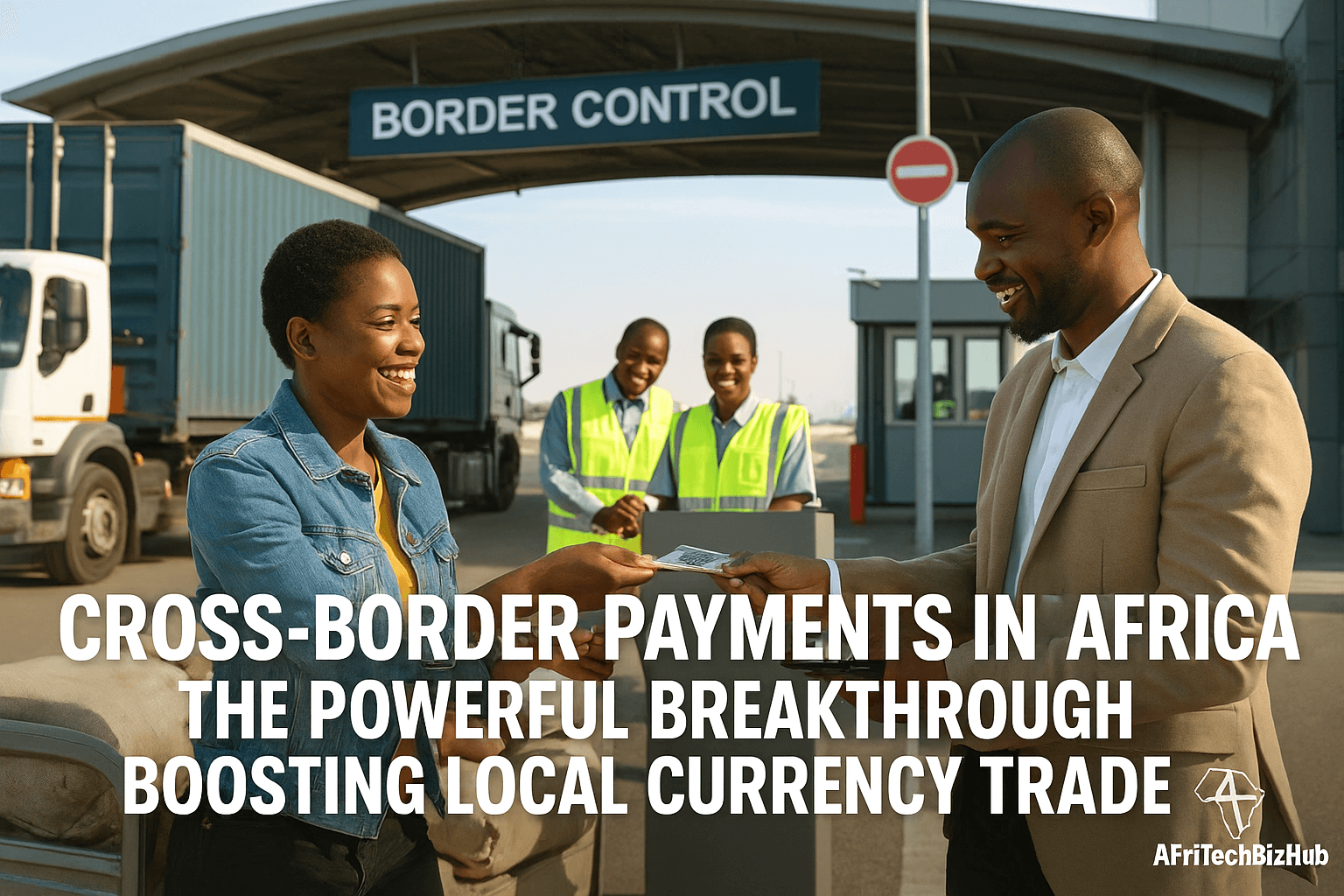
Cross-border payments in Africa 2025 are being rewired by new regional systems that cut costs, delays, and dependence on the US dollar. From PAPSS to AfCFTA-led local currency settlement, African banks and fintechs now enable faster, cheaper trade flows for SMEs and exporters. This shift is redefining digital payments and intra-African trade.

See how local-currency payments are reshaping regional trade dynamics and creating new opportunities across Africa in 2025.
The Core Issue: High Costs, Border Friction, and Fragmented Payment Systems
For years, cross-border payments in Africa were slow, expensive, and dependent on the US dollar, even when two neighbouring countries shared a land border. A World Bank assessment shows that Africa has some of the highest intra-regional transaction costs in the world, driven by currency conversions, bank delays, and manual border processes. This made it harder for SMEs to move goods across short distances like Nigeria–Ghana, despite being major trade partners.
A major part of the problem was Africa’s fragmented payment rails, each country had its own banking rules, settlement timelines, and currency requirements. This forced merchants to route payments through overseas correspondent banks, adding extra fees, compliance hurdles, and multi-day delays. These inefficiencies shaped public frustration at border posts and customs points where traders often paid far more than the value of the goods they carried.

Read how Africa’s resource shift is reshaping global trade flows in our latest analysis on From Oil to Opportunity.
The Major Shift: PAPSS and AfCFTA Are Reducing Payment Friction
The launch of the Pan-African Payment and Settlement System (PAPSS) and the African Continental Free Trade Area (AfCFTA) has started reducing these long-standing barriers. PAPSS now allows approved banks and fintechs to settle cross-border transactions instantly in local currencies, removing the need for USD routing. According to Afreximbank, PAPSS can cut transaction costs by up to 50% for merchants trading across African borders.
Under AfCFTA, participating nations are aligning customs procedures and digitising trade documentation to reduce road checkpoint delays that previously discouraged cross-border commerce. Countries such as Ghana, Nigeria, Kenya, Rwanda, Egypt, and South Africa are part of the early networks using interoperable systems that support faster verification, fewer FX charges, and reduced customs friction. This shift means goods moving from West Africa to East Africa can now follow clearer rules and more predictable payment processes.
Real Change: Regional Trade Is Becoming Cheaper and More Efficient
One of the clearest signs of progress is COMESA’s recent launch of a local currency settlement program, which allows member states to trade without depending on the dollar. This directly supports border regions like Kenya–Uganda, Zambia–DRC, and Egypt–Sudan, where traders historically struggled with double currency conversions and cash-based settlements.
This reform matters for everyday Africans. A trader sending goods from Nigeria to Ghana or a logistics company delivering packages across East African borders now faces fewer unpredictable charges. Digitised settlement systems reduce the informal payments that drained SMEs, while harmonised customs processes cut down the long border waits that previously made regional trade feel impossible.
Discover practical, proven ways African SMEs can trade across borders in 2025 with our in-depth AfCFTA business opportunities guide.
How Cross-Border Payments in Africa 2025 Works: The New System Behind Faster Cross-Border Payments
- PAPSS acts as a central switch that connects African banks, payment providers, and central banks on one network. When a buyer in Nigeria pays a seller in Ghana, PAPSS instantly verifies the transaction, clears it, and settles it using each country’s central bank, no USD routing and no correspondent banks. This cuts settlement time from 2–5 days to seconds, and removes double currency conversion fees.
- The system works through three steps: instant validation, centralized clearing, and local-currency settlement. PAPSS first confirms that the sender has funds, then routes the payment directly to the recipient’s bank, and finally settles it in both countries’ local currencies. Banks no longer need to hold US dollars for regional trade, a major shift from the old model.
- AfCFTA strengthens this system by harmonizing customs rules, trade documents, and border procedures across member countries. Under the Guided Trade Initiative, AfCFTA-enabled countries now use aligned digital forms, shared standards, and simplified checks to reduce road delays and unofficial charges. This creates a clearer pathway for goods to move while the money moves instantly through PAPSS.
- Together, PAPSS and AfCFTA allow traders to send money and move goods with far fewer barriers. A merchant can sell goods from Kenya to Rwanda, receive payment in Kenyan shillings, while the buyer pays in Rwandan francs, each staying within their own currency. Border officials process goods faster because AfCFTA’s documentation is recognized across participating states.
- This is the first time Africa has a coordinated financial and trade infrastructure built for intra-African commerce. West Africa, East Africa, Central Africa, and parts of North and Southern Africa are now linked through interoperable payment rails, supported by Afreximbank, the African Union, and national central banks. The result is a system that makes African trade more predictable, less costly, and more accessible for SMEs.

Cross-Border Payments vs. Local Currency Settlement: What’s the Real Difference?
- Cross-border payments in Africa refer to the movement of funds between countries, such as a merchant in Nigeria paying a supplier in South Africa. This process has traditionally required USD routing, correspondent banks, and multiple FX conversions, which made intra-African trade unnecessarily expensive and slow. PAPSS and AfCFTA directly address this challenge by providing continental infrastructure that enables direct, instant, and multi-country payment flows across West, East, Central, Southern, and North Africa.
- PAPSS handles the core financial layer of cross-border settlement. It connects central banks, commercial banks, and payment providers across the continent, allowing transactions to be validated, cleared, and settled within seconds. AfCFTA reinforces this by harmonizing customs, documentation, and trade rules, ensuring that goods can move across African borders with fewer delays. Together, PAPSS and AfCFTA create a unified environment where cross-border payments no longer depend on offshore settlement or volatile FX exposure.
- Local currency settlement, however, is a different mechanism, and this is where COMESA’s recent launch becomes essential. Unlike PAPSS and AfCFTA, which operate at the continental level, COMESA provides a regional local currency settlement framework focused specifically on Eastern and parts of Southern Africa. Under this new system, countries such as Kenya, Uganda, Zambia, Rwanda, and Egypt can settle regional trade transactions directly in their own currencies, without converting to the dollar or passing through external banks.
- This is a structural reform because local currency settlement solves a problem cross-border payment systems alone cannot fix: the cost and volatility tied to USD liquidity. COMESA’s mechanism enables each central bank within the bloc to settle obligations in real time, allowing importers and exporters to price goods more competitively, reduce FX risk, and trade with greater predictability. It complements, rather than replaces, continental systems by strengthening the short-to-medium distance trade corridors within East and Southern Africa.
- In practical terms, PAPSS and AfCFTA make it easier for goods and payments to move across the entire continent, while COMESA ensures that regional trade among neighbouring countries happens with far lower currency friction. The distinction matters. Cross-border payment rails link Africa as a whole; local currency settlement stabilizes the costs within regional blocs. Together, they form the backbone of Africa’s new payment revolution.
Learn how Africa’s fast-rising digital banks are driving a new cashless era and opening fresh opportunities across the continent in 2025.

Opportunities Emerging From Cross-Border Payments in Africa’s New Trade System
Opportunities for Individuals
- PAPSS now enables people across Africa to send and receive money across borders in seconds, using their local currencies without depending on USD liquidity or correspondent banks. A Nigerian sending funds to Ghana or a Kenyan sending money to Uganda experiences lower transfer fees and faster confirmation because settlement occurs directly through central banks. Individuals benefit from predictable costs, reduced delays, and simpler access to regional markets.
- In the COMESA region, the newly launched local-currency settlement system allows individuals—including micro-traders and transport operators—to receive payments directly in their home currencies. This eliminates the double-conversion losses that once discouraged informal cross-border commerce. For many small traders in Zambia, Malawi, and Kenya, this system reduces cash-handling risk and supports more transparent pricing along regional corridors.
Opportunities for Businesses (SMEs & Corporates)
- SMEs benefit directly from PAPSS because continental payment delays—previously ranging from 2 to 5 days—are now shortened to real-time settlement. This speeds up working-capital rotation, strengthens cash-flow planning, and removes the FX shocks that once made regional transactions unpredictable. Companies trading between West, East, and Southern Africa gain access to a more unified customer base because settlement does not require dollar liquidity.
- Businesses within the COMESA bloc enjoy an even more targeted advantage: local-currency pricing. A Zambian agribusiness can invoice a Rwandan buyer in kwacha, while the buyer pays in francs, each relying on their local currency. This reduces FX exposure, lowers operational costs, and allows SMEs to build wider distribution networks without facing the exchange-rate swings that used to erode profit margins.
Opportunities for Africa
- Africa now has an emerging continental payments backbone through PAPSS and AfCFTA, helping reduce the billions lost annually to currency conversion, offshore settlement, and fragmented financial systems. With 150+ participating financial institutions and expanding multi-regional adoption, Africa’s payment infrastructure is shifting away from USD dependency, a key step toward trade competitiveness and stronger monetary sovereignty.
- COMESA’s local-currency mechanism strengthens this continental movement by reducing regional reliance on external settlement systems. As countries within Eastern and Southern Africa trade more in their own currencies, they improve balance-of-payments stability and enhance their resilience to global FX volatility. Together, PAPSS, AfCFTA, and COMESA form a multi-layered payment ecosystem that supports Africa’s ambition for deeper regional value chains and a more integrated continental market.
Opportunities for Investors
- Africa’s shift to real-time cross-border payments creates new investment openings in fintech infrastructure, API gateways, compliance automation, merchant platforms, and digital banking rails. Investors can participate in the build-out of payment connectors, settlement engines, and regional liquidity solutions powering intra-African trade growth. The demand for payment technologies that integrate with PAPSS and regional central banks is rising rapidly.
- Local-currency settlement platforms, particularly within COMESA, open further opportunities in FX-risk management tools, regional clearing systems, and trade-finance services tailored to SMEs. As more businesses reduce reliance on USD-denominated settlement, investors positioned in digital FX platforms, SME lending, logistics-fintech hybrids, and multi-currency wallets stand to benefit from Africa’s expanding, friction-reduced trade corridors.
Understand how Africa’s digital economy is already reshaping growth, innovation, and opportunity across the continent in our latest analysis for 2025.

Data, Trends, and Future Outlook for Cross-Border Payments in Africa 2025
Africa’s cross-border payments systems are at a turning point as new infrastructures like Pan‑African Payment and Settlement System (PAPSS) and African Continental Free Trade Area (AfCFTA) move from pilot to scale-up. These systems are reducing costs, shortening settlement times, and enabling local-currency settlement across borders, which signals a faster shift in intra-African trade dynamics than many past integrations.
Predictions:
- 2025: PAPSS expands to 20+ countries and integrations reduce cross-border payment costs by up to 50%.
- 2027: Local-currency settlement corridors under regional blocs such as Common Market for Eastern and Southern Africa (COMESA) and AfCFTA become widely adopted, enabling SMEs to invoice in their home currencies and trade across East/West/Southern Africa.
- 2030: Africa approaches intra-regional trade volumes comparable to Asia’s early integration phase, supported by integrated payments and customs systems, lifting trade efficiency and reducing USD-dependence.
See how Africa’s banking revolution is reshaping wealth creation, financial access, and investment opportunities across the continent in 2025.

Connecting the Dots: How PAPSS, AfCFTA, and COMESA Are Reshaping Cross-Border Payments in Africa
Africa’s payment transformation is happening through three coordinated layers: PAPSS at the continental level, AfCFTA at the trade-policy and customs level, and COMESA at the regional local-currency settlement level. Together, they form a unified system that reduces delays, removes USD dependency, and strengthens the reliability of cross-border payments in Africa.
PAPSS provides the real-time financial infrastructure that allows banks and payment providers across West, East, Central, and Southern Africa to validate and settle transactions instantly. AfCFTA complements this by harmonizing customs procedures, digital documentation, and trade rules so that goods move across borders with fewer checkpoints and lower compliance friction. The combination of real-time settlement and streamlined border processes enables SMEs to trade continent-wide with more predictable costs.
COMESA’s local-currency payment platform fills a critical gap by stabilizing regional trade within Eastern and Southern Africa. It allows member states such as Kenya, Uganda, Zambia, Rwanda, and Egypt to settle imports and exports directly in their own currencies, eliminating FX volatility and strengthening regional liquidity. This creates short-distance trade corridors where local-currency settlement supports traders while PAPSS and AfCFTA enable continental-scale transactions.
When these three systems interact, Africa achieves something it has never had before, a multi-layered, interoperable payment and trade ecosystem. Cross-border payments become faster and cheaper through PAPSS, goods face fewer border delays under AfCFTA, and currency risk reduces across COMESA corridors. This alignment is what finally positions Africa to grow intra-continental trade beyond its historical 15% share, strengthen regional value chains, and compete with the integration levels seen in Asia and Latin America.
See how the U.S.–Africa trade boom is unlocking billions in new investment and reshaping opportunity across the continent right now.
Opportunities Ahead: Cross-Border Payments in Africa and the New Trade Era Taking Shape
Africa’s new payment architecture—powered by PAPSS, AfCFTA, and COMESA’s local-currency settlement—signals the beginning of a more competitive, integrated continental economy. As real-time settlements replace slow, dollar-dependent systems, SMEs, exporters, and regional value chains gain predictable costs and wider market access. The shift already underway positions Africa to compete with emerging economic blocs and unlock the next decade of intra-African growth.
Africa is entering a phase where payments move instantly, borders process goods more efficiently, and regional currencies support sustainable trade corridors. The systems being built today are laying the foundation for a continent where African businesses can scale across borders with the same ease seen in Asia and Latin America. The opportunity ahead is clear: Africa’s next economic leap will be powered by seamless cross-border payments and a fully connected continental market.
Discover how Africa’s breakthrough innovations over the past three years are setting the pace for the continent’s next generation of tech leadership.


Recent Comments