

Last updated: December 12, 2025
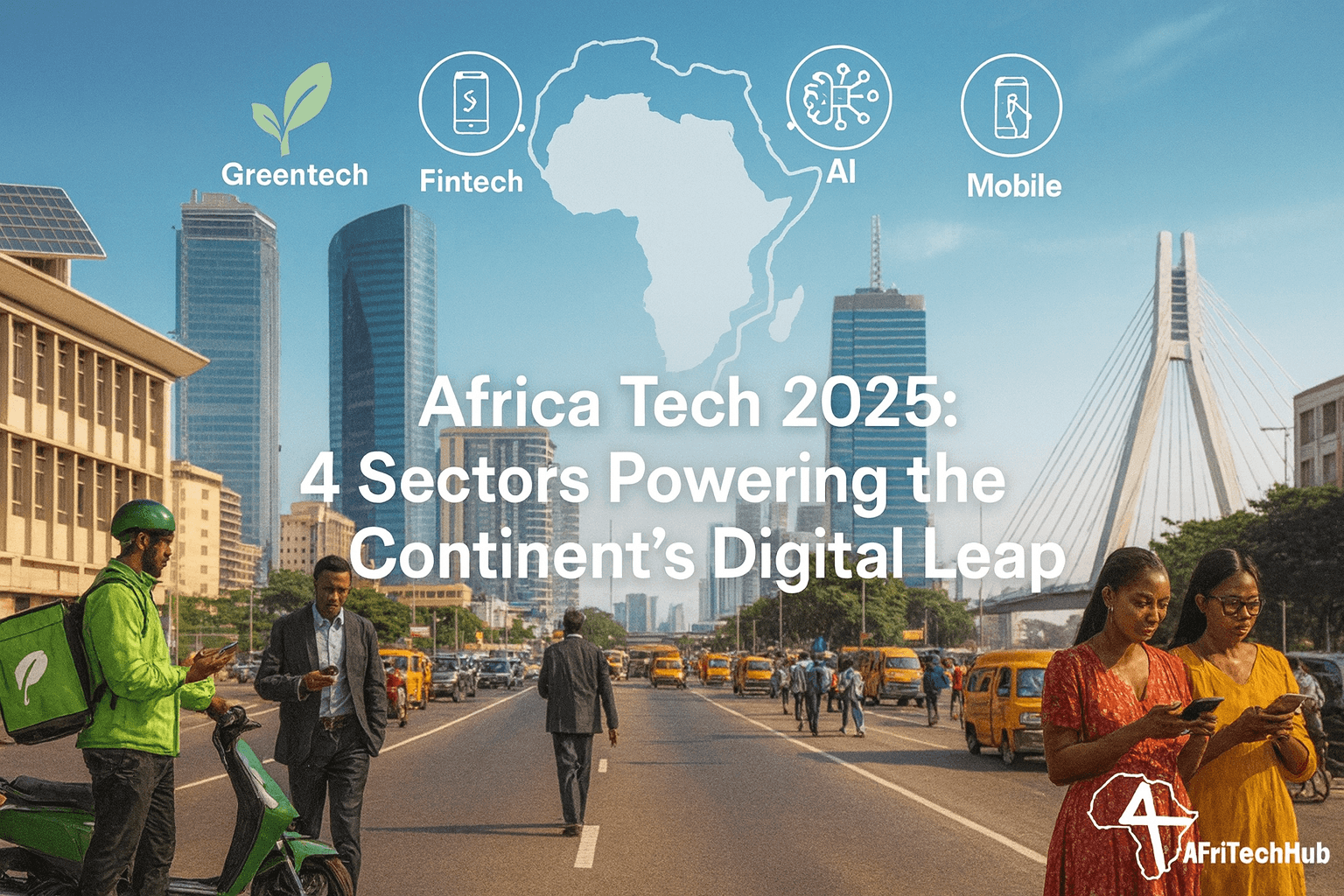
Africa Tech 2025 signals a defining moment for the continent. Fintech, greentech, AI, and mobile-first platforms are reshaping how people pay, work, learn, move, and trade—creating unprecedented opportunities in every major market.
Africa has entered a period of accelerated digital transformation. For years, progress moved unevenly, but the momentum behind payments, energy, mobility, artificial intelligence, and mobile platforms now reflects a deeper structural shift. What Africa Tech 2025 represents is not hype, it is the most coordinated technology leap the continent has seen in decades.
Featured Summary:
For a long time, Africa’s progress was slowed by fragmented infrastructure, limited access to capital, and regulatory uncertainty. Innovation hubs existed, but their impact rarely extended across borders.
In recent years, however, the rise of mobile connectivity, digital payments, clean energy solutions, AI adoption, and modern startup ecosystems has unlocked a new foundation for growth. Africa Tech 2025 captures this convergence.
Fintech — The Rails Driving Africa Tech 2025
Fintech remains the engine behind Africa’s digital economy. Mobile payments, real-time banking, cross-border platforms, and embedded finance are transforming how individuals and businesses transact. Africa now hosts the world’s largest mobile money ecosystem, with mobile transactions surpassing $1.3 trillion annually
The acceleration of real-time payments is redefining financial services. Nigeria, Kenya, Ghana, Egypt, and South Africa have expanded instant payment frameworks, allowing businesses to operate faster than ever.
Africa’s fintech story is also one of scale. From Flutterwave to Chipper Cash, M-Pesa, OPay, Nala, Paga, Moniepoint, and PalmPay, fintech platforms are becoming digital infrastructure, not just apps.
Afritech Biz Hub previously analyzed this shift in: Nigeria’s Real-Time Banking Leap Is Reshaping Africa’s Fintech in 2025
Greentech — The Infrastructure Behind the Continent’s Next Leap
Greentech is now a central pillar of Africa Tech 2025. Solar energy, EV mobility, mini-grids, climate-tech, and clean transport are emerging as the systems enabling digital transformation. As Africa’s population grows, demand for affordable and sustainable energy continues to rise.
Africa’s clean-energy sector is projected to exceed $120 billion by 2030. Solar home systems, pay-as-you-go financing, and renewable mini-grids are expanding energy access in remote communities and powering MSMEs.
Electric Mobility — Spiro & Alpha Emobility Lead the Shift
Spiro is building one of Africa’s fastest-growing electric motorcycle networks, dramatically reducing fuel dependency across West and East Africa. Afritech Biz Hub covered this in-depth: Africa’s Electric Vehicles in 2025: The Real Story Behind the $100M Mobility Shift
On November 14, Alpha Emobility unveiled its new electric tricycle in Abuja, marking a major step for clean transportation and commercial logistics. Their approach targets low-cost, high-demand mobility for Nigeria’s urban and peri-urban users.
Greentech Startups Shaping Africa Tech 2025
- BasiGo – electric buses in Kenya & Rwanda
- M-KOPA – solar + device financing for millions of homes
- Sun King – large-scale solar distribution
- d.light – affordable solar systems across 20+ countries
- Husk Power – mini-grids powering rural communities
- SolarTaxi Ghana – EV leasing and logistics
- Zembo Uganda – electric motorcycles
- Mobility for Africa – solar tricycles for women and farmers
- Rubicon SA – industrial solar and EV charging
- Alpha Emobility – EV tricycles and charging innovation
- Spiro – electric motorcycle ecosystem
Greentech is no longer a niche, it’s a foundational infrastructure layer enabling mobility, commerce, agriculture, and small businesses.
Artificial Intelligence — Africa’s Strategic Entry Into the Global AI Race
AI is becoming one of the strongest pillars of Africa Tech 2025. Governments and private institutions are building AI policies, data infrastructures, talent pipelines, and localized language models that reflect Africa’s cultural and linguistic context.
The African AI market is expected to reach $17 billion by 2030. This growth is driven by AI adoption in agriculture, healthcare, logistics, education, and enterprise automation.
Afritech Biz Hub’s earlier breakdown of Africa’s emerging AI momentum: Africa’s AI Gold Rush: How Artificial Intelligence Is Powering a New Era of Innovation, Investment, and Inclusive Growth
AI Startups Defining the Space
- Lelapa AI – building large-language models for African languages
- Masakhane – open-source NLP research collective
- InstaDeep – deep tech solutions acquired by BioNTech
- Zindi – Africa’s largest data science community
- Data Science Nigeria – AI training & research ecosystem
- Africa AI Lab – applied AI solutions for enterprise
- Soso Care AI – health micro-insurance innovation
AI is no longer abstract. It is powering real solutions for farmers, clinics, logistics networks, SMEs, and cross-border businesses.
Mobile-First Platforms — Where Africa Lives Online
Africa Tech 2025 is fundamentally mobile-first. With over 475 million mobile internet users, the smartphone remains the continent’s most important economic engine.
Mobile-first platforms now power:
- Banking
- Learning
- Transport
- Content
- E-commerce
- Gig work
- MSME tools
- Government services
Leading Mobile-First Startups
- Wasoko – B2B commerce
- Copia – distributed retail
- Jumia – e-commerce ecosystem
- Glovo – last-mile delivery
- SafeBoda – mobility & payments
- SweepSouth – digital labor marketplace
- Moniepoint – mobile banking for businesses
- PalmPay – digital wallets & payments
These platforms are not just apps, they are essential infrastructure for Africa’s young, entrepreneurial, and mobile-native population.
Continental Perspective
Nigeria
A booming fintech ecosystem, rapid EV pilot programs, and rising AI adoption in government and banking.
Kenya
M-Pesa dominance, electric buses from BasiGo, and a fast-growing solar sector powering rural businesses.
Ghana
Strong solar adoption, mobile commerce growth, and EV innovation from SolarTaxi.
South Africa
Cloud infrastructure, AI enterprise solutions, greentech manufacturing, and deep startup hubs.
Rwanda
Electric mobility leadership through e-motorcycles, drones, and progressive digital regulation.
Opportunities Created by Africa Tech 2025
A. For Individuals
- Access to digital payments and financial tools
- Green mobility jobs (charging, maintenance, fleet operations)
- AI-driven remote work and tech skills training
- Mobile-first platforms enabling new income streams
B. For Businesses
- Embedded finance for SMEs
- Clean energy solutions to cut costs
- AI automation and analytics
- Digital marketplaces for distribution and logistics
C. For Africa as a Whole
- Lower energy and transport costs
- Regional trade acceleration
- Improved financial inclusion
- Stronger innovation ecosystems
Data, Trends, and Future Outlook
Africa Tech 2025 represents the start of a deeper digital decade. Over the next five years:
Predictions
- 2025: Real-time payments become standard across 12+ African markets.
- 2027: EV motorcycles and tricycles exceed 1 million units across East and West Africa.
- 2028: Local-language AI models become mainstream across government, education, and health.
- 2030: Africa’s digital economy surpasses $700 billion.
Compared with Asia and Latin America, Africa is growing from a lower base but accelerating at a faster rate, the “leapfrog effect” is becoming visible.
Connecting the Dots
When these developments are viewed together, fintech rails, clean mobility, localized AI, and mobile-first platforms, one conclusion becomes clear: Africa is building its own technology infrastructure, designed for its people, its markets, and its future.
CONCLUSION
Africa Tech 2025 represents a pivotal moment. The momentum is already underway, and the continent is shaping a digital future defined not by external expectations, but by its own innovation and ambition. The next decade belongs to the builders, the creators, and the nations willing to transform at scale.


Recent Comments