

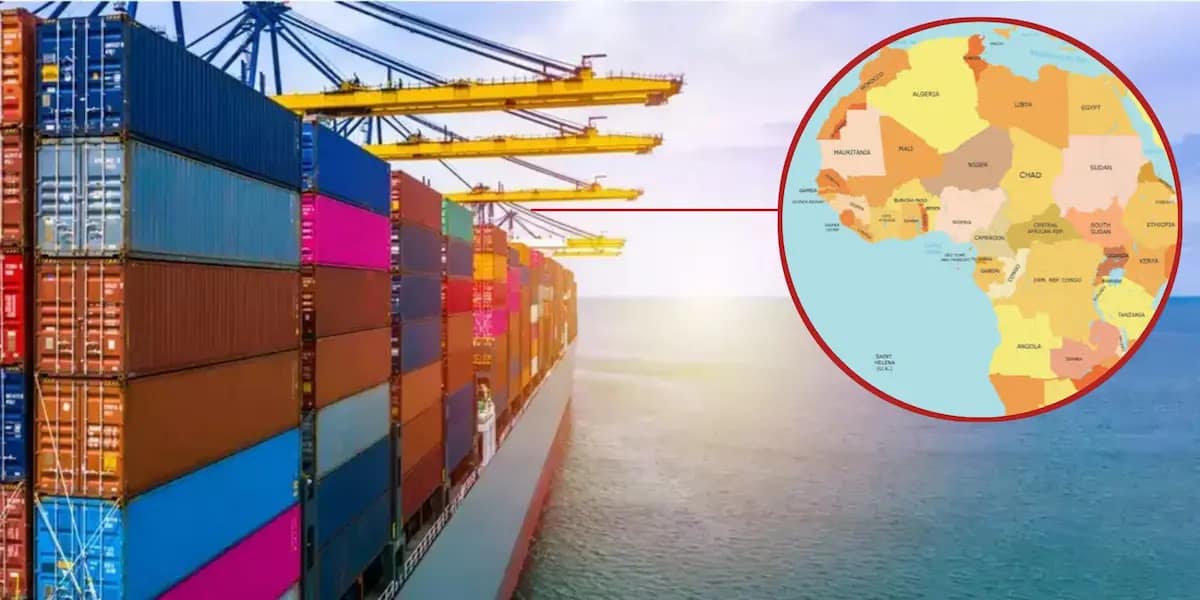
Featured Summary:
- An October freight listing put Spain–Lagos container shipping at about $1,500, while published Lagos–Tema prices varied sharply
- Africa’s liner shipping connectivity increased 10% in the year to June 2025, according to UNCTAD
- The World Bank estimates that about 60% of African trade costs arise from barriers within national borders
- Red Sea diversions have lengthened global shipping journeys, exposing African cargo movements to changing vessel routes and freight charges
An October 2026 listing from Globy advertised freight of approximately $1,502 for a 20-foot container travelling from Algeciras, Spain, to Lagos, Nigeria.
Cogoport published higher rates for shipments from Lagos to Tema, Ghana, although its prices varied considerably. The quotations cover different terms and cannot be treated as a direct comparison of shipping costs.
Africa’s average liner shipping connectivity rose 10% between June 2024 and June 2025, according to UN Trade and Development (UNCTAD).
The improvement followed changes to international shipping networks during the Red Sea disruptions, which brought additional services to some African ports.
The World Bank reported in August 2026 that only 15% to 20% of Africa’s trade takes place within the continent.
Manufactured goods account for more than 60% of that commerce, according to the African Union. Freight expenses affect the prices African producers can offer customers in neighbouring countries.
The rates available to exporters also reflect how shipping companies organise their services. Large international routes carry substantial cargo volumes, while some regional connections have fewer sailings and limited return shipments.
These differences affect the freight quotations available to businesses trading between African ports.
Global Shipping Networks Shape Freight Costs on African Routes
CMA CGM announced three revised Asia–West Africa services in February 2026, including connections from China to Nigeria’s Lekki port, Abidjan in Côte d’Ivoire and Kribi in Cameroon.
Another rotation serves Tema, Abidjan and Pointe-Noire. The carrier said the changes would increase capacity and improve sailing reliability.
Maersk’s September schedule included Lagos and Tema on its WAF6 service linking West Africa with Mediterranean ports.
Hapag-Lloyd also revised its West Africa Express rotation, with calls at Lagos, Onne, Cotonou, Tema and Lomé, alongside ports in Türkiye and the Mediterranean.
Cargo volumes influence the rates available on these networks. UN Trade and Development (UNCTAD) identifies vessel size, trade imbalances and economies of scale among the factors affecting maritime transport costs.
Carriers operating routes with limited return cargo have fewer loaded containers over which to recover vessel expenses.
UNCTAD’s Review of Maritime Transport 2025 reported a 10.1% increase in global container shipping capacity in 2024, equivalent to nearly three million twenty-foot-equivalent units.
Red Sea diversions lengthened voyages and absorbed part of the additional fleet capacity, affecting the number of vessels available to maintain scheduled services.
Port Charges and Border Delays Raise Africa’s Import Costs
Barriers within African countries account for about 60% of the continent’s estimated trade costs, according to the World Bank’s August 2026 Integrating Africa report.
The estimate covers domestic transport restrictions, customs procedures and other obstacles to trade, rather than ocean freight charges alone.
Nigeria’s Lekki Freeport Terminal lists a handling fee of ₦131,040 for a standard 20-foot import container and a delivery charge of ₦10,236.51 under its February 2025 tariff.
The two charges total ₦141,276.51, excluding customs duties, taxes and inland transport. Containers kept beyond the permitted free period attract additional storage fees.
In July 2025, Nigerian exporters told The Guardian that moving a truckload of goods from Lagos to Accra could cost more than ₦10 million.
They attributed the expense to transit levies, checkpoints and customs delays along the route through Benin and Togo. The amount was an exporter-reported estimate, not a standard freight rate.
A March 2026 survey by the Abidjan–Lagos Corridor Organisation recorded border-crossing delays of between two and 47 hours.
Researchers surveyed 1,896 trucks and 845 road users at ten crossings and identified approximately 41 roadblocks along the corridor. Among respondents with compliant documents, 74% reported making informal payments.
The reported road transport costs cannot be added to Lekki’s terminal tariff to calculate the cost of a single shipment.
A comparable delivered-cost figure would require the ocean booking, port handling, customs clearance and final delivery charges for the same consignment.
Global Shipping Diversions Change Africa’s Freight Economics
Global seaborne trade measured in tonne-miles increased 5.9% in 2024, according to UN Trade and Development’s Review of Maritime Transport 2025.
By May 2025, cargo tonnage passing through the Suez Canal remained 70% below its 2023 level as shipping companies continued diverting vessels around the Cape of Good Hope.
UNCTAD reported improved liner shipping connections at some African ports following changes to international shipping routes during the Red Sea disruption.
The gains varied across the continent, reflecting differences in the services introduced or maintained by shipping companies.
War-risk insurance premiums for Saudi-linked tankers calling at Yanbu rose from below 1% to approximately 3% of vessel value by September 24, according to Reuters.
Tanker charter rates exceeded $1 million a day in some transactions by October 23 as attacks on commercial shipping around the Strait of Hormuz intensified.
Container shipping companies have made separate pricing adjustments. On October 12, Maersk announced peak-season surcharges of $800 for 20-foot containers and $1,600 for 40-foot containers moving from China, Hong Kong and Taiwan to West Africa, effective October 26 for eligible non-spot bookings.
Another notice issued October 20 introduced charges of $600–$800 on selected Southeast Asian routes, taking effect in early November.
Maersk’s October 28 announcement reduced emergency contingency surcharges for eligible shipments from selected UAE and Omani ports to West Africa.
From November 1, the charge for a standard 20-foot container would decline from $3,950 to $3,450, while the rate for a standard 40-foot container would fall from $5,150 to $4,650.
Africa’s Shipping Costs Put Regional Trade Expansion to the Test
About 85% of Africa’s trade takes place with markets outside the continent, according to an African Union assessment published in August 2026.
In July, Ocean Network Express announced its Mediterranean Africa Express service, connecting Dakar, Tema, Lekki and Abidjan with Mediterranean ports. CMA CGM introduced KORA EXPRESS in August, linking Northern Europe with Tema, Lekki, Cotonou and Dakar.
The two services include multiple African ports on routes primarily serving trade with Europe and the Mediterranean.
Maersk announced revised Western Mediterranean–West Africa services on October 19, scheduled to begin in December.
Its plans include connections to Onne, Pointe-Noire, Monrovia and Takoradi, alongside a revised WAF5 rotation serving Abidjan, San-Pédro and Lagos.
The World Bank’s 2026 Integrating Africa: From Threads to Hubs report identifies customs reform, competition in transport services and stronger regional production networks among the measures needed to reduce trade costs.
The new shipping schedules extend Africa’s access to international markets, but they do not establish whether moving goods between African countries has become cheaper.


Recent Comments