

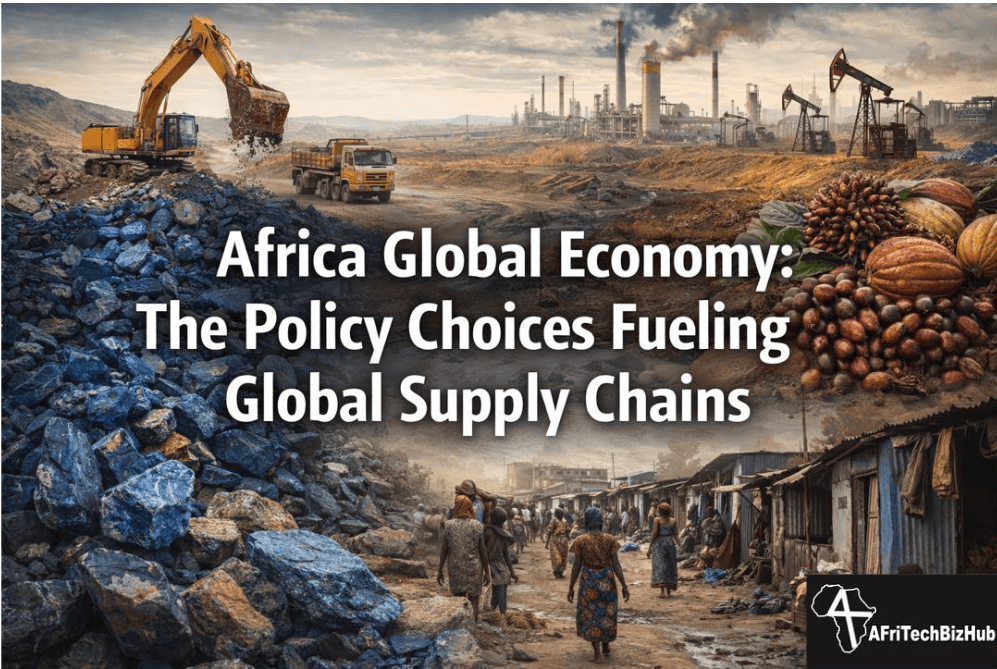
Africa global economy is shaped less by extraction and more by policy choices that determine value capture, local processing, and competitiveness across global supply chains
Featured Summary:
- Africa supplies the materials behind EVs, clean energy, and global manufacturing, but earns a fraction of the value.
- The gap isn’t exploitation alone; it’s policy design that prioritizes raw exports over industrial capture.
- As infrastructure and payments systems improve, 2026 becomes the year Africa either upgrades, or locks in the status quo.
Africa’s role in the Africa global economy is foundational but structurally imbalanced. The continent supplies critical minerals, energy inputs, and raw materials that sustain global manufacturing, technology, and energy supply chains.
Yet the bulk of value generated from these exports is captured outside Africa. This outcome is not accidental, it reflects policy frameworks that prioritize extraction and short-term liquidity over processing, industrial depth, and long-term value retention, embedding Africa at the lowest tier of global value chains.

What Does Africa’s Role in the Global Economy Mean
Africa’s role in the global economy refers to how the continent supplies essential raw materials, energy inputs, and commodities that underpin global manufacturing, technology, and energy systems, while capturing limited downstream value.
Within the Africa global economy, the continent supplies:
• Over 30% of global critical minerals, including cobalt, manganese, and platinum-group metals
• More than 60% of global cobalt, a core input for electric vehicles and battery storage
• Significant shares of lithium, copper, oil, gas, and agricultural commodities
These exports directly support:
• Global energy transition supply chains
• Industrial and manufacturing inputs
• Technology hardware and battery production
• Global food and energy security systems
Despite this scale, Africa’s participation in the global economy remains concentrated at the lowest value layer of global trade, exporting raw inputs while processing, pricing power, and margins accrue elsewhere.
How Africa Became a Structural Supplier—Not a Value Capturer
Africa’s position in the Africa global economy is shaped less by market inevitability and more by post-1990s policy architecture that prioritized capital inflows over downstream value capture.
Across many African economies, mining and extractive frameworks share common features:
• Low royalty regimes
• Long tax holidays
• Full profit repatriation allowances
• Limited or weakly enforced local-processing requirements
• Thin domestic supply-chain integration
According to UNCTAD, over 80% of Africa’s mineral exports leave the continent in raw or minimally processed form, even though downstream processing captures the majority of global margins.
These frameworks were designed to attract capital quickly, not to anchor industrialization.
The result is structural: Africa optimizes volume and speed in the global economy, while other regions optimize processing depth, margins, and technology spillovers.
The Real Subsidy: Policy-Enabled Value Leakage
Africa does not subsidize the global economy through aid or discounts.
It subsidizes the Africa global economy role in global supply chains through policy-enabled value leakage.
According to UNCTAD, more than 70% of Africa’s exports leave the continent in raw or minimally processed form, while over 80% of global manufacturing value-added is captured outside Africa, despite the continent’s dominance in critical inputs.
When Africa exports:
• Unrefined minerals
• Unprocessed agricultural commodities
• Energy inputs without downstream conversion
It transfers:
• Processing margins
• Industrial employment
• Taxable value
• Technology learning curves
to importing economies.
This is how global supply chains achieve lower input costs, while Africa absorbs environmental, fiscal, and opportunity costs, cementing its position in the Africa global economy as a supplier of volume, not value.

Why Other Resource Regions Capture More Value
Africa’s position in the global economy diverges sharply from other resource-rich regions not because of geology, but because of policy design and institutional choices.
Other commodity exporters structured their economies to retain value beyond extraction:
Australia
• Enforced local services, engineering, and processing ecosystems around mining
• Built mining-linked industrial clusters that retain margins, skills, and tax revenue
Chile
• Developed domestic copper processing and pricing leverage
• Anchored fiscal stability to resource rents through disciplined royalty regimes
Indonesia
• Restricted raw nickel exports
• Forced downstream smelting and EV supply-chain investment domestically
By contrast, Africa’s resource framework prioritizes extraction speed and capital inflow over value capture.
According to UNCTAD, more than 80% of Africa’s mineral exports leave the continent in raw or minimally processed form, compared with less than 20% in economies such as Australia and Chile, where downstream processing captures the majority of value added.
This gap explains why the Africa global economy supplies critical inputs to global supply chains while capturing only a narrow slice of processing margins, industrial employment, and technology spillovers.
The divergence is not natural, it is institutional, strategic, and policy-driven.
Why African Leaders Maintain These Policies
Three structural incentives shape current policy choices within the Africa global economy:
- FX Dependence
Raw exports generate immediate foreign exchange needed to stabilize currencies and meet external obligations. In several African economies, primary commodities account for over 60% of total export revenues, making extractive flows the fastest source of FX liquidity. - Fiscal Pressure
Governments rely on mining, oil, gas, and agricultural exports to fund short-term budgets, service debt, and manage subsidy regimes, often prioritizing cash flow over downstream value capture. - Infrastructure Gaps
Power shortages, transport constraints, and limited industrial capacity weaken enforcement of beneficiation and local processing requirements.
These pressures create a persistent trade-off inside the Africa global economy:
Short-term liquidity versus long-term industrial value. Most governments choose liquidity.
Africa’s Role in the Global Economy Today
Africa’s role in the global economy is primarily as a structural supplier of raw materials and energy inputs that support global manufacturing, technology, and clean-energy supply chains.
The continent provides critical minerals, hydrocarbons, and agricultural commodities that underpin EV production, renewable energy systems, industrial manufacturing, and global food security.
However, within the Africa global economy, value capture remains limited. While exports feed global production, most processing, refining, and advanced manufacturing occur outside the continent.
UNCTAD data shows Africa accounts for less than 2% of global manufacturing value added, underscoring the gap between Africa’s contribution to global supply chains and the value retained domestically.
As a result, Africa’s global trade position supports cost compression and supply stability for importing regions, while Africa itself captures narrow margins, limited industrial spillovers, and constrained employment multipliers.
This outcome reflects trade and industrial policy choices that prioritize export volume and foreign exchange generation over downstream value creation, defining Africa’s current position in the global economy.
How Africa Payments Infrastructure Reinforces the Africa Global Economy Pattern
Africa payments infrastructure is a core but often overlooked component of the Africa global economy, determining how trade value is settled, converted, and captured across borders.
Historically, Africa’s payment systems routed cross-border trade through U.S. dollar correspondent banks and offshore clearing networks, rather than regional settlement platforms.
As a result, Africa global economy developed with three structural characteristics:
• High FX and transaction costs, driven by offshore settlement and multiple currency conversions
• Limited SME participation in cross-border trade, due to slow settlement and liquidity constraints
• Persistent capital leakage, as trade value exits the continent before local circulation
According to World Bank payment benchmarks, cross-border payments involving African currencies cost more than double the global average and often take two to five days to settle, reinforcing raw-export dependence within the Africa global economy.
Recent reforms—such as local-currency settlement and regional clearing initiatives like PAPSS—are reducing friction.
However, payments infrastructure reform alone cannot correct Africa’s value leakage unless it is aligned with industrial, trade, and processing policies that retain value onshore.
In the absence of such alignment, faster settlement still accelerates export volume, not value capture, leaving the structural position of the Africa global economy largely unchanged.
What Needs to Change for Africa’s Global Position to Shift
Africa’s position in the Africa global economy will not shift through higher export volumes alone, but through policy changes that increase value capture per unit exported.
According to UNCTAD, manufacturing value added accounts for less than 11% of Africa’s GDP, compared with over 20% in East Asia, highlighting how limited processing—not resource availability—constrains Africa’s global trade position.
To rebalance this structure, Africa’s economic repositioning requires:
• Explicit beneficiation timelines embedded in mining and export licenses
• Regional processing hubs aligned with AfCFTA trade corridors
• Mineral-linked infrastructure financing for power, transport, and industrial zones
• Coordinated trade and industrial policy under AfCFTA frameworks
• Capital markets aligned with processing and manufacturing, not extraction alone

Opportunities Emerging From Policy Recalibration in the Africa Global Economy
In the Africa global economy, policy recalibration determines whether countries remain raw-material suppliers or begin retaining value through processing, industrial linkages, and domestic value chains.
The opportunity is not abstract, it is measurable, structural, and execution-dependent.
UNCTAD estimates that downstream processing can increase the export value of minerals by 3–7× compared with raw exports, highlighting how much economic value is currently transferred offshore through existing trade and industrial policy choices.
Opportunities for Governments
Policy shifts toward beneficiation and regional processing unlock:
• Higher long-term fiscal yields from value-added exports
• Reduced FX vulnerability by diversifying export earnings
• Stronger industrial employment multipliers tied to processing and services
These outcomes strengthen macro stability rather than relying on volatile commodity cycles.
Opportunities for Businesses
As policy incentives align with value retention, new ecosystems emerge:
• Processing, logistics, and industrial services linked to minerals and agriculture
• Manufacturing adjacencies around energy, metals, and critical inputs
• Regional value-chain integration under AfCFTA frameworks
This expands the private sector beyond extraction into scalable industrial activity.
Opportunities for Investors
For capital allocators, the Africa global economy presents:
• Infrastructure-linked industrial assets with long-duration demand
• Processing and logistics platforms anchored in trade flows, not speculation
• Policy-aligned investments with clearer regulatory visibility and defensibility
Returns increasingly favor execution-ready assets embedded in value chains, not volume-only extraction.
Connecting the Dots: Africa Global Economy and 2026
Africa global economy is shaped less by resource availability than by policy sequencing that determines where value is processed, priced, and retained.
As infrastructure improves, payments systems modernize, and AfCFTA deepens—against a backdrop where Africa still captures less than 40% of global mineral value chains despite supplying a far larger share of inputs—the question for 2026 is no longer whether Africa has resources, but whether it chooses to monetize them structurally rather than transactionally.
The next phase of Africa’s global integration will be decided by execution, not rhetoric.
Africa Global Economy Is a Policy Choice
Africa is not constrained by a lack of resources, relevance, or demand within the global economy. It is constrained by policy frameworks that prioritize extraction over industrialization, liquidity over value capture, and short-term stabilization over long-term economic architecture.
Until Africa aligns minerals, infrastructure, finance, trade, and the Africa digital economy into a unified value-capture strategy, the continent will continue to underpin global supply chains more than it benefits from them.
Heading into 2026, the opportunity is not louder narratives, but deliberate economic architecture that converts participation into power.


Recent Comments