


Featured Summary:
- Africa trade finance gap is increasingly being driven by global banking retreat rather than missing trade demand
- Global banks are cutting exposure faster than AfCFTA trade ambition is rising
- SMEs are paying for the collapse in credit lines and correspondent banking confidence
- Africa’s $4 trillion domestic capital pool remains trapped outside trade finance
Global banks are retreating from African trade faster than AfCFTA is expanding it.
The African Development Bank estimates Africa trade finance gap averaged $74 billion between 2021 and 2024, while GTR reported that banks intermediated only 23 percent of African trade between 2021 and 2023, down from roughly 40 percent before the pandemic.
That is not a routine funding shortage. It is a balance-sheet withdrawal.
Trade corridors cannot scale when banks refuse to finance the transaction behind the cargo.
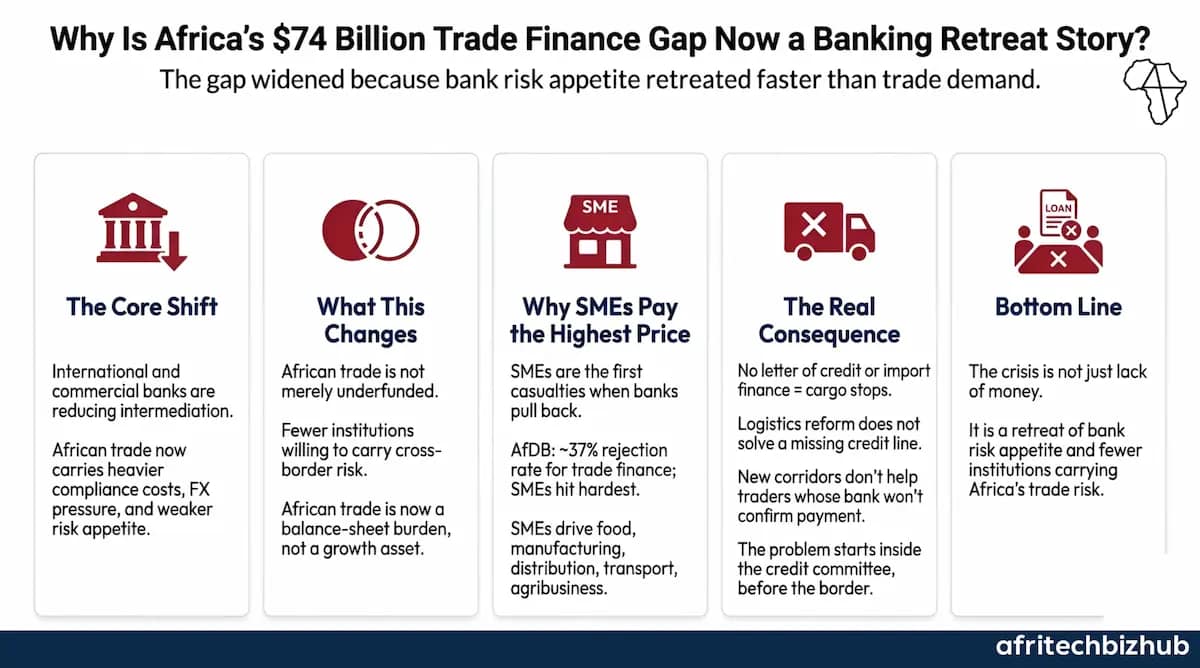
Why Are Global Banks Retreating From Africa Trade Finance?
The trade finance gap widened because bank risk appetite retreated faster than trade demand.
Traditional commentary treats Africa trade finance gap as a shortage of available money.
The AfDB data points to a harder market failure.
International and commercial banks are reducing intermediation because African trade exposure now carries heavier compliance costs, foreign-exchange pressure, correspondent banking risk, and weaker internal risk appetite.
That shift changes the crisis. African trade is not merely underfunded. It is being underwritten by fewer institutions willing to carry cross-border risk.
The international trade credit line is becoming thinner, more selective, and more expensive for African counterparties.
It is what happens when global banks decide African trade is no longer a growth asset but a balance-sheet burden.
Why Are SMEs Paying the Highest Price for Africa Trade Finance Gap?
SMEs are the first casualties when banks pull back from trade risk.
AfDB’s report places rejection rates for trade finance applications at about 37 percent, with smaller businesses carrying the heaviest damage.
That matters because SMEs sit at the operating edge of African trade: food supply, manufacturing inputs, regional distribution, transport, agribusiness, and light industrial commerce.
The consequence is brutally simple. If an SME cannot secure a letter of credit, import finance, inventory funding, or a settlement guarantee, the cargo stops.
Logistics reform does not solve a missing credit line. A new corridor does not help a trader whose bank cannot confirm payment.
Africa’s trade problem now starts inside the credit committee before it reaches the border.
Why Is Africa’s $4 Trillion Domestic Capital Pool Still Missing From Trade Finance?
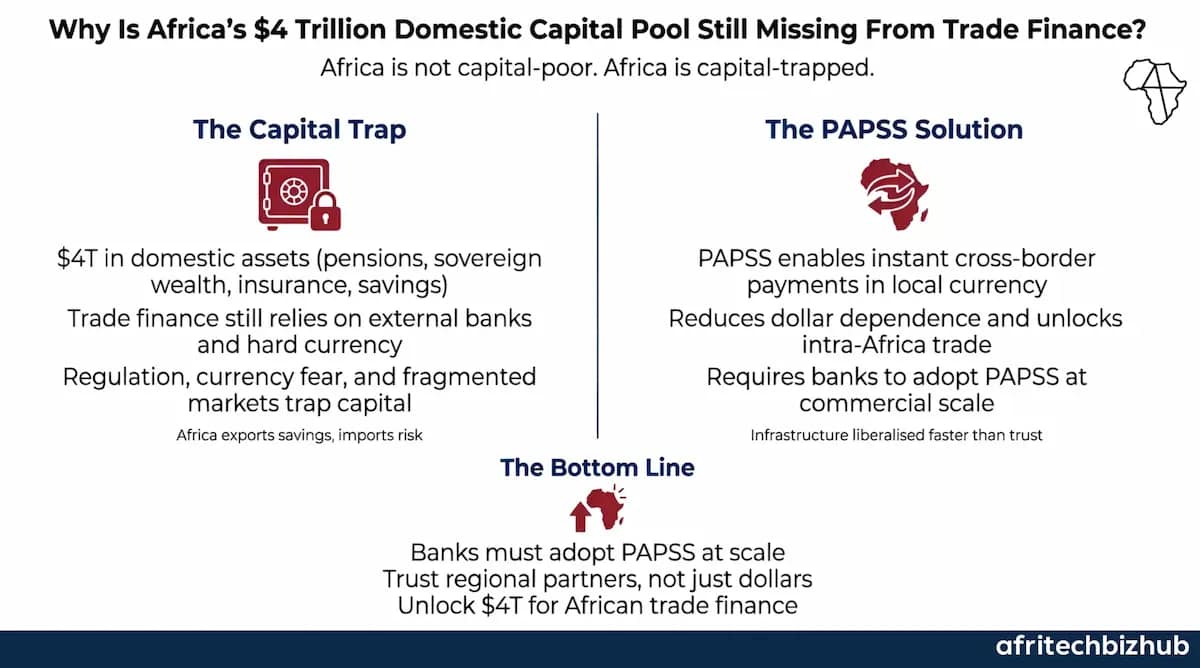
Africa is not capital-poor. Africa is capital-trapped.
AfDB Annual Meetings discussions and Africa Finance Corporation commentary have pointed to roughly $4 trillion in domestic African institutional assets across pensions, sovereign wealth structures, insurance balance sheets, banking liquidity, and savings.
Yet African trade finance still leans heavily on external banks, multilateral lenders, and hard-currency liquidity.
That contradiction is the capital myth. The money exists, but regulation, currency fear, conservative asset allocation, fragmented markets, and weak regional investment vehicles keep it away from trade finance.
Africa repeatedly exports savings and imports risk appetite. That is not scarcity. It is a self-inflicted liquidity trap.
Can PAPSS Break Africa’s Foreign Exchange Liquidity Trap?
PAPSS can reduce the dollar choke point, but only if banks use it at commercial scale.
PAPSS was designed to enable instant cross-border payments and local-currency settlement across African markets, while AfCFTA was created to deepen intra-African trade through a single continental market.
The institutional logic is clear: Africa cannot build regional trade if every transaction still depends on external clearing routes and scarce dollar or euro liquidity.
Sub-Saharan Africa has spent a decade optimizing cross-border payment rails to move goods, yet regulatory structures and prudential frameworks still encourage defensive cross-border allocation behaviour.
That is the contradiction. Africa liberalised movement infrastructure faster than it liberalised institutional trust.
If domestic commercial banks do not adopt digital trade infrastructure at scale, AfCFTA will remain legally ambitious and financially underpowered.
Why AfCFTA Will Remain a Paper Tiger Without Trade Liquidity
Trade agreements do not move cargo. Balance sheets do.
Corporate treasurers already face the pressure. Trade refinancing becomes more expensive as correspondent banking relationships weaken.
Importers absorb longer settlement cycles. SMEs lose inventory access because guarantees fail to clear.
Industrial firms operate with shorter liquidity horizons because long-duration trade finance remains scarce.
Multilateral lenders can keep African trade alive on life support. They cannot replace domestic commercial banking forever.
If African banks continue retreating from trade risk while pension funds, insurers, and sovereign pools stay trapped in defensive allocation, the continent will build corridors faster than it builds commercial confidence.
The next African trade disruption may begin less at the port and more inside treasury departments unable to clear inventory finance on time.


Recent Comments