

Featured Summary:
- The AfDB Bond attracted strong investor demand despite a more selective global financing environment
- Global investors are not avoiding Africa. They are increasingly concentrating capital around institutions they trust
- Africa Finance is increasingly being shaped by credibility, guarantees, and risk-sharing mechanisms rather than capital availability alone
- Institutions capable of lowering perceived risk are becoming increasingly important within Africa’s evolving financial architecture
The African Development Bank raised €1.25 billion with little difficulty.
That should attract attention at a time when access to affordable capital remains one of the most persistent challenges facing many African economies.
The transaction arrived into a market that has become increasingly selective about risk.
Borrowing costs remain elevated across much of the developing world. Investors continue scrutinising sovereign balance sheets, debt profiles, and macroeconomic vulnerabilities.
Yet the AfDB Bond attracted strong participation and reinforced the institution’s position within global capital markets.
That exposes a contradiction at the centre of Africa Finance. Capital remains available for African development.
The real divide is no longer between Africa and global investors. It is increasingly between institutions investors trust and borrowers they do not.
Why Did AfDB Launch a New €1.25 Billion Social Bond?
The AfDB Bond forms part of the African Development Bank’s broader funding strategy, providing resources that support projects linked to social and economic development across its member countries.
The more revealing story is not that the bond was launched. It is that investors responded.
The transaction entered a market where risk is being priced aggressively and capital is no longer moving as freely as it did during years of ultra-low interest rates. Yet demand remained strong.
That response reinforces a reality often overlooked in debates about Africa’s financing challenges.
Investors are not withdrawing from African development altogether.
They are becoming more selective about the channels through which they participate. The size of the AfDB Bond matters. The confidence behind it matters more.
Why Are Global Investors Buying AfDB Bonds?
Trust accumulates slowly and compounds over time. The African Development Bank enters global capital markets with advantages that many borrowers cannot easily replicate.
AAA credit ratings, multilateral shareholder support, a long repayment history, and a clearly defined development mandate create a level of institutional credibility that investors recognise.
That credibility influences behaviour. Global investors continue searching for assets capable of providing stability, diversification, and predictable performance.
Institutions with strong governance frameworks and established track records naturally attract greater attention during periods of uncertainty.
The tension becomes visible elsewhere in Africa Finance.
Global investors remain comfortable financing African development through institutions they trust.
Many remain considerably more cautious when financing African governments directly.
The AfDB Bond suggests global investors are not stepping away from Africa.
They are becoming far more selective about who represents Africa. Capital is still moving. Trust is determining the route.
What Does the AfDB Bond Reveal About Africa Finance Today?
The AfDB Bond exposes a contradiction that sits at the centre of Africa Finance.
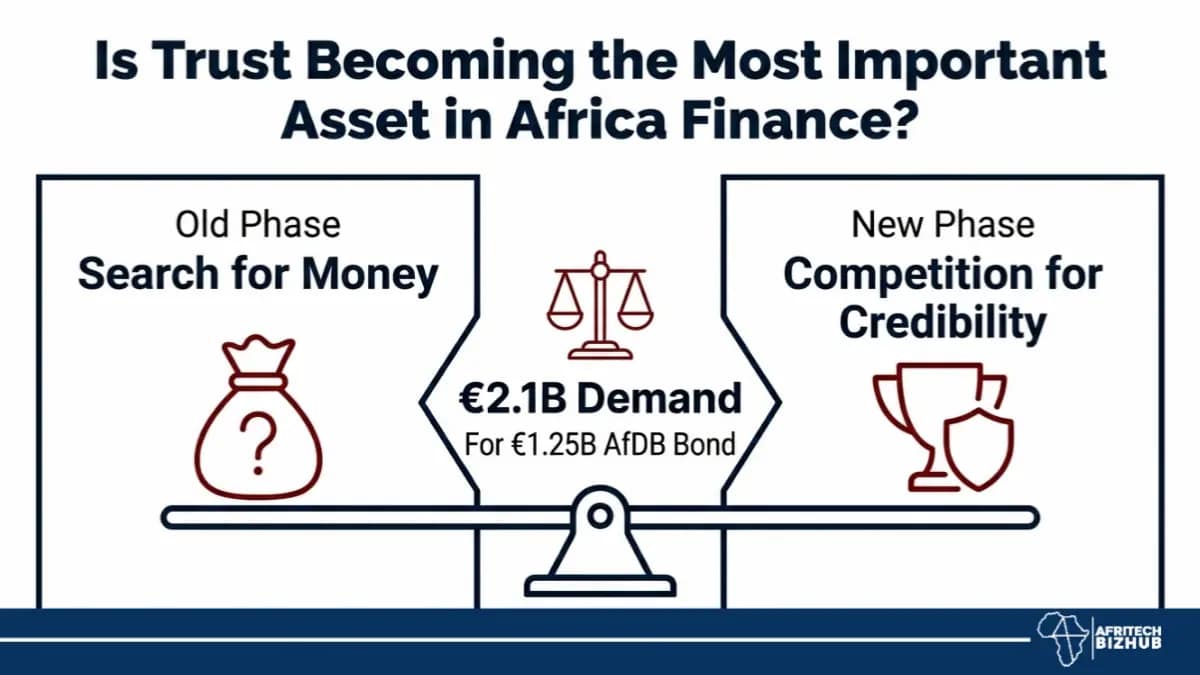
Investors placed more than €2.1 billion of orders for a €1.25 billion transaction despite persistent concerns about risk across emerging markets.
The demand was not weak. It exceeded supply.
That reality challenges a popular assumption. Global capital is not abandoning Africa.
It is concentrating around institutions capable of reducing uncertainty.
The financing challenge increasingly appears less about attracting money and more about building institutions that investors trust to allocate it.
How Does the AfDB Bond Fit Into Africa’s New Financial Architecture?
Across Africa, a growing number of institutions are focusing on a different question. Not how to find capital, but how to make capital feel safer.
That logic sits behind the New African Financial Architecture for Development (NAFAD), the expansion of guarantee mechanisms through ATIDI, growing efforts to mobilise domestic institutional capital, and wider discussions around blended finance and risk-sharing structures.
The common thread is difficult to miss. African institutions increasingly appear less interested in searching for entirely new pools of money than in reducing the risks that prevent existing pools of money from moving.
According to the African Development Bank, initiatives linked to guarantee expansion, domestic capital mobilisation, de-risking mechanisms, and institutional strengthening are becoming increasingly important components of the continent’s financing strategy.
The future of Africa Finance may depend less on raising capital and more on reducing perceived risk.
That is the principle increasingly shaping Africa’s emerging financial architecture.
The objective is no longer simply to raise capital. It is to create institutions capable of attracting capital repeatedly.
Is Trust Becoming the Most Important Asset in Africa Finance?
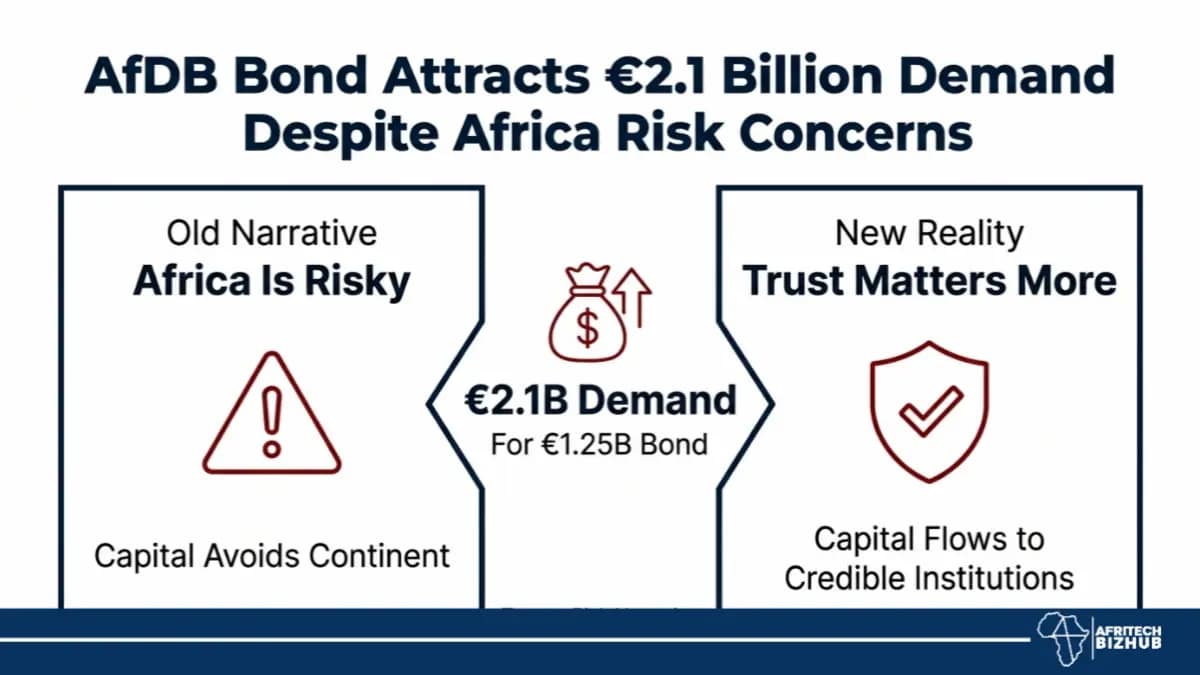
Investors placed more than €2.1 billion of orders for a €1.25 billion AfDB Bond. That signal matters.
Global capital is not avoiding Africa. It is concentrating around institutions capable of providing credibility, discipline, and predictable execution.
Markets are increasingly separating trusted institutions from the broader risk narratives often attached to African borrowers.
The AfDB Bond does not prove that Africa’s financing challenges have disappeared. It proves that capital remains available when trust exists.
The next phase of Africa Finance will be defined less by the search for money and more by the competition for credibility.
Investors have already shown where the money is. The question is which institutions can consistently attract it.


Recent Comments