


Featured Summary:
- Africa Crude Oil is finding more buyers within the continent as refining capacity expands
- Dangote Refinery is increasing purchases of Nigerian crude while traditional export patterns continue to evolve
- Domestic refining can retain more value inside African economies but does not eliminate exposure to global oil markets
- The bigger challenge is not producing more oil. It is capturing more value before the barrel leaves the continent
More Africa Crude Oil is staying on the continent than at any point in recent memory.
Dangote Refinery is buying more Nigerian barrels. New refining projects are emerging across multiple markets.
Export patterns that shaped the industry for years are beginning to shift. On the surface, that looks like progress.
Yet the vulnerability remains. Africa continues to produce crude, refine more of it locally, and still pay prices shaped by global markets.
That contradiction sits at the centre of the continent’s energy story. The issue is no longer whether Africa can produce oil. The issue is how much value Africa Crude Oil creates before it leaves the continent.
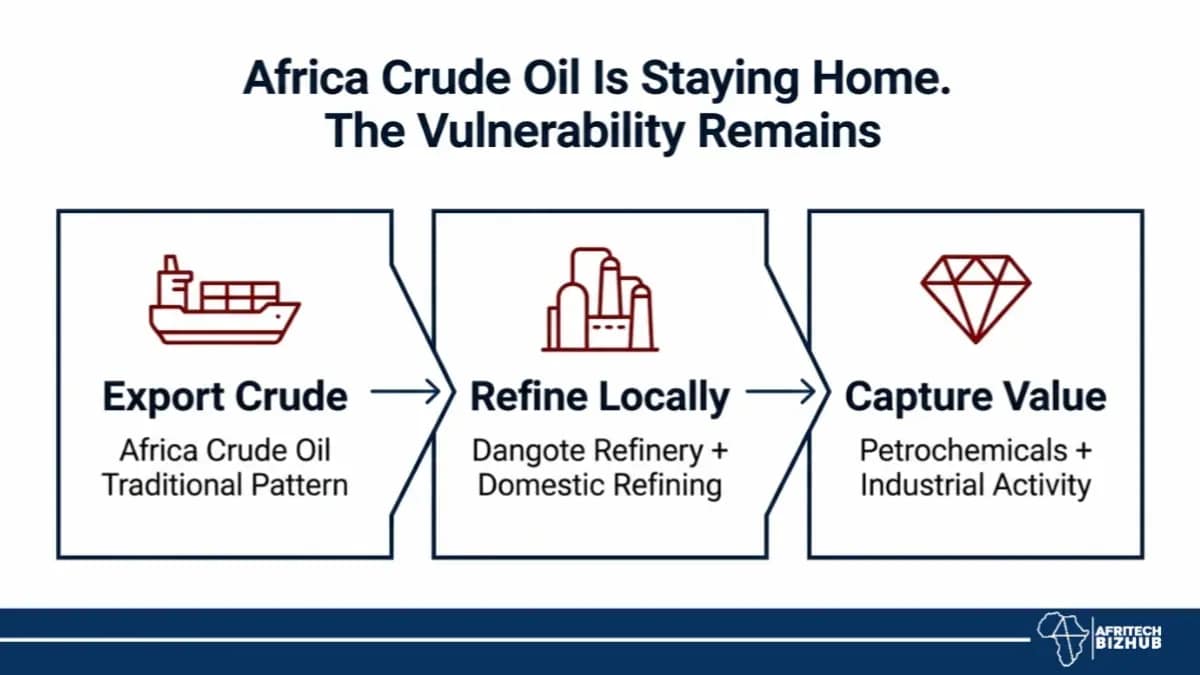
Why Is Dangote Buying More Nigerian Crude?
Dangote Refinery needs crude, and Nigerian producers need buyers. That reality is creating one of the most important shifts in Africa’s oil market.
Barrels that would historically have been exported are increasingly finding demand closer to home as refining activity expands.
The significance extends beyond a single refinery. For decades, many African economies exported crude and imported refined products at significantly higher values.
Every barrel processed locally changes part of that equation. More refining creates demand for logistics, storage, distribution, petrochemicals, and industrial activity that would otherwise take place elsewhere.
What makes the development particularly important is timing. Dangote’s growing appetite for local crude is arriving just as global crude trade patterns are becoming less predictable.
Domestic demand is beginning to provide an alternative outlet for Africa Crude Oil at a moment when producers are looking for greater flexibility.
Why Are Overseas Buyers Pulling Back From African Crude?
The global market that shaped African crude exports is changing.
The United States now produces significantly more oil than it did a decade ago.
New suppliers have entered international markets. Geopolitical disruptions continue to reshape trade flows.
Buyers have more sourcing options than they once did, creating a more competitive environment for exporters around the world.
This does not mean demand for Africa Crude Oil is disappearing. It means traditional patterns are becoming less certain.
The market is no longer defined by the same buyers, the same routes, or the same assumptions that previously governed global crude trade.
Africa Crude Oil is no longer competing against yesterday’s market. It is competing against a growing number of suppliers chasing the same buyers.
As competition intensifies, producers are increasingly looking inward for demand, making domestic refining a more important part of the continent’s energy strategy.
Why Does Africa Still Pay Global Oil Prices?
This is where the contradiction becomes impossible to ignore.
Producing oil and controlling energy prices are not the same thing.
Many oil-producing economies assume resource ownership should provide protection from international volatility. Global oil markets rarely work that way.
Crude prices are influenced by worldwide supply and demand, geopolitical developments, refining capacity, shipping costs, and market expectations.
Even countries that produce substantial amounts of oil remain exposed to forces beyond their borders.
This explains why Africa Crude Oil staying on the continent is important but not transformational on its own.
Refining more crude locally improves value retention.
It does not automatically remove exposure to the global pricing system that continues to influence fuel costs across producing and non-producing countries alike.
Is Domestic Refining Changing Africa Crude Oil Markets?
The answer is increasingly yes.
Domestic refining is beginning to alter the flow of Africa Crude Oil by creating demand closer to production centres.
Instead of exporting every available barrel, producers now have growing opportunities to supply refineries located within African markets.
The result is a gradual shift from extraction toward processing and industrial activity.
Afreximbank have consistently argued that refining capacity is critical to strengthening African industrialisation and reducing dependence on imported petroleum products.
Through initiatives supporting refining, energy infrastructure, and intra-African trade, the bank has repeatedly highlighted the importance of retaining more value from the continent’s natural resources before they enter global supply chains.
The significance of refining therefore extends beyond fuel production.
It represents an attempt to reposition Africa Crude Oil within a broader industrial value chain rather than treating extraction as the final economic objective.
What Must Africa Crude Oil Do Next?
The continent’s challenge is no longer proving it can produce oil. That argument was settled long ago.
The more important question is how much economic value remains inside African economies after production takes place.
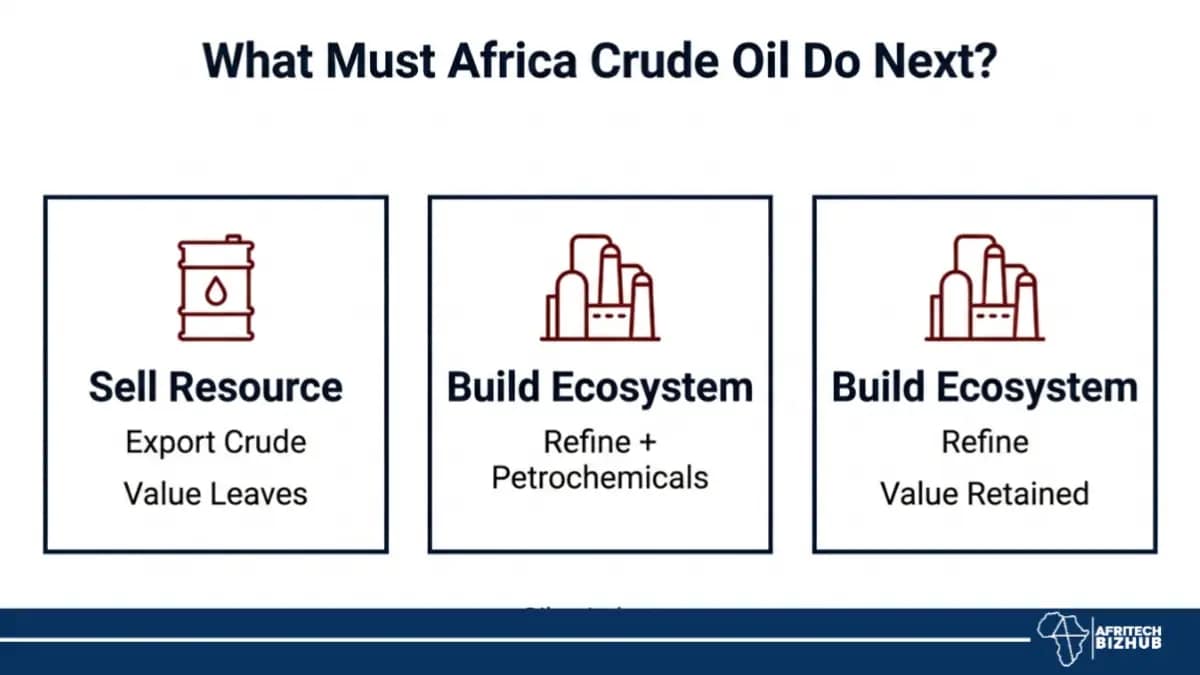
Extraction generates revenue, but refining, petrochemicals, logistics, and manufacturing create the industries that support long-term growth.
The difference between exporting crude and processing crude is the difference between selling a resource and building an ecosystem around it.
The structural weakness has never been the absence of oil. It is that too much value still leaves with the barrel.
Domestic refining is beginning to change that equation, but refining capacity alone will not determine the future of Africa Crude Oil.
The future of Africa Crude Oil may depend less on how many barrels the continent produces and more on how much economic activity those barrels create before they leave African shores.
In a market where competition for buyers is increasing and global price shocks remain unavoidable, the countries that capture the most value will not necessarily be those that produce the most oil.
They will be the ones that build the strongest industries around it.


Recent Comments