


Featured Summary:
- Competition for critical minerals in Africa is rising as global powers expand mining and refining activity across the continent.
- Central Africa continues dominating Africa cobalt reserves and copper supply linked to global EV manufacturing.
- Southern Africa remains strategically important to lithium, platinum, manganese, and battery-mineral expansion.
- Graphite projects and rare-earth exploration activity are attracting stronger investment attention across East African mining corridors.
The global scramble for critical minerals in Africa is moving deeper as governments and corporations race to secure lithium, cobalt, graphite, copper, and rare earth supply chains tied to electric vehicles, AI systems, and industrial energy infrastructure.
The continent’s mineral geography is now influencing everything from rail corridors to refinery projects as African mining regions attract stronger geopolitical and commercial attention from the United States, China, Europe, and Gulf investors.
Read: Why Global Powers Are Racing for Africa Critical Minerals.
Why Central Africa Controls Africa’s Cobalt Supply
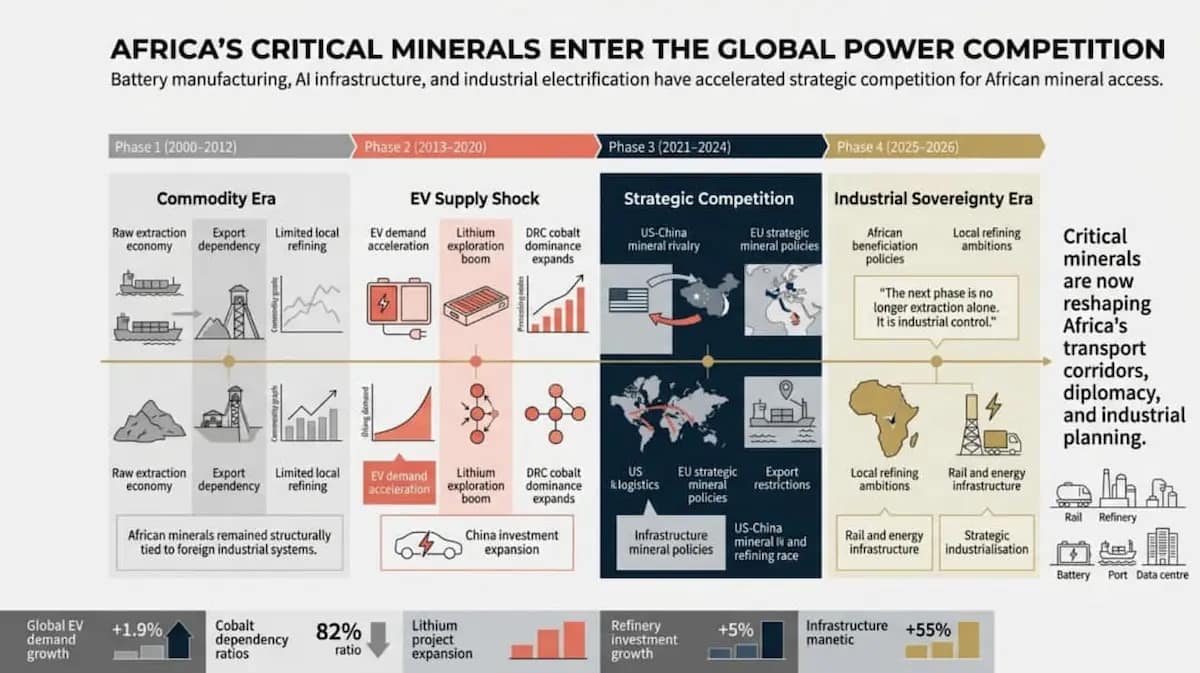
Central Africa remains the center of global cobalt production as the Democratic Republic of Congo continues supplying most of the cobalt feeding battery manufacturing and EV supply chains.
Africa cobalt reserves are heavily concentrated inside the DRC’s copper belt where mining companies, commodity traders, and foreign governments continue expanding long-term agreements tied to strategic mineral access.
That concentration is also reshaping infrastructure development across Central Africa itself.
Export corridors, rail systems, logistics hubs, and processing facilities are increasingly being positioned around mineral transportation and refining activity.
The DRC’s mineral importance is no longer only about extraction. It is increasingly about who controls the systems surrounding extraction.
Where Lithium Is Found in Africa and Why Southern Africa Matters
Southern Africa is becoming more strategically important to battery supply chains as Zimbabwe, Namibia, Zambia, and South Africa expand lithium and industrial-mineral production tied to global energy-transition demand.
Zimbabwe has rapidly emerged as one of Africa’s most important lithium markets while South Africa remains central to platinum-group metals and manganese supply linked to industrial manufacturing systems.
Where is lithium found in Africa is now becoming part of a wider industrial debate across Southern Africa.
Governments are increasingly trying to avoid exporting raw minerals without local processing, refining, or manufacturing participation.
That shift is pushing stronger focus toward beneficiation policies, refinery investment, and export restrictions designed to keep more long-term industrial value inside African economies.
How African Mining Regions Are Drawing New Global Investment
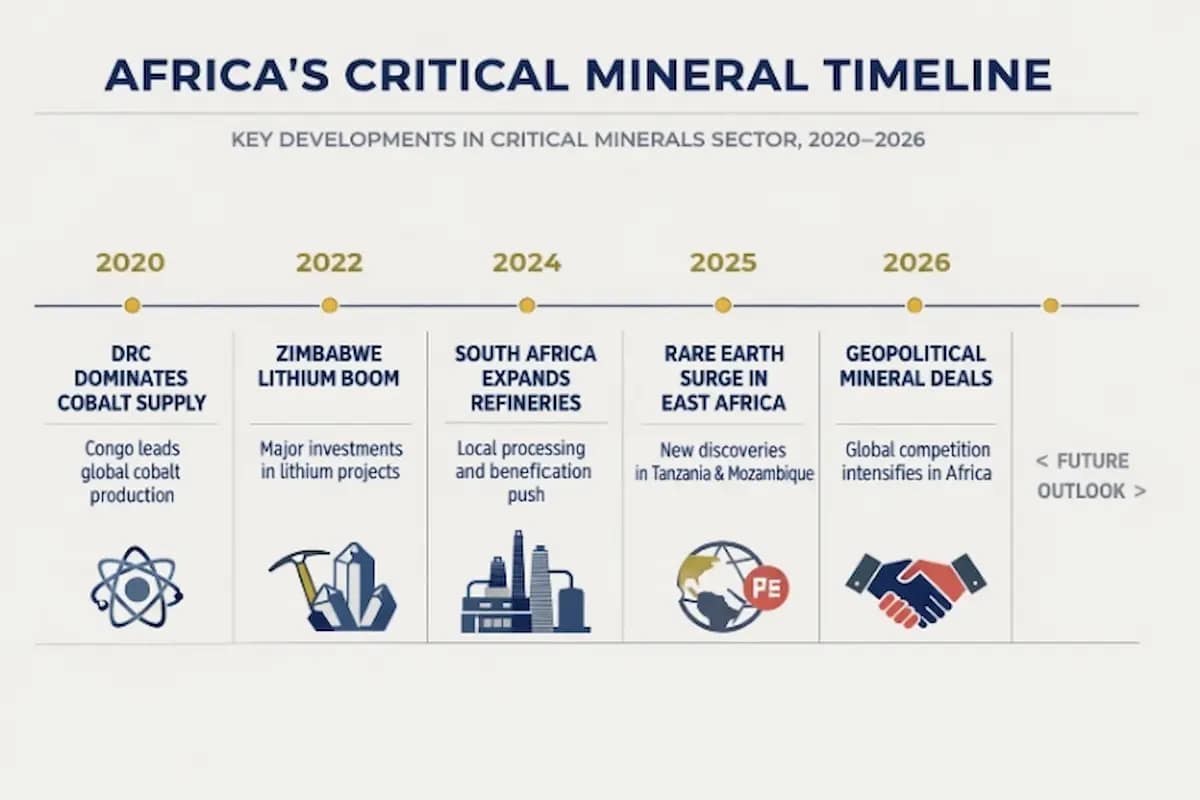
Competition for critical minerals in Africa is increasingly reshaping investment flows across mining corridors tied to battery manufacturing, industrial processing, and energy infrastructure.
Governments, commodity traders, and global manufacturers are expanding partnerships linked to lithium, cobalt, graphite, copper, and rare earth supply chains as EV production and AI infrastructure increase long-term pressure around mineral security and refining access.
The World Bank noted in its 2025 Mineral Resources of Africa report that Africa’s long-term economic gains from critical minerals will depend on whether countries move beyond raw extraction into processing, infrastructure expansion, and industrial value chains.
Reuters reported on May 13, 2026, that Congo’s state-backed cobalt company EGC, EVelution Energy, and Trafigura signed an agreement tied to long-term cobalt supply-chain development between the DRC and the United States.
The agreement reflects how rail systems, refinery planning, logistics corridors, and export infrastructure are increasingly being positioned around strategic mineral access across African mining economies.
Can Critical Minerals in Africa Build Industrial Power?
East Africa is attracting stronger attention inside rare earth minerals Africa discussions as graphite discoveries, exploration activity, and mineral-processing interest expand across Tanzania, Mozambique, and Madagascar.
Governments are beginning to recognize that long-term value may come less from exporting raw minerals and more from controlling refining systems, industrial infrastructure, and processing capacity tied to those resources.
The deeper shift unfolding across African mining regions is becoming difficult for governments to ignore.
Countries that continue exporting raw minerals while other economies control refining, battery production, and industrial processing may eventually realize too late that owning resources alone does not automatically create industrial power.
The next phase of Africa’s mineral economy will likely reward countries that move fastest on infrastructure, electricity, rail access, and local processing capacity.
The countries that build industries around their minerals instead of simply exporting them may ultimately shape Africa’s next industrial era.


Recent Comments