


Featured Summary:
- AI data centers investment is becoming central to Africa’s digital sovereignty agenda as demand for local compute rises.
- African AI growth depends on power, fibre networks, regulation, and local data infrastructure.
- Sovereign data centers could expand AI service access for businesses, governments, researchers, and startups.
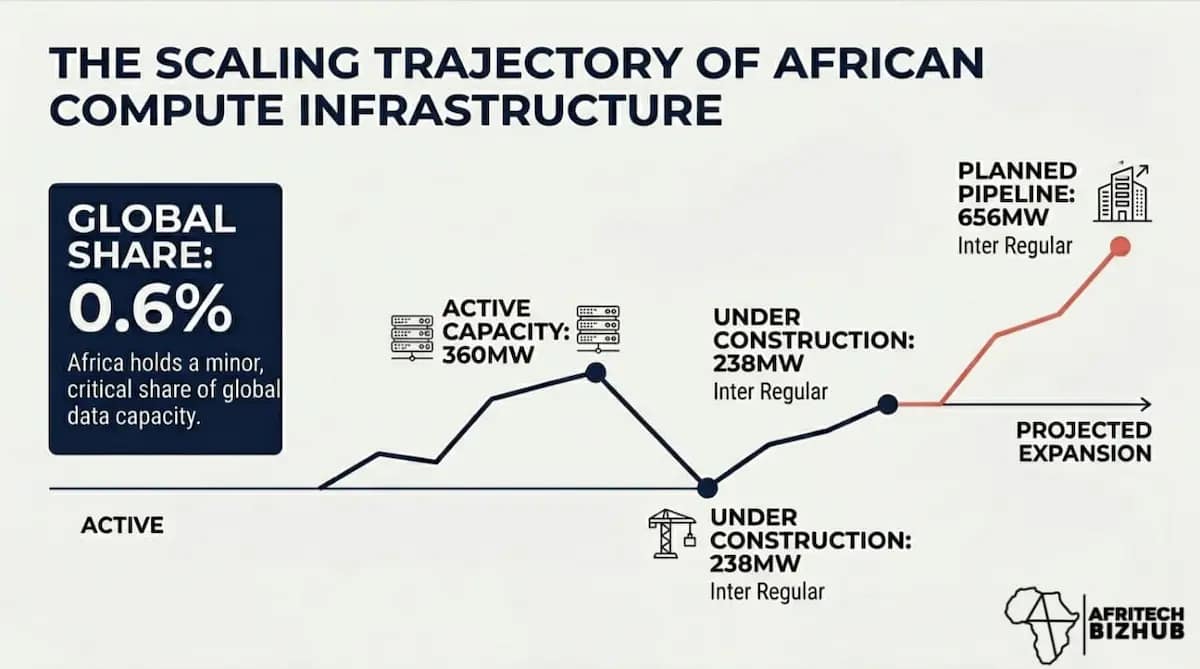
- Africa still accounts for a small share of global data centre capacity despite rising digital demand.
Africa’s AI ambitions are moving from policy discussions into infrastructure pressure as governments and technology investors push for local data centers, sovereign cloud systems, and AI-ready compute capacity.
Rising demand for AI service access, stronger data-protection rules, and concerns over foreign dependence are now pushing African governments to treat AI data center infrastructure as part of the continent’s wider digital economy strategy.
Read: Africa Data Centers: Capacity Lags as AI Demand Scales.
How Will AI Data Centers Expand African AI Service Access?
Local compute capacity remains one of the biggest structural gaps inside the African AI ecosystem.
Without enough AI-ready infrastructure, startups, universities, businesses, and governments still depend heavily on offshore cloud systems that increase latency, operational costs, and exposure to external data governance systems.
Africa still accounts for a small share of global data center capacity despite rising digital demand across the continent.
That imbalance is increasing the strategic importance of sovereign AI data centers expansion across African markets.
Local infrastructure could allow governments, financial institutions, research organizations, and private technology firms to process data closer to users while improving AI service access across sectors tied to finance, health care, education, logistics, and digital commerce.
African AI expansion is now becoming increasingly dependent on whether local compute infrastructure can scale fast enough to support rising digital activity across the continent.
How Will AI Data Centers Reshape African Economies
AI data center infrastructure is increasingly becoming part of Africa’s wider economic competitiveness strategy.
Governments and investors are beginning to view sovereign compute systems as economic infrastructure capable of supporting industrial productivity, digital commerce, financial systems, public services, and enterprise technology expansion across African markets.
The shift reflects growing recognition that African AI development may struggle to scale competitively if core processing infrastructure remains concentrated outside the continent.
The expansion of sovereign AI systems is also widening discussions around industrial modernization, digital sovereignty, productivity growth, and long-term economic transformation across African economies.
African AI development is becoming more closely tied to infrastructure ownership as governments seek stronger control over data systems, digital services, and local technology ecosystems.
Can African AI Infrastructure Power Local AI Data Center Growth?
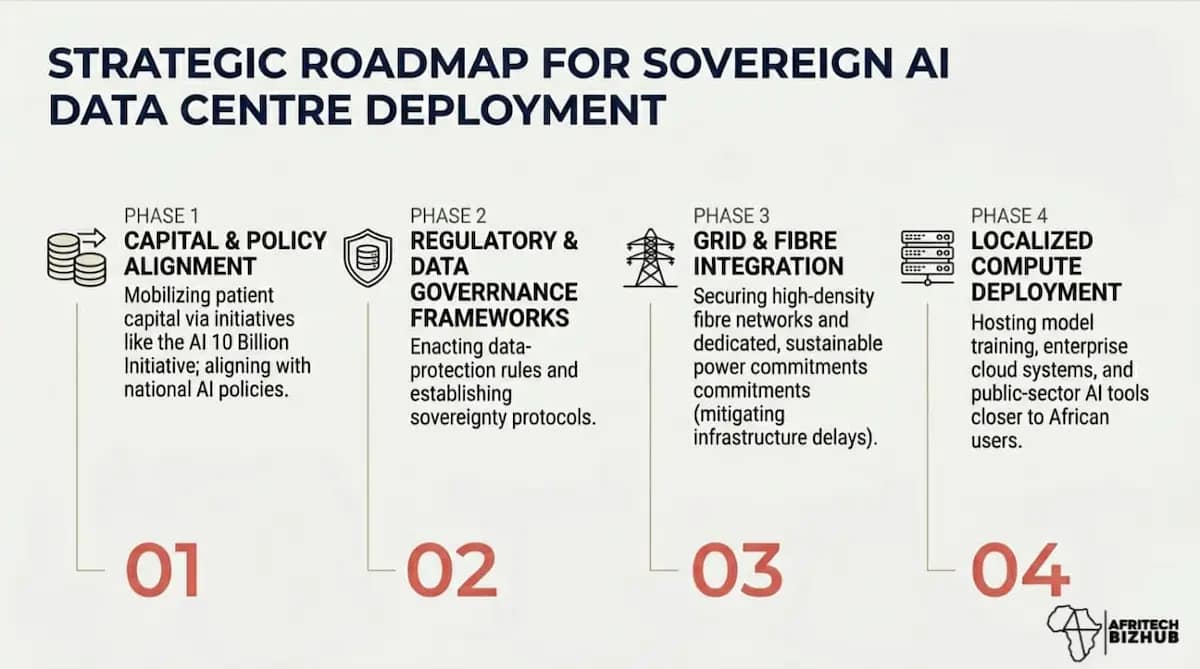
Power reliability, fibre density, regulation, and financing capacity remain major constraints facing African AI infrastructure expansion.
Several African markets still struggle with unstable electricity supply, high infrastructure costs, and weaker cloud connectivity systems that limit large-scale AI data center deployment.
The challenge is no longer only about technology demand. Infrastructure readiness itself is becoming one of the biggest structural tests facing African AI growth.
The United Nations Economic Commission for Africa warned in its 2026 discussion on Africa’s push for data sovereignty and digital independence that African governments must strengthen sovereign digital infrastructure if the continent hopes to reduce external dependence across strategic technology systems.
UNECA’s position reflects growing concern that African AI demand may continue expanding faster than the infrastructure required to support local processing, storage, and compute capacity across the continent.
The discussion is also widening pressure on governments and investors to treat AI data center expansion as part of Africa’s wider economic and digital security agenda.
Why Is AI Data Center Key to Africa’s Digital Independence?
Digital independence is increasingly being shaped by where African data is stored, processed, and governed.
Sovereign AI data centers could give governments and businesses stronger control over sensitive information while reducing exposure to offshore infrastructure risks and foreign processing systems.
The debate is also expanding beyond cybersecurity into broader questions around industrial competitiveness, regulatory control, and whether African AI systems can be built around local markets, languages, and economic priorities.
Power availability, infrastructure financing, and compute capacity are now becoming as strategically important to African economies as roads, ports, and energy systems.
Africa’s digital economy is moving deeper into an infrastructure-intensive phase where countries able to build sovereign AI data center systems may gain stronger control over innovation, enterprise technology, financial systems, and long-term digital growth.
African AI development is no longer only a technology conversation. It is increasingly becoming part of the continent’s wider struggle for economic control inside the next global digital cycle.


Recent Comments