

Featured Summary:
- Dangote oil refinery gained new export opportunities as the US-Iran conflict restricted fuel movements through the Strait of Hormuz.
- Atlantic access gave the refinery a commercial advantage over suppliers exposed to disrupted Middle Eastern shipping routes.
- Jet fuel export demand increased as Europe and other markets searched for replacement cargoes outside the Gulf.
- Wider international sales strengthened the case for additional refining capacity across Africa.
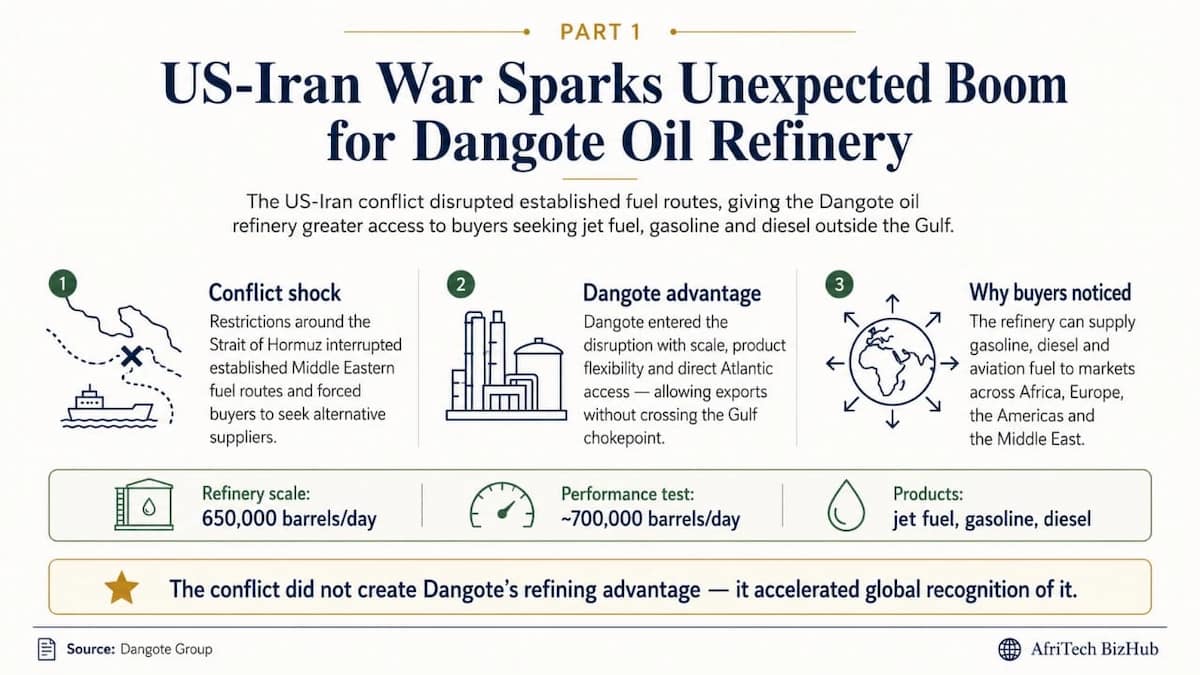
The US-Iran conflict has exposed a weakness in the global energy market: large volumes of crude oil and refined fuel still depend on one narrow shipping corridor.
Restrictions around the Strait of Hormuz interrupted Middle Eastern supplies and forced buyers to search for refiners with available products and access to safer trade routes.
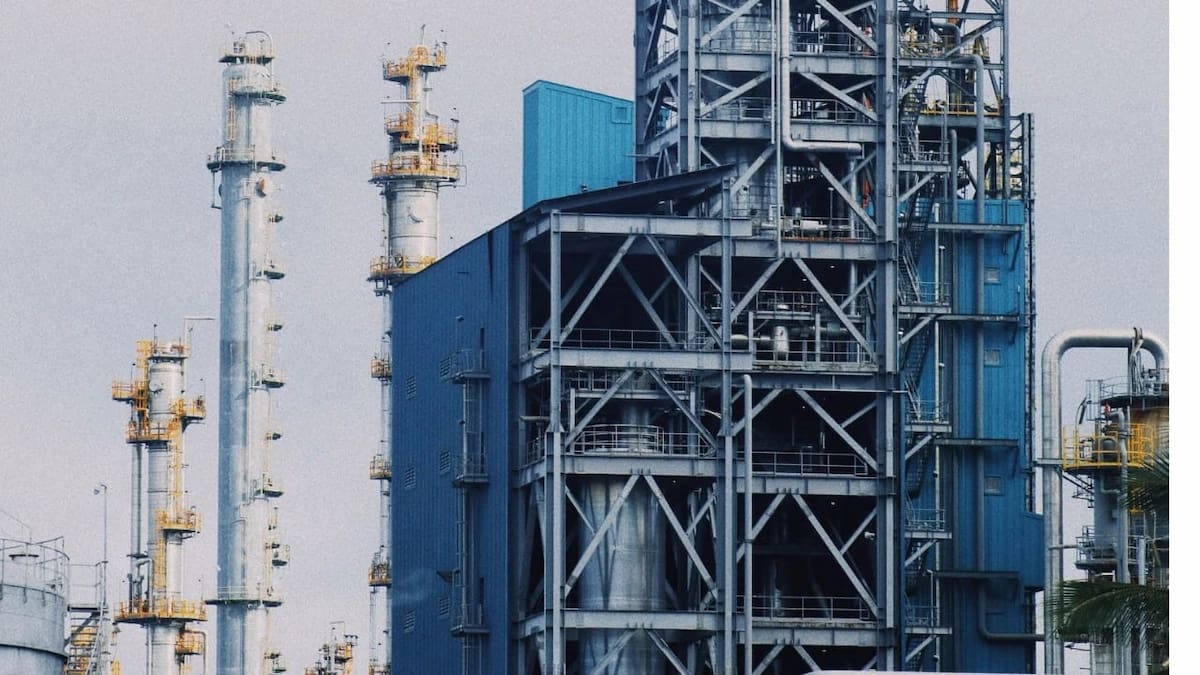
The Dangote oil refinery entered that disruption with scale, product flexibility and direct access to the Atlantic.
Its ability to supply gasoline, diesel and aviation fuel gave Nigeria a role previously dominated by Gulf and European refiners.
The conflict did not create Dangote’s refining advantage, but it accelerated international recognition of a facility capable of serving markets across Africa, Europe, the Americas and the Middle East.
How Did the US-Iran Conflict Boost Dangote Wealth?
The US-Iran conflict strengthened Dangote wealth through the rising commercial value of the refinery rather than through a confirmed increase in Aliko Dangote’s personal fortune.
Restricted Gulf exports tightened supplies of jet fuel, diesel and gasoline, allowing refiners outside the conflict corridor to command stronger demand and improved margins.
The Dangote oil refinery gained access to buyers seeking replacement cargoes as established Middle Eastern routes became less reliable.
Its location created an advantage that production capacity alone could not provide.
Fuel loaded in Lagos can reach Europe, the Americas and African markets without crossing the Strait of Hormuz.
While Gulf suppliers faced delayed shipments, higher insurance costs and uncertain delivery schedules, Dangote retained access to Atlantic trade routes.
The disruption therefore increased the earning potential and strategic value of a refinery positioned outside the conflict zone.
Why Is the Dangote Oil Refinery Winning Globally?
The Dangote oil refinery is competing globally because it combines industrial scale with access to several major markets.
The facility was designed to process about 650,000 barrels of crude oil per day and has completed performance tests above its original nameplate capacity.
That output allows it to meet part of Nigeria’s domestic fuel demand while directing substantial volumes toward international buyers.
Product flexibility strengthens its position.
The refinery can adjust production across gasoline, diesel, aviation fuel and other petroleum products according to changing market conditions.
Jet fuel can move toward Europe, gasoline can serve African importers, and other products can enter Atlantic trading networks.
This ability to redirect cargoes gives Dangote an advantage over facilities built mainly around one domestic market or a limited range of products.
How Is Global Oil Demand Driving Jet Fuel Export?
Dangote’s jet fuel export growth is not being driven by a uniform rise in global oil consumption.
The stronger force is a shortage of available refined products after the conflict restricted Gulf production and shipping.
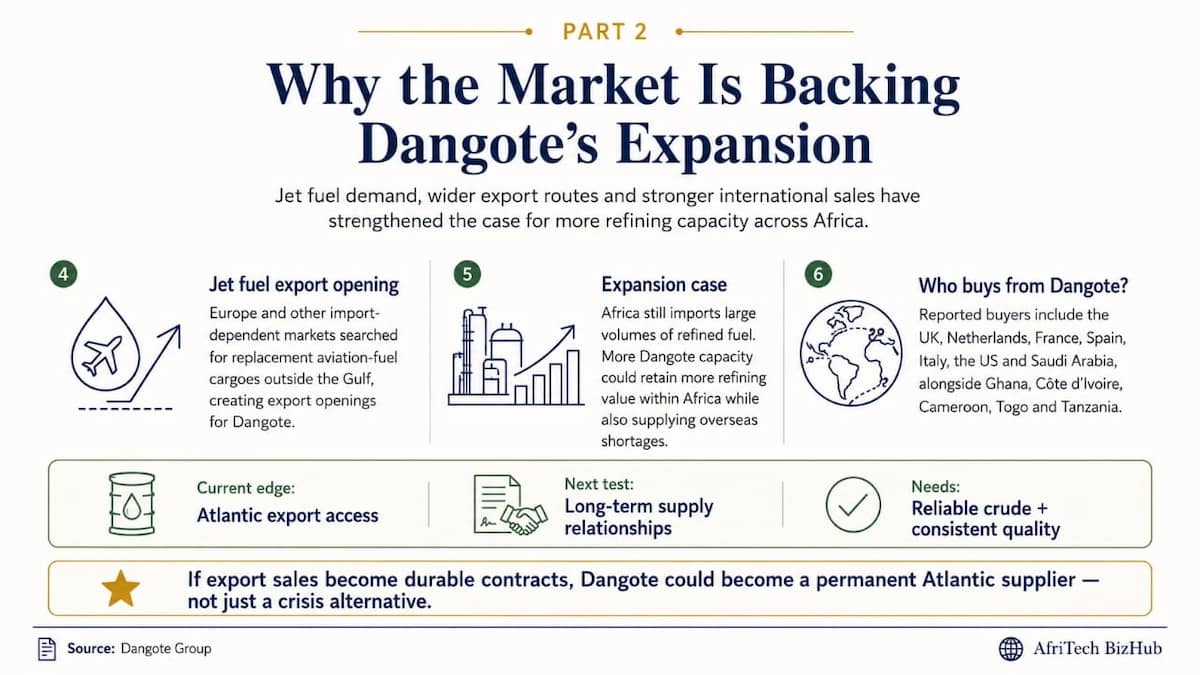
Airlines still required aviation fuel, but fewer cargoes were reaching Europe and other import-dependent markets, creating opportunities for refiners able to maintain output.
The Dangote oil refinery had surplus aviation fuel available as buyers searched for alternatives.
African demand remains below the facility’s potential jet-fuel production, leaving significant volumes for overseas sales without excluding domestic customers.
Europe’s greater reliance on Nigerian cargoes shows how quickly supply chains can shift when established exporters are disrupted.
Nigeria is no longer participating in jet fuel export trade only at the margins; it is supplying markets that now view Atlantic refiners as part of their energy-security strategy.
Why Is the Energy Market Backing Dangote’s Expansion Plans?
The energy market is backing Dangote’s expansion plans because the refinery has demonstrated production scale, access to international buyers and the ability to respond when global fuel supplies tighten.
The company confirmed that the facility completed performance tests at about 700,000 barrels per day, above its original capacity of 650,000 barrels per day.
Stronger exports and wider product reach have also shown that additional output would not have to depend entirely on Nigerian consumption.
The strategic case extends beyond the temporary gains created by the US-Iran conflict.
Africa remains heavily dependent on imported refined fuel despite producing substantial volumes of crude oil, leaving regional economies exposed to distant refineries, foreign exchange pressure and geopolitical disruption.
Greater Dangote capacity could retain more refining value within Africa while supplying overseas markets when international shortages emerge.
The next phase will be measured by whether the company converts current investor interest and strong refining margins into disciplined expansion, reliable crude supply and sustained production.
Which Countries Buy Fuel From Dangote Refinery?
Countries reported to have received products from the Dangote oil refinery include the United Kingdom, the Netherlands, France, Spain, Italy, the United States and Saudi Arabia, alongside buyers in Ghana, Côte d’Ivoire, Cameroon, Togo, Tanzania and other African markets.
Cargo destinations change according to prices, product shortages, shipping costs and contracts arranged by international traders.
The geographic spread of these sales is more important than any single shipment.
Dangote is building a customer base across four regions, giving the refinery room to move jet fuel toward Europe, gasoline toward African markets and other products across the Atlantic when commercial conditions change.
Saudi Aramco’s purchase of aviation fuel provided an especially strong signal because it showed that a Nigerian refinery could supply a major energy company based in one of the world’s largest oil-producing countries.
The next test is whether these transactions become durable supply relationships rather than temporary responses to geopolitical disruption.
Long-term contracts, reliable crude access and consistent product quality would establish the Dangote oil refinery as a permanent Atlantic supplier.
If that transition holds, Nigeria will move beyond replacing imported fuel at home and gain lasting influence over how refined products are traded across Africa and the wider global energy market.


Recent Comments