


Last updated: May 17, 2026
Featured Summary:
- Africa critical minerals 2026 now anchor a global EV and AI supply war as governments and manufacturers race to secure lithium, cobalt and rare-earth supply chains.
- The minerals race has shifted beyond extraction into battery production, mineral refining and long-term manufacturing control.
- Africa holds the minerals powering the next industrial era, but foreign economies still dominate the factories, logistics networks and strategic value surrounding them.
The global EV and AI boom is pulling Africa deeper into a strategic minerals struggle shaping industrial policy, energy security and geopolitical influence across major economies.
Governments from Washington to Beijing are accelerating efforts to secure lithium, cobalt, copper and rare-earth supply chains as industries move to lock down future production and reduce dependence on foreign-controlled processing networks.
Africa holds many of the minerals driving that transition. Yet much of the value still leaves the continent as foreign economies dominate the factories, battery systems and industrial infrastructure tied to them.
Why Are the U.S., China and Europe Racing to Secure Africa’s Critical Minerals?
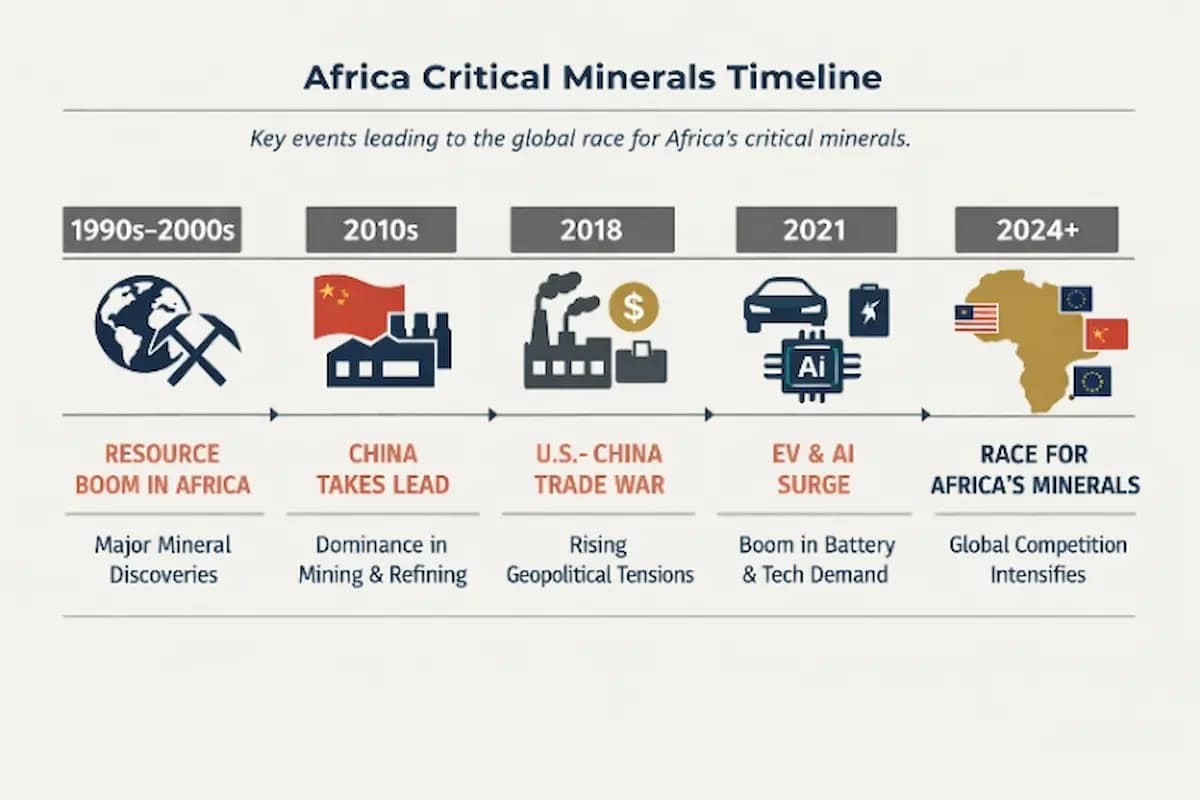
Africa critical minerals 2026 have become central to the global contest over EV manufacturing, AI infrastructure and industrial influence as the United States, China and Europe move aggressively to secure long-term access to lithium, cobalt, copper and rare-earth supply chains.
From Washington to Brussels and Beijing, governments are increasingly treating mineral access as industrial security as battery demand, AI expansion and clean-energy investment accelerate across major economies.
China entered Africa’s mineral sector years earlier and still holds major influence across cobalt, lithium and copper networks tied to the Democratic Republic of Congo, Zambia and Zimbabwe.
The United States and Europe are now moving faster to reduce that dependence through financing partnerships, mining agreements and strategic supply deals across the continent.
The struggle is no longer centered only on mineral access underground. It now extends across battery production, industrial capacity and control over the systems surrounding those resources.
How China Built Dominance Over Africa’s EV Battery and Mineral Processing Chains
China secured its position inside Africa’s critical minerals sector years before the United States and Europe accelerated their supply-chain response.
Chinese firms now hold major stakes across cobalt, copper and lithium systems tied to the Democratic Republic of Congo, Zambia and Zimbabwe, while Beijing continues expanding influence across mineral refining, battery processing and logistics tied to the global EV economy.
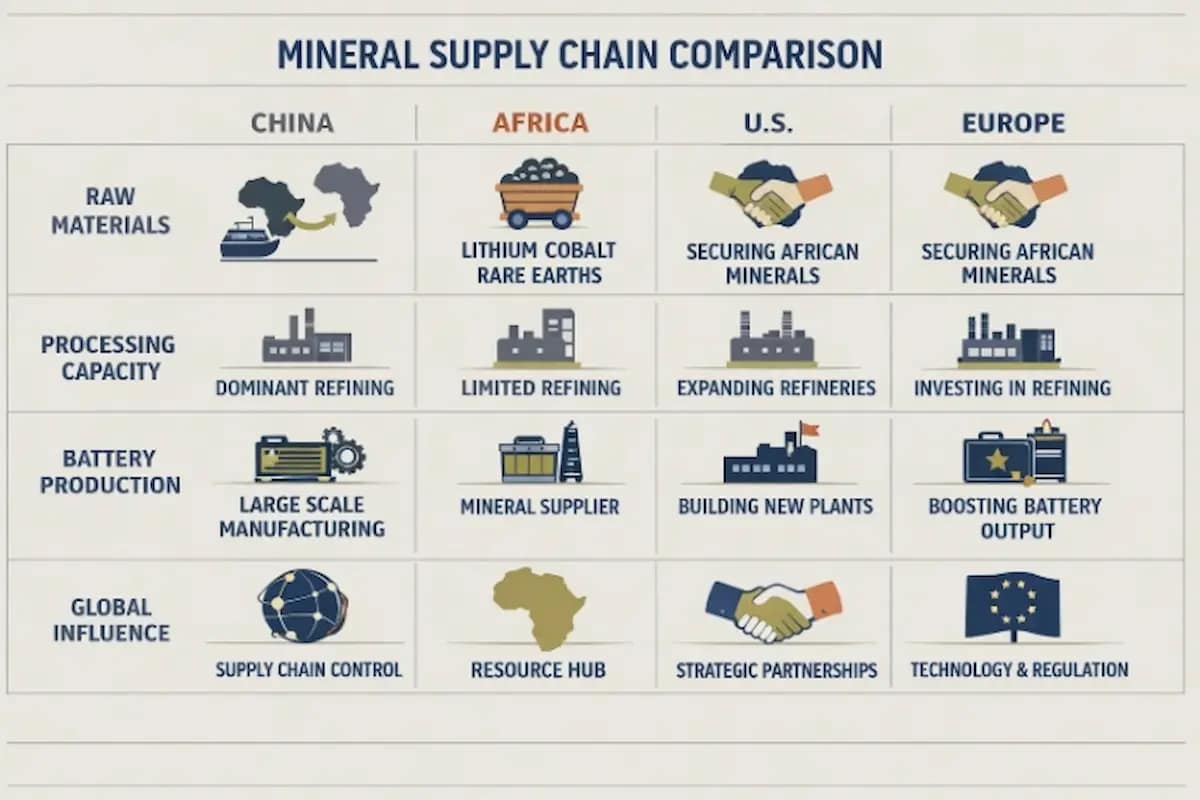
The International Energy Agency says China still dominates large sections of global refining for cobalt, graphite and rare-earth minerals critical to EV batteries and advanced technologies.
That early lead now shapes a broader industrial divide as Washington and Brussels move more aggressively to reduce dependence on Chinese-controlled battery and mineral-processing networks.
Africa critical minerals 2026 are no longer simply feeding commodity markets.
They are increasingly shaping manufacturing influence, technology security and the balance of industrial power surrounding the EV economy.
The advantage no longer sits only in mineral ownership. It sits in control over the systems built around those resources.
Why Africa Still Risks Losing the EV and AI Boom Despite Its Mineral Wealth
Africa critical minerals 2026 are attracting deeper global competition across lithium, cobalt, graphite, copper and rare-earth supply chains, yet much of the industrial activity tied to those minerals still sits outside the continent.
The Democratic Republic of Congo dominates global cobalt production, Guinea remains central to bauxite supply, while Zimbabwe and Mozambique continue attracting new lithium and graphite investment linked to EV batteries and AI infrastructure expansion.
But battery manufacturing and high-value mineral processing remain concentrated across China and other foreign markets.
The African Minerals Development Centre has increasingly pushed African governments toward mineral beneficiation, local refining and stronger industrial participation as competition over strategic resources intensifies.
Africa’s global mineral position is strengthening. Its manufacturing position is not.
The continent still risks supplying the foundation of the next technology economy while foreign industrial systems retain most of the strategic advantage.
Can Africa Critical Minerals Drive Industrial Growth Instead of Another Resource Boom?
Africa critical minerals 2026 are pushing governments across the continent toward stricter beneficiation policies, export restrictions and domestic processing demands as competition over EV and AI supply chains intensifies.
Zimbabwe has already moved against raw lithium exports, while mineral-producing economies across Southern and Central Africa are increasing pressure for more local battery-material production and manufacturing participation tied to strategic mineral investment.
Africa’s resource position is strengthening. Its influence over industrial output remains far weaker.
The minerals race is now moving beyond extraction into supply-chain ownership, factory capacity and industrial scale.
Africa holds many of the minerals powering the next industrial economy, but possession alone will not shift economic power toward the continent.
Countries controlling battery networks, processing infrastructure and manufacturing systems will shape the next phase of global industrial dominance.
Africa still has time to position itself differently. That window is narrowing quickly.


Recent Comments