


Featured Summary:
- AI banking is moving beyond customer-facing services into core banking operations and decision-making processes.
- Banking jobs built around repetitive information handling face growing pressure as automation expands.
- African banks are increasingly pursuing productivity gains through technology rather than workforce expansion.
- The biggest workforce impact may emerge in middle-income banking careers positioned between frontline service and senior management.
African banks spent years digitising customers.
Mobile banking expanded.
Digital payments accelerated.
Branch visits declined.
Much of that transformation focused on how people interacted with banks.
The next phase is moving inside the institution itself.
Artificial intelligence is increasingly being deployed across compliance monitoring, fraud detection, customer support, risk assessment, document processing, and internal operations.
The technology arrives with familiar promises: lower costs, faster decisions, greater efficiency, and improved customer experience.
What receives less attention is what happens to the workforce when information itself becomes easier to process, verify, analyse, and manage.
The debate around AI banking is no longer only about technology adoption.
It is increasingly becoming a discussion about the future structure of work inside African banks.
How is AI Banking Reshaping Employment Models in Africa?
The traditional banking workforce was built around movement of information.
Documents moved between departments.
Transactions moved through verification processes.
Customer requests moved through operational teams.
Entire functions existed to manage, review, and process information at scale.
That structure is beginning to change.
Across the banking sector, artificial intelligence is being introduced into areas that once depended heavily on human review.
Compliance systems can flag unusual activity.
Fraud-monitoring tools can identify suspicious patterns.
Customer-service platforms can resolve routine enquiries.
Internal systems can generate reports that previously required significant manual input.
The shift remains uneven across African banks, but the direction is becoming clearer.
The focus increasingly appears to be productivity.
Banks are looking for ways to process more activity without expanding operational complexity at the same pace.
The result is a gradual redesign of work itself.
Some tasks are disappearing into software.
Others are moving closer to oversight, judgment, and decision-making.
Are Banking Jobs Disappearing due to Automation?
The pressure is not appearing equally across the workforce.
Roles centred on repetitive administration, routine processing, standard customer interactions, and structured verification functions face a different reality from roles built around judgment, relationships, strategy, and specialist expertise.
That distinction matters because automation rarely arrives by eliminating entire professions overnight.
It tends to target tasks before it targets job titles.
A role may survive while a growing share of its responsibilities shifts elsewhere.
This helps explain why discussions around AI layoffs often become confusing.
The disappearance of work and the disappearance of jobs are not always the same thing.
The first often arrives earlier than the second.
For many employees, the immediate challenge is not replacement.
It is adaptation.
The value of certain skills is changing faster than the titles attached to them.
How are African Banks Cutting Workforce Roles?
Large workforce reductions rarely begin with a single announcement.
The process often starts elsewhere.
Branch networks become smaller.
Customers migrate toward digital channels.
Self-service platforms handle routine requests.
Automated systems process activities that once required manual intervention.
African banks have already been moving in that direction for years as mobile banking, digital payments, and online services gained adoption across markets such as Nigeria, Kenya, South Africa, and Egypt.
AI banking is accelerating an existing trend rather than creating an entirely new one.
The effect becomes visible through slower hiring, operational consolidation, workforce rationalisation, and reduced dependence on certain functions.
Banks can increase service capacity without increasing staffing levels at the same rate.
The reduction is often gradual enough to escape attention.
The cumulative effect is harder to ignore.
Does Job Automation Threaten Middle-income Bank Careers?
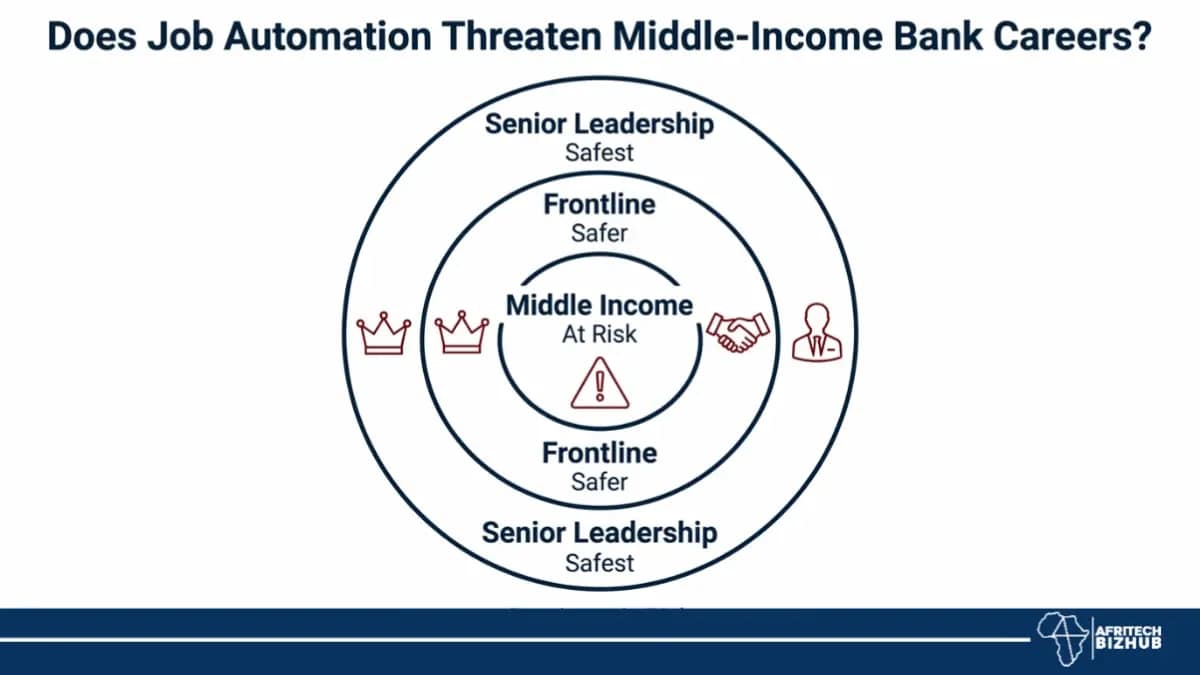
The greatest pressure may not sit at the top of the organisation or the bottom.
It increasingly appears in the middle.
Many middle-income banking careers were built around reviewing information, managing workflows, producing reports, verifying records, processing documentation, and supporting operational decisions.
Those responsibilities sit close to the activities artificial intelligence performs most efficiently.
According to the World Economic Forum, technological change continues to reshape workforce requirements globally, increasing demand for analytical, digital, and technology-related skills while reducing demand for some routine tasks.
The implication is difficult to ignore.
The jobs most exposed to job automation are often the jobs that helped build the modern banking workforce.
Experience remains valuable.
Expertise remains valuable.
But routine information processing is becoming less scarce.
The safest roles increasingly appear to be those that artificial intelligence struggles to replicate: judgment, trust, negotiation, leadership, and complex decision-making.
Is Fintech AI Driving Massive Banking Layoffs?
The headline suggests a simple answer.
The reality is more complicated.
Evidence of continent-wide AI layoffs across African banks remains limited.
What is visible, however, is a steady shift in how banks think about productivity, workforce planning, and operational efficiency.
Fintech AI is changing expectations.
Customers expect faster service.
Institutions face pressure to reduce costs.
Digital competitors operate with leaner structures.
Banks increasingly find themselves pursuing the same objective: doing more with fewer layers of operational friction.
That pressure inevitably reaches the workforce.
The most important shift may not be the number of jobs disappearing today.
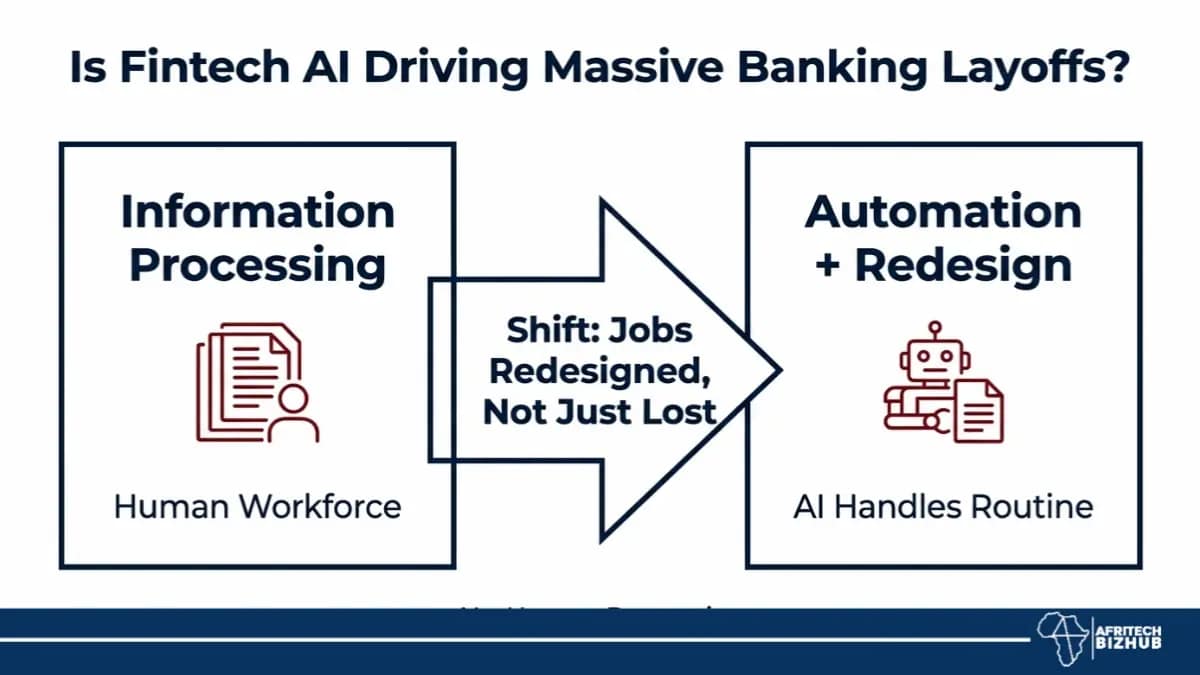
It may be the number of jobs being redesigned before anyone notices.
Banking built much of its workforce around the movement and processing of information.
Artificial intelligence increasingly performs those functions faster, cheaper, and at greater scale.
The question facing African banks is no longer whether AI banking will change employment.
That process is already underway.
The more difficult question is what the banking workforce looks like once information processing is no longer a uniquely human advantage.


Recent Comments