


Featured Summary:
- SpaceX has secured multibillion-dollar government contracts, prompting investors to reassess its long-term growth prospects.
- Government agreements are playing an increasingly significant role in the valuation of space-sector companies.
- U.S. Space Force funding is reinforcing SpaceX’s position within critical national infrastructure.
- Expanding international space cooperation may enhance U.S. influence across emerging space economies, including those in Africa.
SpaceX IPO interest no longer depends on rocket-launch hype alone.
Investors now price the company as strategic infrastructure: part launch provider, part satellite operator, part communications backbone, and part national-security contractor.
Recent U.S. Space Force awards worth billions of dollars have strengthened that view.
SpaceX now sits deeper inside long-term government demand across defense, communications, and space-based systems.
That makes any future IPO less a speculative technology listing and more a test of how public markets value private infrastructure built around state demand.
How Will SpaceX IPO Reshape Markets?
A SpaceX IPO would introduce one of the world’s most strategically positioned private companies to the public markets.
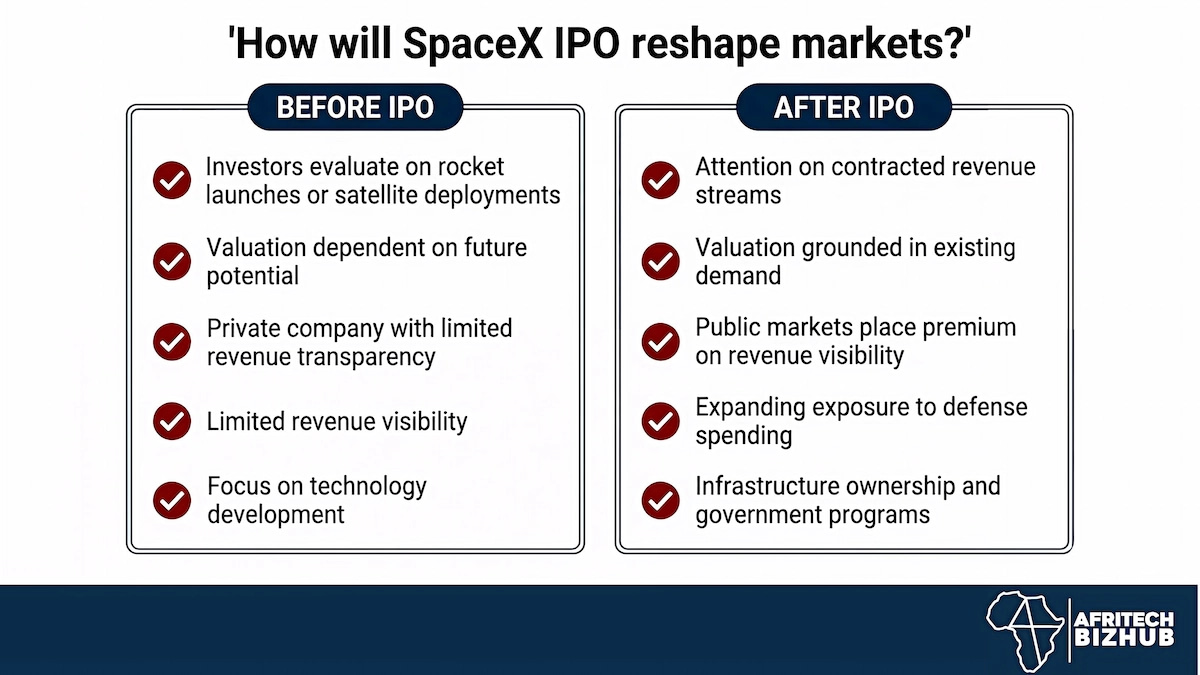
Investors are no longer evaluating SpaceX solely on the basis of rocket launches or satellite deployments.
Increasingly, attention is focused on contracted revenue streams, infrastructure ownership, and the company’s role within critical government programs.
This distinction is significant because public markets generally place a premium on businesses with greater revenue visibility.
SpaceX enters any future IPO discussion with expanding exposure to defense spending, communications infrastructure, and national security initiatives.
Consequently, its valuation narrative is becoming less dependent on future potential and more grounded in existing demand already supported by government commitments.
What Do SpaceX Contracts Mean for Growth?
Recent SpaceX contracts provide a key attribute highly valued by investors: predictability. Large-scale government agreements offer visibility into future revenue, support long-term strategic planning, and reduce the volatility often associated with emerging technology sectors.
Growth increasingly favors institutions capable of deploying capital over extended periods.
SpaceX contracts connected to defense infrastructure, satellite services, and national security programs enable the company to expand capacity, strengthen operational capabilities, and pursue technological innovation with a degree of financial stability that few private enterprises can achieve.
While the contracts themselves are substantial, the confidence they generate may prove even more valuable.
Investors are increasingly valuing SpaceX less as a technology company and more as a strategic government infrastructure provider.
That distinction could have significant implications for how public markets eventually price the business.
Why Are Government Contracts Boosting Valuation?
Valuation multiples increasingly reflect the durability of demand rather than technological promise alone.
Government contracts reduce uncertainty regarding future revenue, allowing investors to assess growth potential, cash generation, and long-term market positioning with greater confidence.
Markets typically assign higher valuations to businesses with visible long-term cash flows.
Government-backed demand strengthens that visibility in ways that many commercial contracts cannot.
This trend is becoming evident across the broader space sector.
Companies operating in areas aligned with defense priorities, communications infrastructure, and strategic national programs are attracting heightened investor interest because demand is supported by government budgets rather than consumer spending patterns.
Markets are responding to a straightforward reality: infrastructure backed by national security expenditures tends to receive sustained funding beyond the duration of many commercial technology cycles.
How Is U.S. Space Force Funding SpaceX?
The U.S. Space Force recently awarded SpaceX significant contracts related to military satellite launches, national security missions, and strategic space capabilities.
These agreements further strengthen the company’s role as a key provider of infrastructure supporting communications, missile tracking, surveillance, and defense operations.
The importance of these awards extends beyond their monetary value.
Space-related investment is increasingly regarded alongside energy, telecommunications, and defense as a fundamental national capability.
This perspective helps explain why investors view U.S. Space Force funding as more than government support.
It represents sustained demand from one of the world’s largest and most reliable institutional customers.
What Drives U.S. and Africa Space Cooperation?
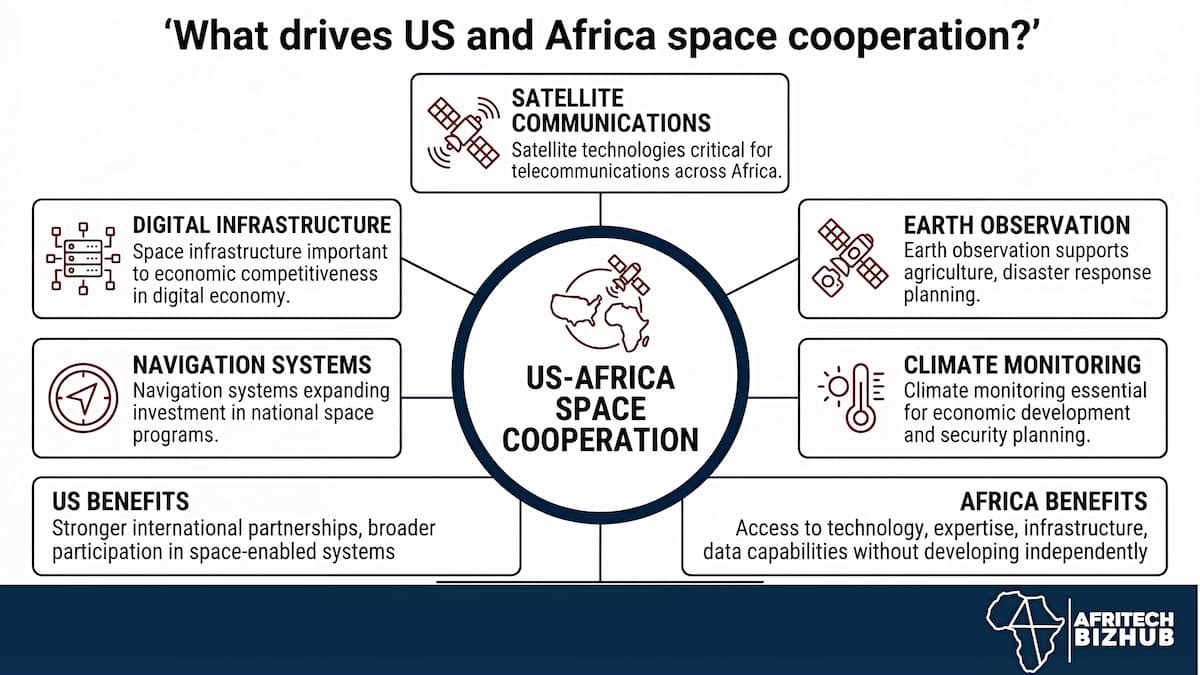
As government-backed space infrastructure expands, its influence increasingly extends beyond U.S. borders. U.S.–Africa space cooperation is increasingly focused on satellite communications, Earth observation, climate monitoring, navigation systems, and digital infrastructure.
Governments across Africa are expanding investment in national space programs because satellite technologies now play a critical role in agriculture, disaster response, telecommunications, security planning, and economic development.
This creates a growing area of strategic alignment.
The United States benefits from stronger international partnerships and broader participation in space-enabled systems, while African nations gain access to technology, expertise, infrastructure, and data capabilities that would otherwise require significant time and resources to develop independently.
The implications extend beyond cooperation alone.
Space infrastructure is becoming a strategic layer of economic competitiveness, influencing communications, navigation, agriculture, security, and digital services.
Countries integrated into advanced space ecosystems will gain advantages that extend well beyond the space sector itself.
In the emerging space economy, access to infrastructure may become as important as access to capital.


Recent Comments