


Featured Summary:
- AI Coding is automating more software tasks, but Cognition AI says engineers remain essential to the development process.
- Coding agents are increasing productivity while raising new questions about the future of software engineering jobs.
- Devin AI can execute complex software tasks, but it still operates within human-defined objectives and constraints.
- Software engineers may write less code in the future, but their role in design, judgment, and decision-making remains critical.
The technology industry is investing heavily in software automation.
From code generation tools to autonomous development systems, the race to accelerate software creation has become one of artificial intelligence’s most competitive battlegrounds.
Yet one of the companies building advanced coding agents is pushing back against a common assumption.
Cognition AI, the company behind Devin AI, argues that software engineers are not disappearing.
The position is notable because it comes from a company developing technology specifically designed to automate portions of software development.
The debate is no longer whether AI Coding can write code.
The debate is whether software engineering is larger than coding itself.
Can AI Coding Replace Human Programmers Fully?
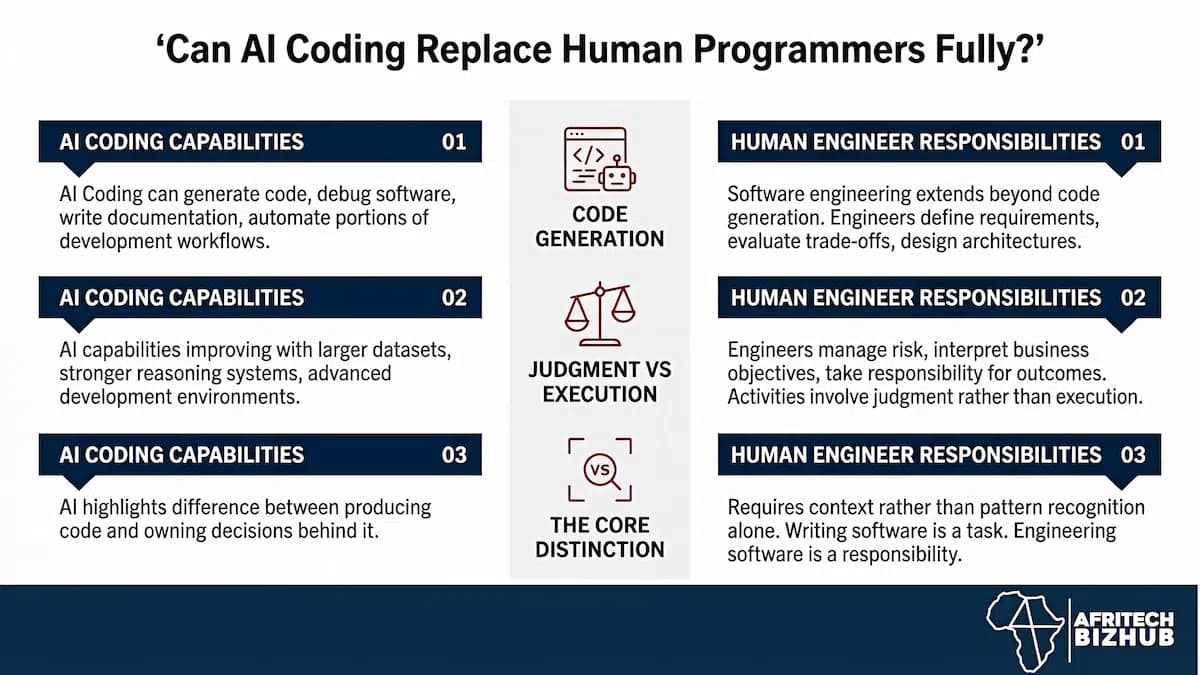
AI Coding can generate code, debug software, write documentation, and automate portions of development workflows.
Those capabilities continue improving as models gain access to larger datasets, stronger reasoning systems, and more advanced development environments.
Software engineering, however, extends beyond code generation.
Engineers define requirements, evaluate trade-offs, design architectures, manage risk, interpret business objectives, and take responsibility for outcomes.
These activities involve judgment rather than execution.
They require context rather than pattern recognition alone.
That distinction sits at the centre of the replacement debate.
The more AI Coding improves, the more it highlights the difference between producing code and owning the decisions behind it.
Writing software is a task.
Engineering software is a responsibility.
Are Coding Agents Replacing Human Engineers Jobs?
Coding agents are already changing how software teams operate.
Tasks that once required hours of manual work can increasingly be completed in minutes.
Code reviews, bug fixes, testing workflows, documentation generation, and repetitive development activities are becoming more automated.
That inevitably changes productivity expectations across technology companies.
The pressure is particularly visible at the entry level.
Many tasks historically assigned to junior developers are becoming easier to automate.
That has raised concerns that coding agents could reduce hiring demand for certain software roles while increasing expectations for existing teams.
The evidence so far points toward job transformation rather than wholesale replacement.
Technology companies continue hiring engineers because software projects still require oversight, coordination, product understanding, and decision-making.
Coding agents are reducing friction inside development workflows.
They are not yet removing the need for the people directing those workflows.
Does Devin AI Own Software Tasks End-to-End?
Devin AI represents one of the most ambitious attempts to automate software work.
Unlike traditional code-generation tools, Devin AI was designed to execute broader development tasks.
The system can write code, navigate development environments, run tests, identify errors, and complete assignments with limited intervention.
The objective is not simply to generate snippets of code. It is to perform software tasks more autonomously.
That capability has driven significant attention toward Cognition AI.
Yet the technology still operates within boundaries established by humans.
Developers define objectives, evaluate outputs, approve deployment decisions, and remain accountable for the final product.
Even highly capable coding agents continue relying on human direction when projects become ambiguous, strategic, or commercially sensitive.
Devin AI is expanding the scope of automation.
It is not independently owning the entire software development lifecycle.
Is Cognition AI Building Self-Driving Development?
The broader ambition behind companies such as Cognition AI is increasingly described as self-driving software development: systems capable of handling larger portions of the engineering workflow with minimal human intervention.
Research trends suggest that automation capabilities will continue advancing.
The Stanford AI Index 2025 highlights significant improvements in AI performance across coding, reasoning, and technical benchmarks, reinforcing expectations that AI systems will assume a larger role in software production over time.
That trajectory helps explain investor interest in coding agents.
The question is not whether automation will expand.
The question is how much of the development process can be automated before human oversight becomes indispensable.
Cognition AI is building toward greater autonomy, but even the company acknowledges that software engineering involves objectives, constraints, priorities, and judgments that remain difficult to automate fully.
The race toward self-driving development is real.
The destination remains contested.


Recent Comments