

Featured Summary:
- Food security remains a major challenge despite years of investment across African agriculture.
- Agricultural learning programmes are strengthening technical knowledge and institutional capacity within Gambia’s agriculture.
- The Gambia is positioning itself as a potential centre for agricultural training and knowledge-sharing.
- Indonesia Africa cooperation is drawing attention to how agricultural progress is achieved, not simply how it is funded.
Agricultural development is often associated with financing, machinery, irrigation projects, and large-scale infrastructure investments.
Across Africa, billions of dollars have been directed toward improving agricultural output through exactly those channels.
Yet productivity gaps continue to persist in many farming systems despite years of investment.
The contradiction is difficult to ignore. Resources have expanded, but results have not always advanced at the same pace.
That reality helps explain the growing significance of Indonesia’s engagement with The Gambia.
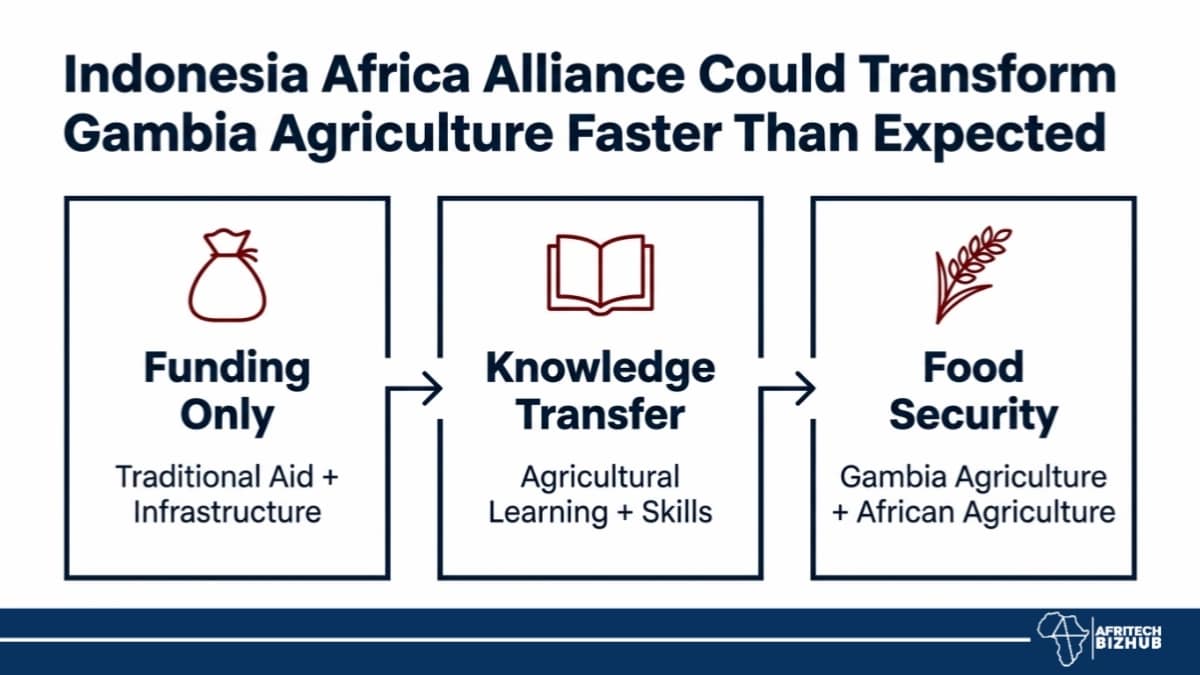
While many agricultural partnerships begin with funding, this one places Agricultural learning, institutional development, and practical training much closer to the centre of the conversation.
As food security becomes a more urgent priority across the continent, attention is increasingly shifting toward what happens after investment arrives.
How Will Food Security Improve Through Indonesia-Gambia Cooperation?
Food security challenges rarely stem from a single problem.
Countries may possess agricultural land, favorable growing conditions, and access to markets while still struggling to produce enough food consistently and efficiently.
In many cases, the constraint is not production potential itself but the systems supporting production.
Productivity, farm management, post-harvest handling, and institutional effectiveness often determine whether agricultural potential translates into reliable food supplies.
The Indonesia-Gambia partnership focuses on strengthening some of those foundations.
Rather than concentrating exclusively on physical assets, the cooperation emphasizes Agricultural learning and practical exposure to production methods that have delivered results elsewhere.
The objective is not simply to increase output during a single season.
It is to strengthen the capabilities that influence food security over the long term.
That distinction is becoming increasingly important as governments search for solutions that remain effective long after projects conclude.
Why is Agricultural Learning Expanding Faster in The Gambia?
A growing number of policymakers are reaching a similar conclusion: technology alone does not transform agriculture.
Improved seeds, mechanization, irrigation systems, and agricultural inputs can improve performance, but their impact is often limited when farmers and institutions lack the capacity to apply them effectively.
This is one reason Agricultural learning is receiving greater attention.
Governments are beginning to treat capability as part of agricultural infrastructure rather than as a supporting activity that follows investment.
The Gambia’s participation in training-focused partnerships reflects this shift.
Exposure to different production systems, farm-management approaches, and institutional practices creates opportunities to strengthen local agricultural capacity from within.
The emphasis is gradually moving from what is being introduced into agriculture to how effectively it can be used, maintained, and scaled over time.
Can Gambia Agriculture Become West Africa’s Training Powerhouse?
Agricultural influence is not always measured by the size of a country’s harvest.
Some countries become important because they serve as centres of research, training, technical support, and institutional development.
Their contribution comes from helping strengthen agricultural systems beyond their own borders. Expertise often travels further than commodities.
The Gambia’s growing focus on Agricultural learning creates an opportunity to strengthen this type of influence.
As partnerships expand and institutional capacity improves, local organisations could play a larger role in supporting agricultural development across the region.
The ambition remains long term, but it reflects a broader understanding that sustainable agricultural progress depends as much on capability-building as it does on production growth.
How Is African Agriculture Benefiting From Indonesia’s Expertise?
Agricultural influence is not always measured by the size of a country’s harvest.
Some countries become important because they serve as centres of research, training, technical support, and institutional development.
Their contribution comes from helping strengthen agricultural systems beyond their own borders. Expertise often travels further than commodities.
The Gambia’s growing focus on Agricultural learning creates an opportunity to strengthen this type of influence.
As partnerships expand and institutional capacity improves, local organisations could play a larger role in supporting agricultural development across the region.
The ambition remains long term, but it reflects a broader understanding that sustainable agricultural progress depends as much on capability-building as it does on production growth.
How is African Agriculture Benefiting From Indonesia’s Expertise?
Indonesia’s agricultural experience is attracting attention because it reflects challenges familiar to many developing economies.
The country has spent decades improving productivity, strengthening food systems, supporting smallholder farmers, and building institutions capable of sustaining growth across the agricultural sector.
Those experiences provide practical examples of how agricultural systems evolve over time.
For African agriculture, the value lies in shortening the learning curve. Countries do not need to replicate Indonesia’s model to benefit from it.
They can identify approaches that fit local realities while avoiding challenges that others have already addressed.
This allows agricultural institutions to build on existing experience rather than beginning from scratch.
The African Development Bank has consistently identified productivity, institutional capacity, resilience, and food security as critical foundations for long-term agricultural transformation.
Those priorities align closely with partnerships that focus on strengthening the systems supporting agricultural performance rather than concentrating exclusively on financing and infrastructure.
Why is Indonesia Africa Cooperation Reshaping Regional Food Systems?
The significance of Indonesia Africa cooperation extends beyond the individual programmes currently being implemented.
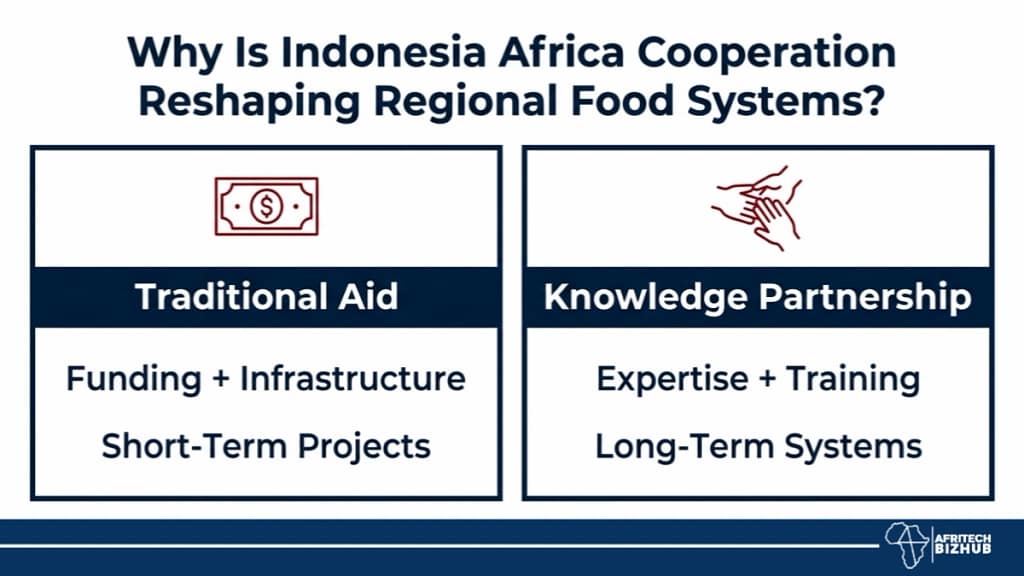
It reflects a broader shift in how agricultural development partnerships are being designed.
For decades, discussions often centred on how much money was being invested into agriculture.
Increasingly, attention is moving toward whether agricultural systems possess the capability required to convert investment into sustained results.
This shift is influencing how governments approach food security, productivity, and agricultural resilience.
Stronger institutions, better farm-management practices, and more effective training systems can influence outcomes long after external support ends.
That is why partnerships built around Agricultural learning are attracting greater attention across African agriculture.
The broader lesson is not that investment matters less. It is that investment performs differently when the systems behind it are stronger.


Recent Comments