

Featured Summary:
- Fuel VAT concerns have returned to public debate as IMF Nigeria discussions focus on strengthening revenue collection.
- Nigeria revenue remains one of the weakest among major economies relative to the size of the country’s economy.
- IMF Article IV recommendations place Tax reforms and fiscal sustainability back at the centre of economic policy discussions.
- Nigeria fiscal policy faces a difficult balance between raising revenue and protecting households from additional cost pressures.
The IMF has put Nigeria’s revenue problem back at the centre of the economic debate.
Its latest Article IV assessment argues that government revenue remains too weak to support the country’s fiscal needs despite recent reforms.
That conclusion has reopened an old political fault line. Every discussion about revenue eventually raises questions about taxes.
Every discussion about taxes eventually raises questions about living costs.
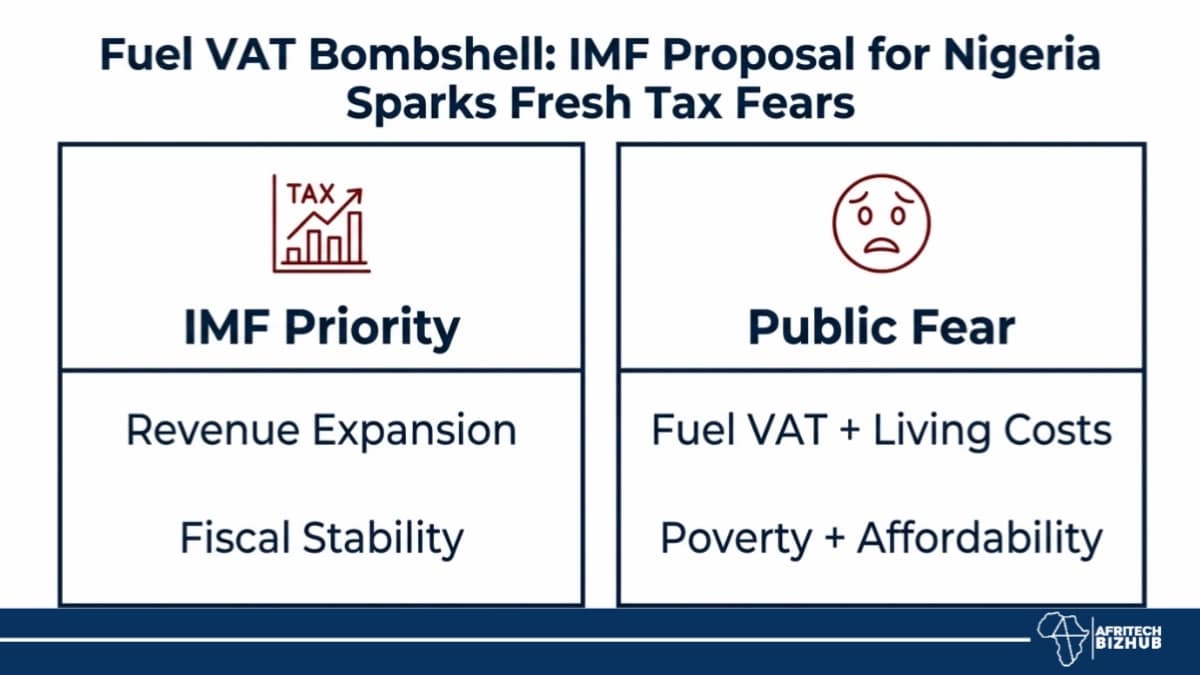
The IMF is talking about revenue collection.
Many Nigerians are hearing something else: the possibility of paying more at a time when affordability remains under pressure.
Why Are Fuel VAT Fears Returning to Nigeria’s Economic Debate?
Fuel VAT remains one of the most politically sensitive ideas in Nigeria because fuel costs influence almost every part of the economy.
Transport, food distribution, manufacturing, logistics, and household spending are all affected when fuel-related costs rise.
That reality explains why any discussion linked to taxation quickly generates public concern.
The current debate is being driven by perception as much as policy.
The IMF has not proposed a direct Fuel VAT increase in its latest assessment.
However, repeated calls for stronger revenue collection, improved tax administration, and broader fiscal reforms have revived concerns that future revenue measures could eventually affect consumption-related taxes.
For many households, the distinction matters little.
Revenue discussions are increasingly being interpreted through the lens of affordability.
Why is Nigeria Revenue Expansion a Top IMF Priority?
Nigeria revenue remains one of the country’s biggest economic vulnerabilities.
Despite its economic size and population, Nigeria continues to generate relatively low levels of public revenue compared with many peer economies.
This limits the government’s ability to finance infrastructure, healthcare, education, security, and social programmes without increasing borrowing.
The IMF’s position is straightforward. Stronger revenue collection creates greater fiscal flexibility.
Governments with stronger revenue systems can respond more effectively to economic shocks, invest in development priorities, and manage public finances with less dependence on debt.
This is why IMF Nigeria discussions consistently return to revenue mobilisation.
The institution views it as one of the central challenges facing the economy.
How Will Tax Reforms Affect Nigerian Consumers and Businesses?
Tax reforms are rarely judged by technical design alone. They are judged by how people experience them.
Businesses are concerned about compliance costs, operating expenses, and the broader investment environment.
Households are focused on purchasing power and the rising cost of living.
That creates a difficult environment for policymakers attempting to strengthen public finances while maintaining economic activity.
The tension is becoming more visible. The government needs higher revenue. Consumers and businesses are wary of additional costs.
That is why Tax reforms remain politically sensitive even when they are focused on efficiency, compliance, and reducing leakages rather than introducing entirely new taxes.
The success of reform may depend as much on public confidence as on policy design.
What Does IMF Article IV Reveal About New Taxes?
The IMF Article IV consultation reinforces a message that has appeared repeatedly in discussions around Nigeria fiscal policy.
Revenue remains too low relative to the country’s spending needs and development ambitions.
The report emphasises stronger tax administration, improved compliance, broader revenue mobilisation, and better fiscal management.
It does not recommend a direct Fuel VAT increase.
What it does indicate is that revenue reform will remain a central policy priority as authorities search for ways to strengthen public finances.
The significance of the IMF Article IV therefore, lies less in a specific tax proposal and more in the direction of policy travel.
Revenue collection, tax administration, and fiscal sustainability are likely to remain at the centre of economic decision-making for the foreseeable future.
Can IMF and Nigeria Balance Fiscal Policy With Poverty?
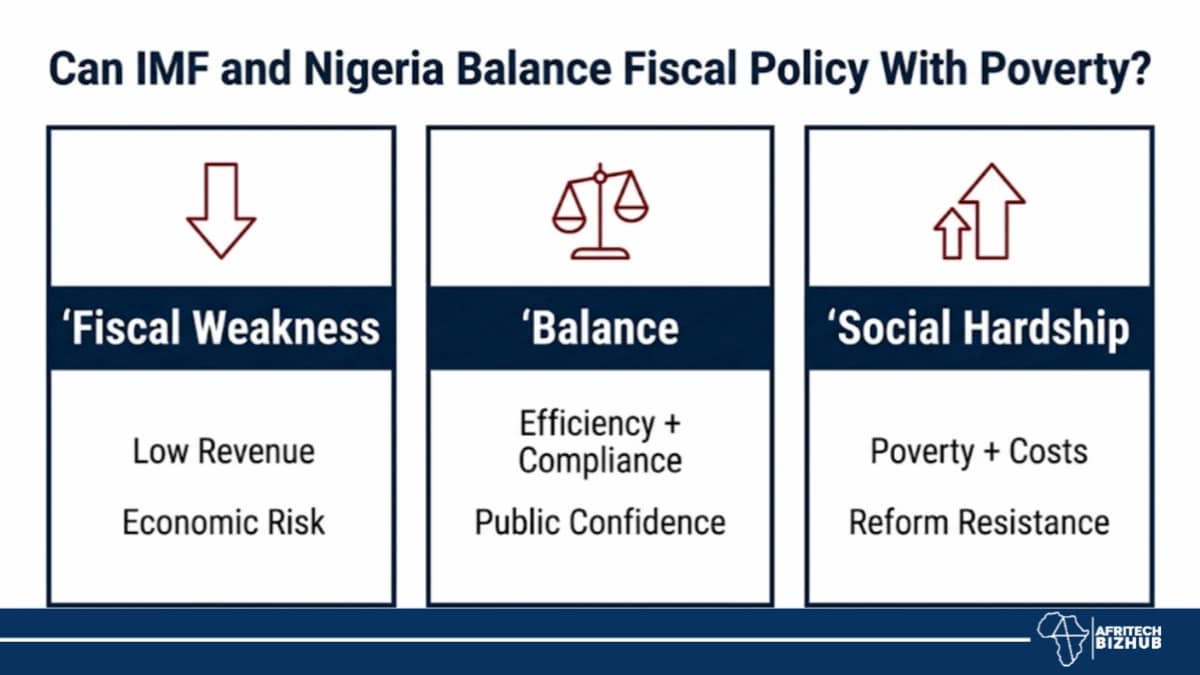
This is where the debate ultimately converges. Nigeria needs stronger public revenue.
The country also faces significant affordability pressures. Both realities exist at the same time.
Ignoring fiscal weaknesses creates risks for long-term economic stability.
Ignoring cost-of-living pressures creates risks for social and political stability.
That is why the debate surrounding Fuel VAT has become larger than fuel itself. The real question is not whether a specific tax is introduced.
It is how Nigeria fiscal policy generates more revenue without placing additional strain on households already adjusting to higher costs.
The IMF is focused on revenue. The public is focused on affordability.
The government must find a way to satisfy both.
That may become one of the defining economic challenges of the next phase of reform.


Recent Comments