

Featured Summary:
- Trade Policy across Africa is increasingly being shaped by continental integration rather than external preference programmes.
- AfCFTA is shifting Africa trade from fragmented national markets toward a more integrated continental economy.
- Critical minerals are reshaping how the United States views Africa’s strategic economic importance.
- Economic integration is strengthening Africa’s bargaining power in global trade and investment discussions.
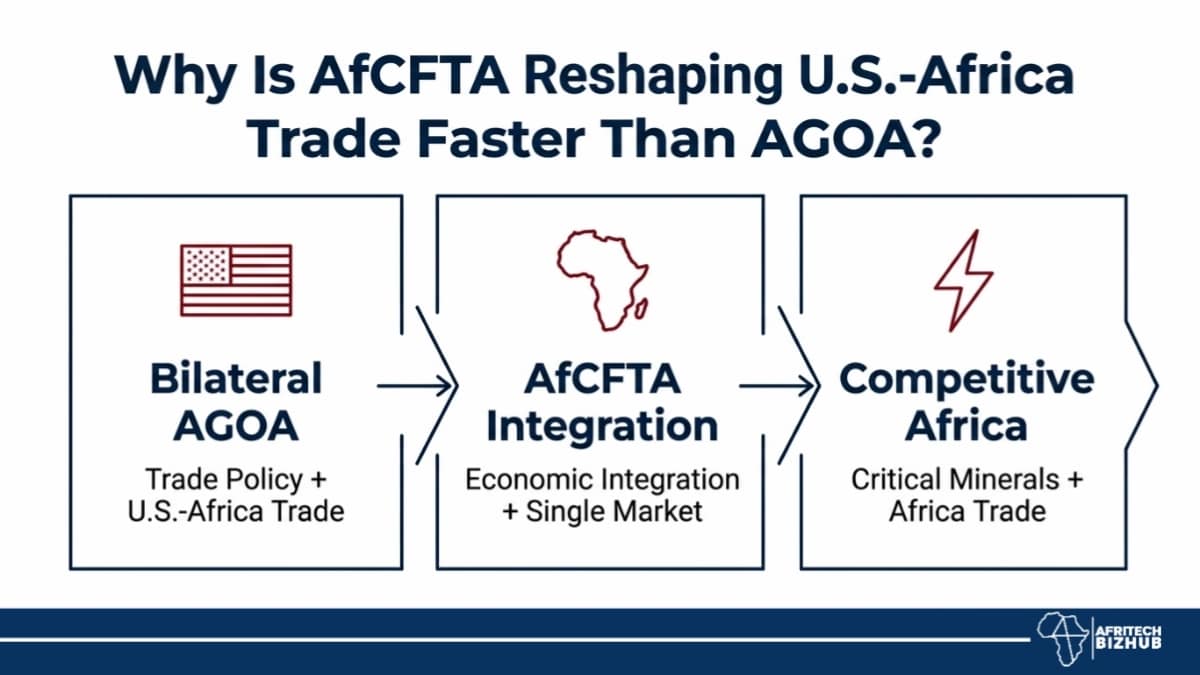
AGOA spent two decades shaping U.S.-Africa trade. AfCFTA is reshaping Africa trade in a fraction of that time.
That shift is becoming difficult to ignore. African governments are lowering barriers inside the continent, strengthening regional supply chains, and treating Economic integration as a growth strategy rather than a trade objective.
The result is a commercial landscape that looks very different from the one AGOA was designed for.
Washington built its Africa trade framework around individual countries.
AfCFTA is building a market that increasingly operates as a continent.
The question is no longer whether AGOA remains relevant.
The question is whether it can keep pace with a faster-moving African trade agenda.
How Will Trade Policy Shape Africa’s Next Economic Future?
Trade Policy is becoming one of the continent’s most important economic battlegrounds. The objective is no longer simply securing access to foreign markets.
The objective is connecting African production, manufacturing, logistics, and consumption across borders.
AfCFTA sits at the centre of that shift. It is creating conditions for businesses to scale beyond national boundaries and operate within a larger continental market.
That changes how industries grow, how supply chains develop, and how investment decisions are made.
Trade Policy is increasingly being used to support industrialisation, value addition, and regional competitiveness rather than simply facilitating exports.
Why is AfCFTA Crucial for AGOA’s Future Success?
AfCFTA is addressing a problem AGOA was never designed to solve.
For years, AGOA improved access to the American market, but access alone could not overcome fragmentation inside Africa.
Producers still faced barriers moving goods across neighbouring countries.
Manufacturers often lacked the scale needed to compete globally.
Supply chains remained scattered across national borders.
AfCFTA changes that equation. Regional integration creates larger markets, stronger production networks, and more efficient trade corridors.
The stronger those foundations become, the more effectively African businesses can utilise external opportunities such as AGOA.
AfCFTA is not replacing AGOA. It is changing the conditions under which AGOA operates.
Can U.S.-Africa Trade Keep Pace With African Integration?
Africa is integrating faster than many external partners are adapting.
U.S.-Africa trade continues to operate largely through frameworks built around individual countries, while AfCFTA is encouraging businesses and governments to think continentally.
That difference is becoming more visible as African economies coordinate policies, strengthen regional value chains, and expand intra-African commerce.
The United States remains an important economic partner, but the competitive environment has changed.
China, the European Union, India, and Gulf economies are increasingly aligning investment, infrastructure, and supply-chain strategies with Africa’s integration agenda.
The challenge for U.S.-Africa trade is not maintaining relevance.
The challenge is remaining aligned with a market that is reorganising itself at a continental scale.
Why Are Critical Minerals Driving America’s Africa Strategy?
Critical minerals have pushed Africa higher up Washington’s economic agenda.
Lithium, cobalt, graphite, manganese, and other strategic resources now sit at the centre of global competition for electric vehicles, battery production, advanced manufacturing, and energy transition technologies.
Countries that control supply chains are gaining influence. Countries that depend on them are looking for security.
That reality is changing the character of U.S.-Africa trade. Market access remains important, but the conversation is moving beyond exports and preferences.
Supply chains, processing capacity, industrial partnerships, and resource security are becoming harder to separate from trade strategy itself.
Africa’s position is changing at the same time. For decades, many economies exported raw materials and imported higher-value products.
AfCFTA is built around a different objective.
The agreement seeks to strengthen regional value chains, support industrialisation, and expand value addition within the continent.
The goal is not simply to move more resources across borders. The goal is to retain more economic value before those resources leave Africa.
That shift matters because the next phase of competition will not be decided by who owns the minerals alone.
It will be influenced by who processes them, who manufactures with them, and who captures the largest share of the value they create.
How Does Economic Integration Strengthen Africa Trade Competitiveness?
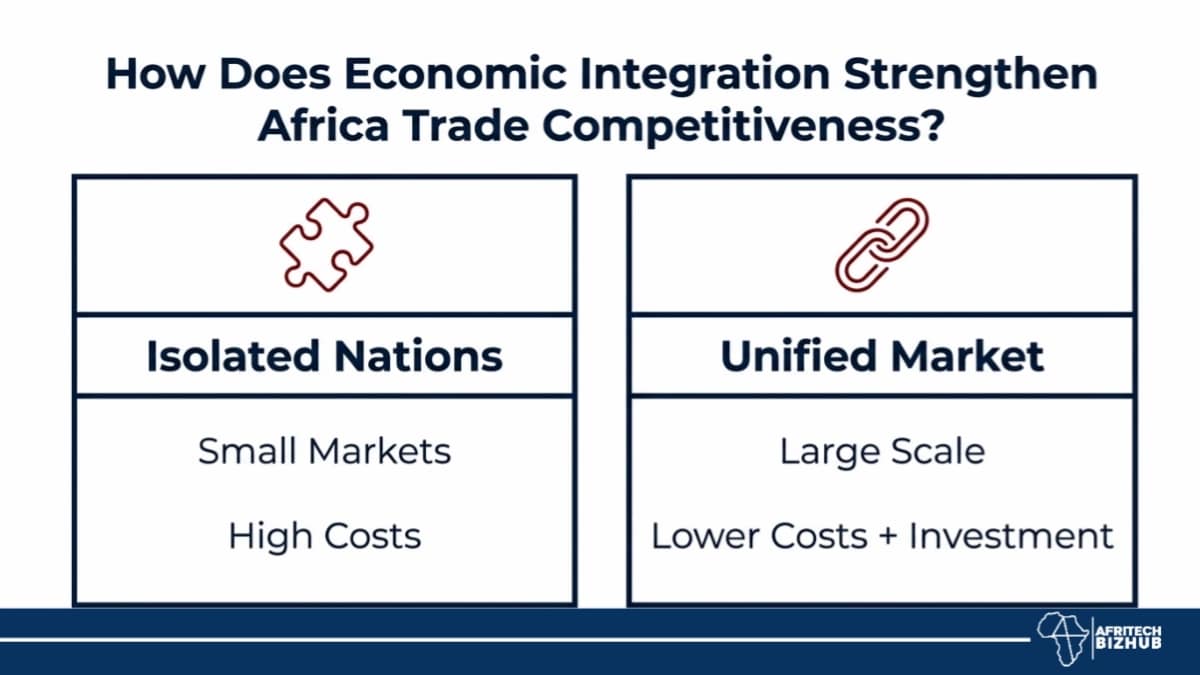
Economic integration is changing how Africa competes. Larger markets allow businesses to scale production, reduce costs, attract investment, and build stronger supply chains.
National markets remain important, but competitiveness is increasingly being determined by how effectively economies connect with one another across borders.
For Africa trade, this represents a structural shift.
The continent is moving away from a model built primarily around exporting outward and toward one that strengthens regional production networks first.
Africa is increasingly trading with itself before trading with the rest of the world.
That shift is altering investment decisions, industrial strategies, and global trade relationships.
Trade Policy is becoming a tool for building continental competitiveness rather than simply securing market access abroad.
AGOA remains important, but it now operates within a continent that is becoming more integrated, more coordinated, and more strategic about its economic future.
AfCFTA is not merely increasing trade flows. It is changing the architecture of Africa trade itself.
The countries and partners that adapt to that reality first are likely to gain the greatest advantage from the next phase of global economic competition.


Recent Comments