


Featured Summary:
- Africa inflation is no longer moving in one direction as central banks respond to different economic conditions across the continent
- South Africa is facing renewed inflation pressure while Central Africa has begun lowering interest rates after inflation stayed below its regional target
- Different inflation environments are producing different monetary policies, shaped by exchange-rate systems, fuel prices, food costs, external shocks and productive capacity
- The next economic divide will depend on whether easier financial conditions translate into stronger investment, manufacturing, energy supply and industrial growth
South Africa is tightening into renewed price pressure while Central Africa is easing into lower inflation.
The two decisions land on the same continent, but they no longer describe the same economic cycle.
Fuel prices, food costs, exchange-rate systems, reserves, imports and domestic production are pulling African economies through different inflation paths.
Africa inflation is becoming harder to read as a single story. The policy split shows a continent where price stability can improve in one region while another faces fresh pressure, and where lower inflation still does not prove stronger production.
The deeper test is no longer whether central banks can move rates. It is whether African economies can build enough productive capacity to make inflation less fragile when the next shock arrives.
Africa Inflation Is No Longer Moving Together
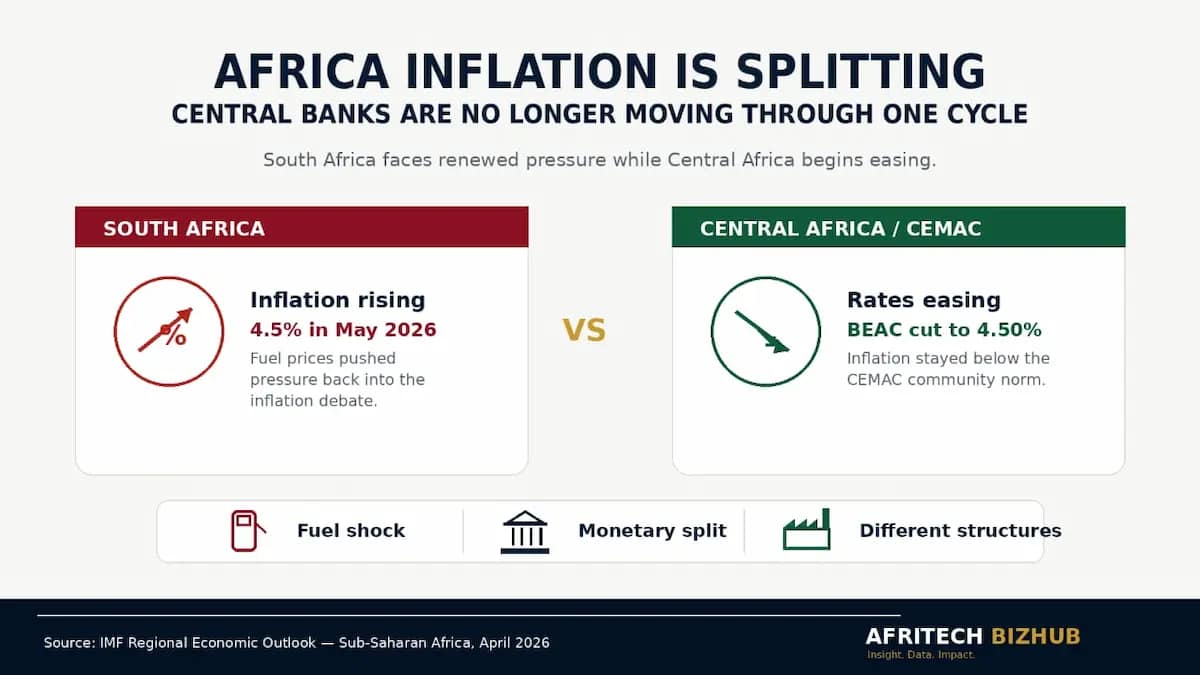
Africa inflation is breaking into regional cycles. South Africa’s annual consumer inflation rose to 4.5% in May 2026, the highest level since July 2024, after a sharp fuel-price surge.
Petrol prices were up 24.8% year-on-year, while diesel prices rose 53.8%.
The South African Reserve Bank’s policy rate stood at 7%, with fuel, food and expectations still sitting inside the inflation debate.
Central Africa moved in the opposite direction. BEAC cut its tender interest rate from 4.75% to 4.50% on June 29, 2026 and reduced other policy settings after inflation remained below the CEMAC community norm.
The contrast is no longer academic. One major African economy is guarding against renewed inflation pressure.
A regional central bank is loosening conditions under a lower inflation path. The continent is not responding to one price environment.
Inflation Is Following Different Economic Conditions
Inflation is following the structure of each economy more closely than the continental average.
South Africa’s pressure runs through fuel, transport, food, electricity, wages, imported inputs and market expectations.
A currency that trades freely can absorb shocks quickly, but it also transmits global pressure into domestic prices when fuel, energy and investor sentiment move against it.
Central Africa carries a different monetary architecture. The CFA franc’s euro anchor reduces one channel of exchange-rate volatility and can soften imported-price pressure when other African currencies come under strain.
That stability helps explain the room BEAC now has, but it does not settle the larger economic question.
A steadier currency can hold prices better. It cannot by itself create factories, fix farms, expand power supply or deepen industrial output.
Lower Interest Rates Do Not Automatically Expand Production
Lower interest rates can loosen financial conditions, but production does not rise because policy rates fall.
Credit has to move into businesses that make, process, transport, store and export real goods. Banks have to lend beyond safe government paper.
SMEs need working capital. Manufacturers need power, machinery, logistics, skilled labour and predictable demand.
Monetary easing gives the economy a softer landing only when capital reaches productive sectors.
That is where the inflation split becomes more revealing.
Central Africa can lower rates under calmer price conditions, but the region still needs stronger non-oil production, better infrastructure and wider private-sector investment.
South Africa can tighten policy to defend credibility, but higher rates do not remove the structural costs that travel through energy, logistics and food systems.
Price stability becomes durable when economies produce more of what they consume and process more of what they export.
What Does the IMF Reveal About Africa Inflation?
The IMF’s April 2026 Regional Economic Outlook for Sub-Saharan Africa described a region coming out of hard-won stabilization gains into a more difficult year.
Growth was projected to slow, with significant differences across countries, while external shocks, higher commodity costs, debt pressure and weaker global conditions threatened the recovery.
Inflation had eased across parts of the region, but the next stage was already moving away from a single regional pattern.
The same outlook keeps the pressure on policy credibility, fiscal discipline and structural reforms.
Central banks can anchor expectations and defend currencies, but they cannot supply electricity, build logistics corridors, expand food production or raise industrial output alone.
Africa inflation will stay exposed where productivity remains weak.
The economies that move from stabilization to resilience will be those that turn monetary space into investment, jobs, production and domestic value creation.
Africa Inflation Will Increasingly Be Decided by Economic Structure
Africa inflation will be decided by structure more than slogans.
Countries with steadier currencies, stronger reserves, reliable food systems, deeper production bases and better energy supply will absorb shocks differently from economies exposed to depreciation, fuel imports and weak domestic supply.
Central banks will still shape financial conditions, but they will operate from unequal foundations.
South Africa’s path shows how quickly fuel and domestic cost pressures can return.
Central Africa’s path shows how a different monetary framework can create room for easing when prices remain contained.
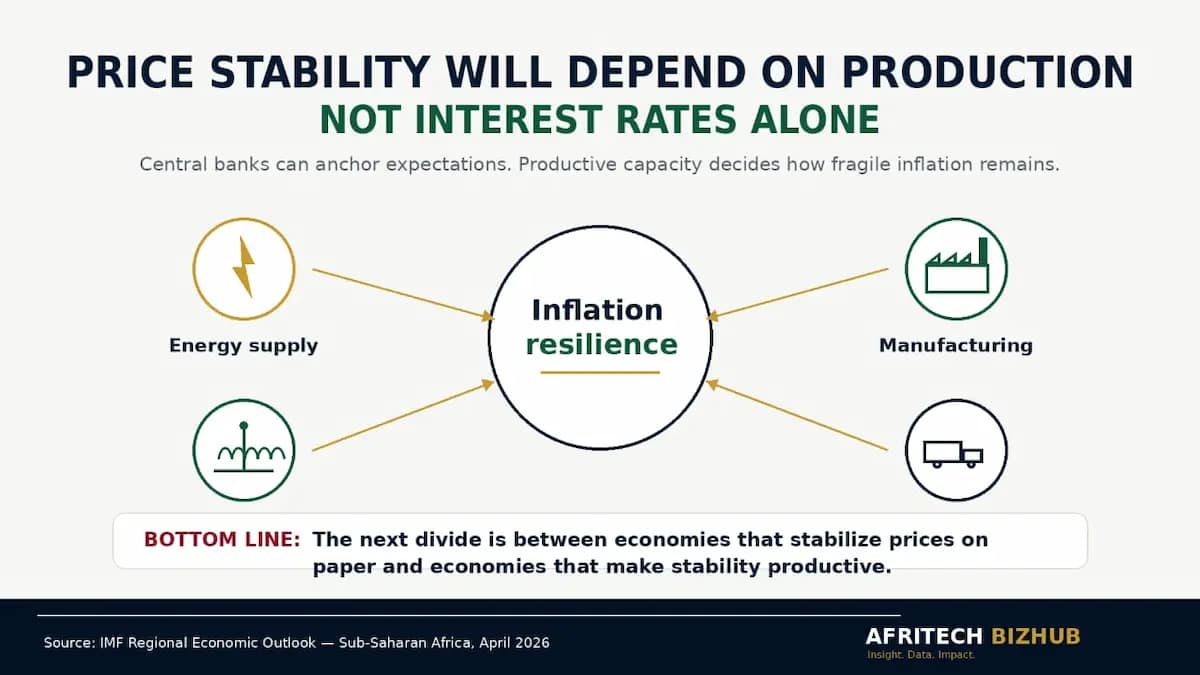
Neither path guarantees stronger output. The next divide will form between economies that stabilize prices on paper and economies that make stability productive.
Long-term inflation resilience will come from energy, manufacturing, agriculture, logistics, capital allocation and domestic value creation, not from interest-rate decisions alone.


Recent Comments