


Featured Summary:
- Tax Reform in Liberia is drawing attention to a gap that exists across many developing economies: economic activity often expands faster than public revenue.
- Capacity Building has emerged as a central priority as governments seek stronger compliance and more effective revenue systems.
- Digital Tax infrastructure is becoming increasingly important as economic activity generates more data and fewer paper trails.
- Revenue Collection challenges often begin with visibility, making tax administration as important as tax policy.
Economic activity is often easier to find than public revenue.
Businesses operate, markets expand, and consumers spend, yet government finances do not always reflect the same momentum.
The disconnect is one of the most persistent challenges in economic development.
Liberia’s latest partnership with South Korea is built around that gap.
The focus is not on introducing new taxes.
It is on strengthening the systems responsible for finding, tracking, and collecting revenue that should already be visible inside the economy.
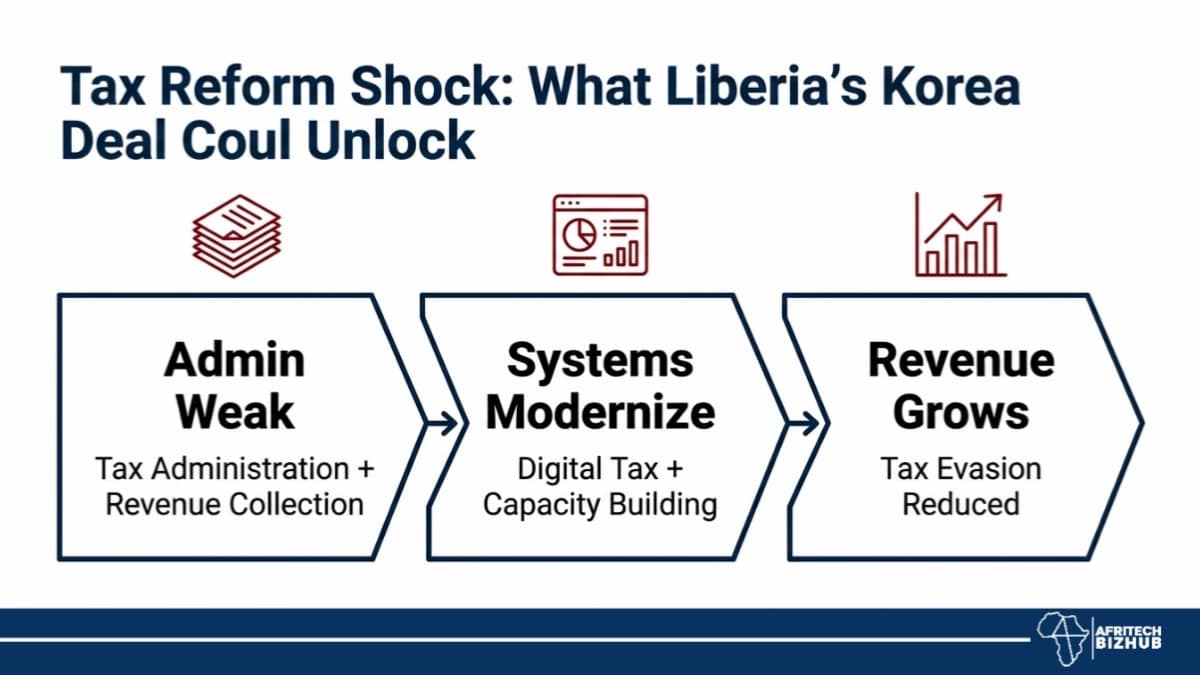
How Will Tax Reform Transform Liberia’s Revenue Future?
Economic growth and public revenue often move at different speeds.
Across developing economies, expanding commercial activity does not automatically translate into stronger government finances.
Informal activity, weak compliance systems, fragmented records, and limited oversight frequently leave tax authorities with an incomplete picture of what is happening inside the economy.
That disconnect sits at the centre of Liberia’s Tax Reform agenda.
Rather than focusing primarily on new taxes, policymakers appear increasingly focused on the systems responsible for Revenue Collection.
The objective is straightforward.
Economic activity that is already taking place should be easier to identify, monitor, and incorporate into the formal revenue system.
The distinction matters because governments rarely struggle to write tax laws.
The greater challenge is ensuring that existing obligations are captured consistently and efficiently.
Liberia’s Tax Reform effort reflects a growing recognition that stronger public finances often depend as much on administration as policy.
Why Is Capacity Building Critical For Tax Success?
Technology attracts attention while Institutions determine outcomes.
Governments around the world have invested heavily in modernization only to discover that software alone does not strengthen Revenue Collection.
Digital platforms, databases, and automated systems still depend on professionals capable of analysing information, identifying risks, conducting audits, and enforcing compliance.
Without those capabilities, even sophisticated systems can produce disappointing results.
This helps explain why Capacity Building occupies such an important position within Liberia’s reform agenda.
South Korea’s success was not built solely on technology.
It was built on institutions capable of using technology effectively.
Liberia’s Tax Reform efforts appear designed to strengthen both sides of that equation by pairing technical modernization with institutional development.
The objective extends beyond solving today’s challenges.
It is about creating a tax authority capable of adapting to future ones.
How Will Digital Tax Systems Boost Compliance?
Digital Tax systems are designed to solve a visibility problem.
One of the biggest obstacles to compliance is not the absence of economic activity but the difficulty of tracking it.
Tax authorities struggle when reporting remains fragmented, records remain incomplete, and large portions of commercial activity move through systems that generate limited oversight.
Compliance becomes harder to enforce because authorities are operating with partial information.
Digital Tax infrastructure changes that dynamic by creating more reliable records and stronger connections between taxpayers and regulators.
Electronic filing, integrated databases, automated reporting, and digital records help create a clearer picture of economic activity.
As economies become more digital, tax authorities that fail to modernize risk losing visibility into increasingly important segments of commerce.
For Liberia, digitalization is not simply an efficiency project.
It is an effort to strengthen the information required for effective Revenue Collection.
Better visibility often produces better compliance, and better compliance frequently produces more predictable public finances.
Can Tax Administration Modernization Reduce Revenue Leakages?
Revenue rarely disappears through a single failure.
It leaks through incomplete records, fragmented databases, inconsistent reporting, weak enforcement, and economic activity that remains difficult to monitor.
Individually, these weaknesses may appear manageable. Collectively, they can create significant pressure on public finances.
This is why Tax Administration modernization has become a recurring priority across developing economies.
Better data integration allows authorities to compare information across multiple sources, identify discrepancies more quickly, and improve the accuracy of taxpayer records.
The result is not simply greater efficiency but a stronger ability to capture revenue that may previously have gone uncollected.
The Liberia Revenue Authority has identified modernization as a central component of efforts to improve Tax Administration and strengthen Revenue Collection.
The emphasis reflects a broader understanding that improving collection outcomes often depends less on introducing new taxes and more on strengthening the systems responsible for enforcing existing ones.
How Will Fighting Tax Evasion Strengthen Economic Growth?
Tax Evasion is often discussed as a compliance issue. Its consequences extend much further.
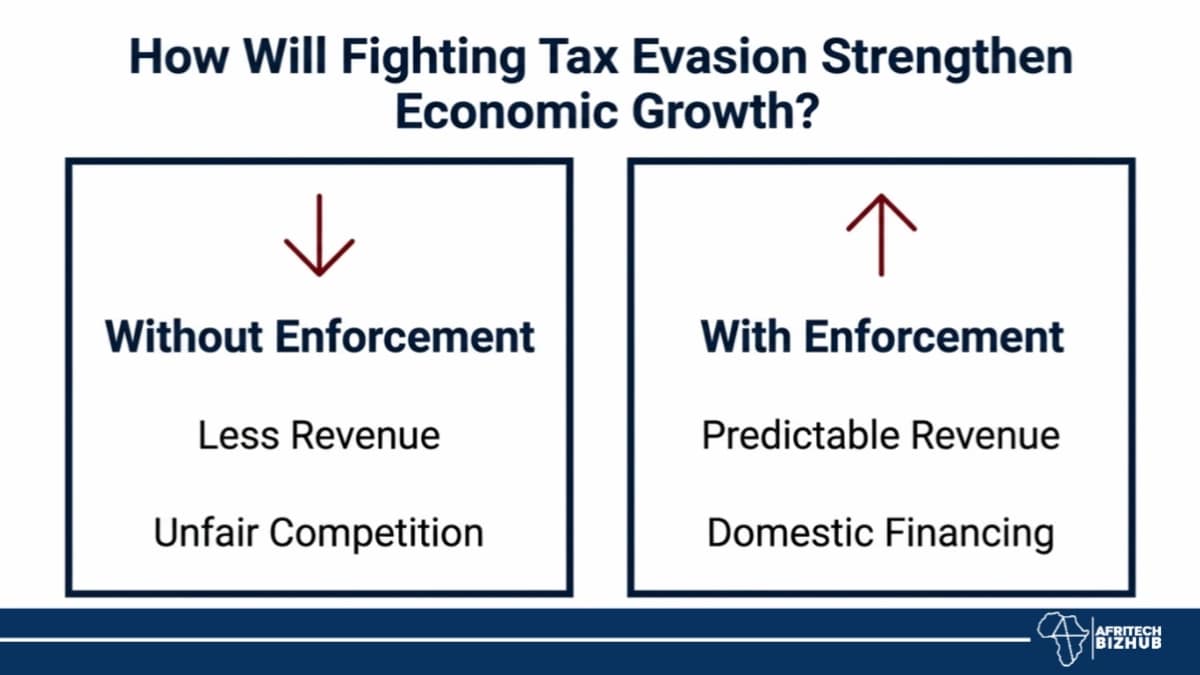
When significant portions of economic activity remain outside the formal tax system, governments collect less revenue, compliant businesses face uneven competition, and development spending becomes more difficult to sustain.
The pressure eventually reaches infrastructure projects, public services, and investment priorities.
Over time, those effects influence how effectively economies can finance their own development.
Reducing Tax Evasion strengthens more than government revenues.
It improves fairness across the economy by ensuring that businesses operating within the rules are not placed at a disadvantage.
Stronger compliance also makes public finances more predictable, giving governments greater confidence when planning long-term investments and responding to economic shocks.
Liberia’s partnership with South Korea ultimately points toward a larger question.
For years, fiscal debates focused on what governments should charge.
The latest Tax Reform efforts suggest attention is shifting elsewhere. Economic activity has never been Liberia’s only challenge. Capturing it may be.


Recent Comments