


Featured Summary:
- Meta AI investigation marks Nigeria’s strongest regulatory challenge yet to global technology platforms.
- AI, copyright and digital publishing are becoming part of the same regulatory battle.
- Big Tech companies are facing growing pressure to comply with Nigerian laws rather than platform policies.
- Nigeria’s digital economy is entering a new phase where regulation could shape how AI operates across Africa.
Nigeria’s dispute with Big Tech has moved beyond complaints about social media moderation, platform visibility or advertising revenue.
The country is now confronting a harder question: who controls the value created from Nigerian content when global platforms use search, social feeds and artificial intelligence to organise, summarise and monetise information.
That question has become urgent because the Nigerian media industry is under pressure from two directions at once.
Publishers need digital platforms for audience reach, but those same platforms can reduce traffic, absorb advertising value and use original reporting to improve AI systems.
The Meta AI investigation, the Google probe and the wider review of X and AI platforms now place Nigeria in a larger global debate over whether Big Tech companies should operate mainly by their own platform rules or under the legal standards of the markets where they make money.
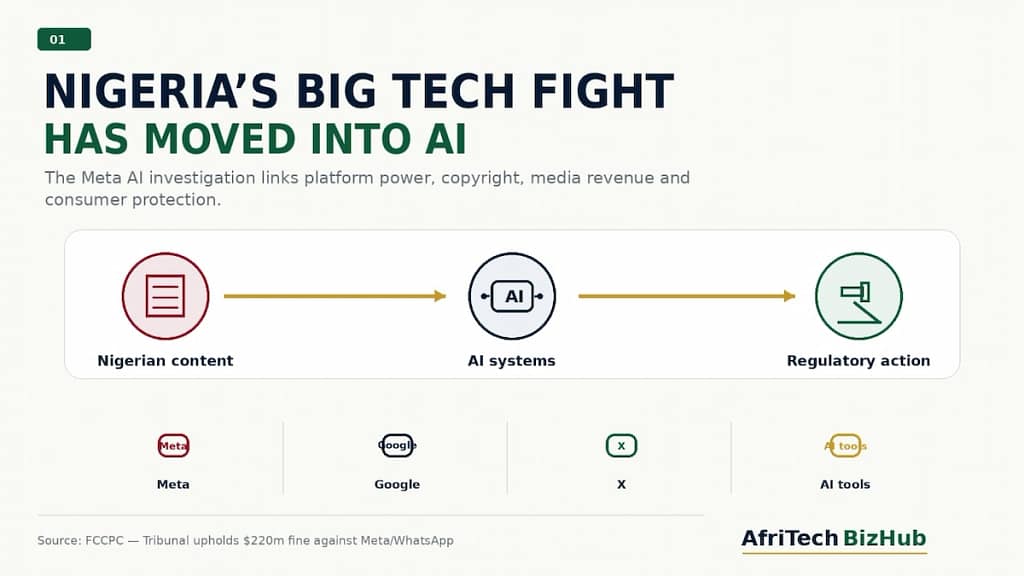
Why Is the Meta AI Investigation Escalating Now?
Artificial intelligence has changed the regulatory stakes because content is no longer only being displayed, shared or ranked.
It can now be scraped, processed, summarised and used to train systems that compete with the publishers whose work made the information valuable in the first place.
That shift explains why Nigeria is moving from concern to enforcement.
The Meta AI investigation reflects a wider fear that Nigerian content could be used inside AI products without clear consent, payment or accountability.
Regulators are now asking whether AI systems operating in Nigeria are respecting copyright, data use rules, competition law and consumer protection standards.
For Meta Nigeria, the question is not only whether its platforms serve users.
It is whether its AI systems and digital products treat Nigerian publishers, creators and consumers fairly under Nigerian law.
How Could the Google Probe Impact Nigerian Publishers?
Search remains one of the most important routes through which Nigerian publishers reach readers and earn digital revenue.
When Google changes how information appears through AI summaries, featured results or automated answers, publishers can lose traffic even when their reporting helps produce the answer users see.
That is why the Google probe matters commercially, not only technologically.
The impact could reach advertising, licensing and the bargaining power of local media companies.
If AI-generated summaries reduce clicks to news websites, publishers may struggle to earn revenue from the journalism that feeds the digital ecosystem.
A fairer framework could push technology platforms to negotiate commercial agreements, improve transparency around content use and give Nigerian publishers a stronger position in digital revenue discussions.
The core issue is simple: original reporting has economic value, and the companies that produce it do not want that value extracted without compensation.
Is Copyright Infringement Threatening the Nigerian Media Industry?
Copyright has become more important because AI writing tools depend on large volumes of text, images, audio and video to function well.
Nigerian newsrooms produce daily reporting, investigations, interviews, analysis and broadcast material that can improve search tools, AI summaries and automated content systems.
If that material is used without permission or payment, the financial pressure on publishers becomes harder to ignore.
The contradiction is that the Nigerian media industry needs digital platforms to survive, but it also needs protection from being weakened by those same platforms.
Original journalism costs money.
Reporters, editors, photographers, producers and publishers all depend on a business model that rewards verified content.
If AI tools and platforms can absorb that content without licensing, copyright infringement becomes more than a legal issue.
It becomes a threat to the commercial base of Nigerian journalism.
Can Consumer Protection Laws Rein in Big Tech Companies?
Nigeria is testing whether consumer protection and competition law can apply to global platforms with the same force they apply to domestic companies.
Big Tech companies in Nigeria shape what people read, how businesses advertise, how publishers reach audiences and how user data moves through digital systems.
That influence gives regulators a reason to examine market power, platform conduct and the fairness of commercial relationships.
The FCCPC’s enforcement history against Meta shows why the current investigation carries institutional weight.
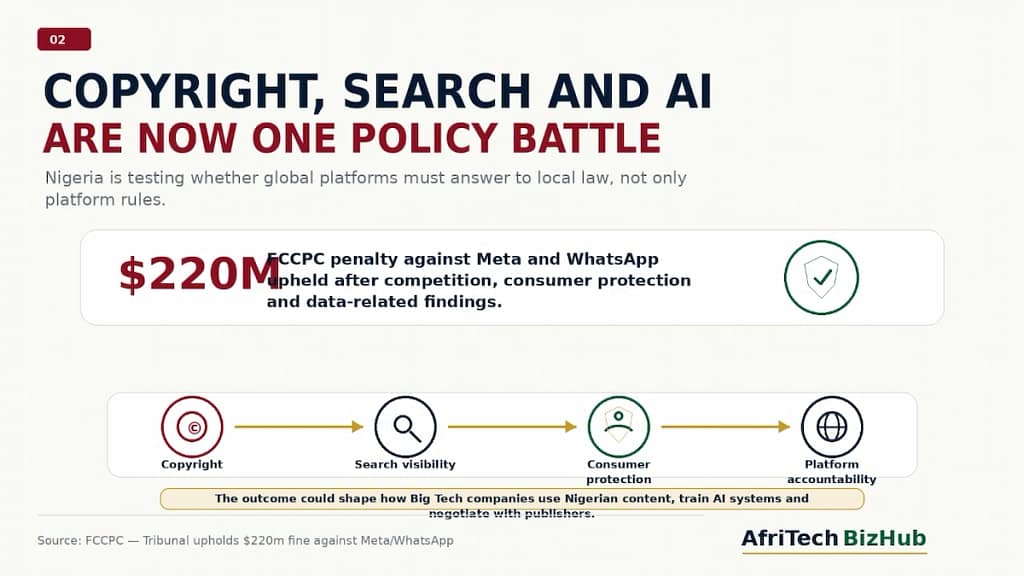
In April 2025, Nigeria’s Competition and Consumer Protection Tribunal upheld the FCCPC’s $220 million penalty against Meta and WhatsApp after a 38-month investigation into competition, consumer protection and data-related conduct.
The tribunal also affirmed the FCCPC’s authority under the Federal Competition and Consumer Protection Act to regulate competition and consumer protection issues, including in regulated industries.
That record gives Nigeria’s new Big Tech inquiry a stronger foundation: the country is no longer only warning platforms; it has already tested its enforcement powers against Meta.
What Happened Between Meta and Nigeria?
The dispute between Meta and Nigeria began as a consumer protection and data accountability issue, but it is now expanding into artificial intelligence, copyright, digital publishing and platform power.
The earlier Meta case showed that Nigeria was willing to challenge a global technology company over how it treated Nigerian users.
The new investigation widens that challenge by asking whether Meta, Google, X and AI platforms are also affecting the economic survival of Nigerian media organisations.
That is why the Meta AI investigation matters beyond one company.
It signals a new stage in Nigeria’s digital regulation, where AI writing tools, search platforms, social networks and publisher rights are being examined under domestic law.
The outcome could influence how Big Tech companies in Nigeria negotiate with publishers, use copyrighted material, train AI systems and respond to consumer protection rules.
It could also shape how other African countries approach the same problem.
Nigeria is not only asking whether technology platforms are useful.
It is asking whether they are accountable.


Recent Comments