


Featured Summary:
- Internet Security is becoming critical infrastructure for Africa’s digital economy.
- Technology regulation is shifting from legal compliance to economic competitiveness.
- Cyber vulnerabilities are exposing the growing gap between digital adoption and digital resilience.
- Africa’s digital future will increasingly depend on trusted cyber governance as much as digital innovation.
Africa has invested heavily in digital banking, fintech, cloud computing, e-government and online commerce.
The systems supporting that growth are now carrying more economic activity than ever before, yet cyber resilience has not expanded at the same pace.
As digital services become essential to everyday economic activity, protecting them has become as important as building them.
That shift explains why Namibia’s latest cybersecurity reforms matter beyond one country.
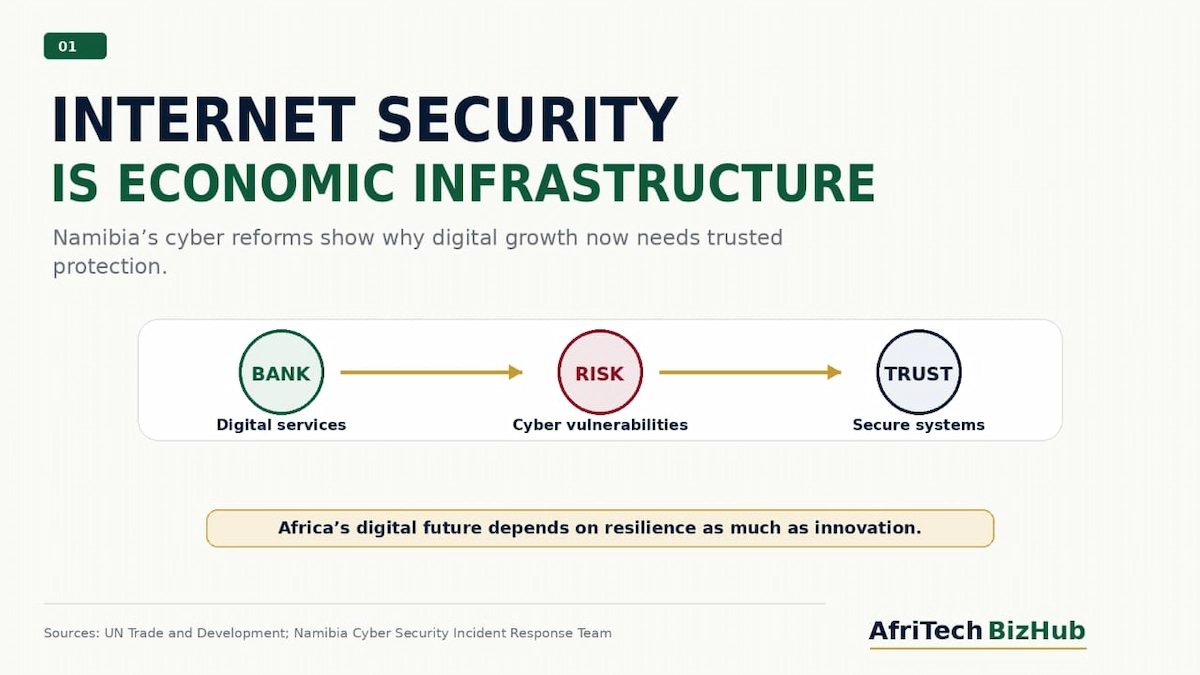
Internet Security is emerging as economic infrastructure rather than a technical responsibility.
The countries that build trusted digital systems will be better positioned to attract investment, expand digital commerce and strengthen confidence in Africa’s rapidly growing digital economy.
How Will Internet Security Change Namibia’s Digital Future?
Internet Security is becoming fundamental to modern economies because banking, communications, public services, identity systems and business operations now depend on trusted digital infrastructure.
Connectivity alone no longer defines digital readiness.
A country can expand broadband, mobile money and online services, but weak protection can quickly turn digital progress into operational risk.
Namibia’s cybersecurity reforms reflect a wider African transition from access-led digital growth to resilience-led digital governance.
The country is strengthening incident coordination, cybercrime rules and data protection processes at a time when more economic activity is moving online.
That makes Internet Security part of national economic planning.
Digital infrastructure must now be protected with the same seriousness as roads, ports, electricity and financial systems.
Why Does Technology Regulation Need Urgent Reform Now in Africa?
Technology regulation needs urgent reform because digital markets grow faster when users, investors and businesses trust the rules protecting them.
Clear governance gives companies more confidence to build platforms, process data, serve customers and move money through digital channels.
Weak rules create uncertainty around liability, privacy, cybercrime, consumer protection and institutional accountability.
UN Trade and Development’s Global Cyberlaw Tracker shows why this matters.
It tracks whether countries have laws covering data protection and privacy, cybercrime, consumer protection, electronic transactions and related areas of the digital economy.
Those categories are no longer legal details.
They are the foundations of trusted digital markets.
African countries with stronger technology regulation will be better placed to attract investment, protect innovation and build digital economies that can scale safely.
How Are Cyber Vulnerabilities Rising Across Namibia?
Cyber vulnerabilities in Namibia show the pressure created when digital adoption expands faster than institutional protection.
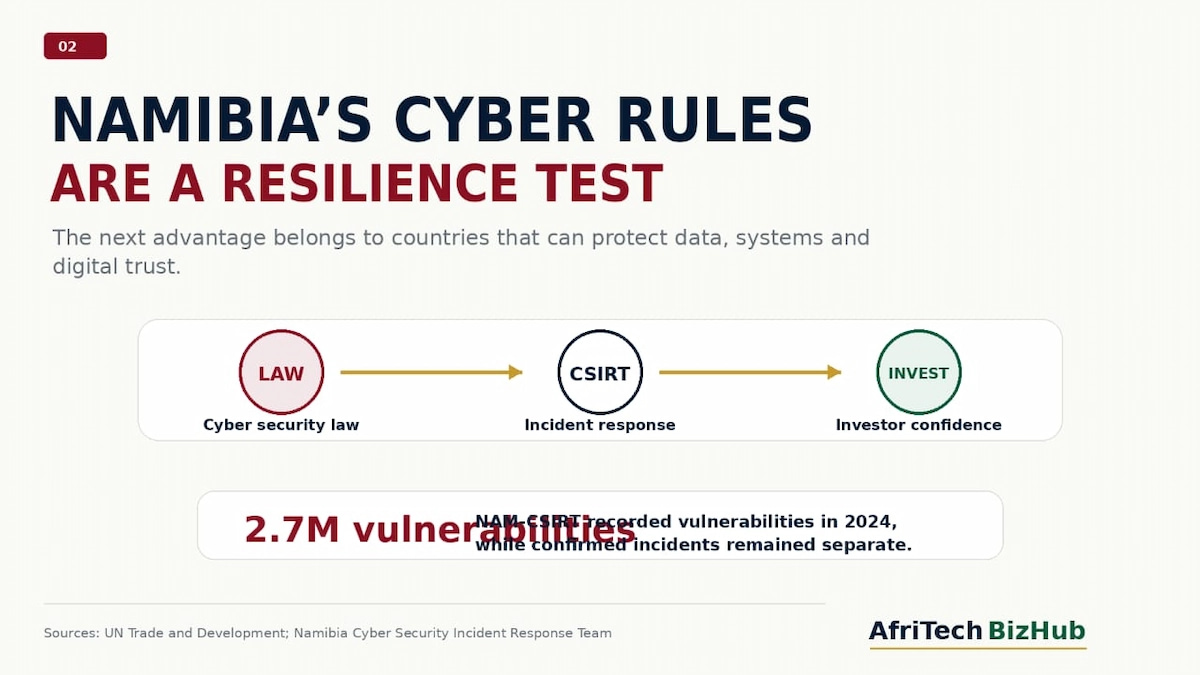
NAM-CSIRT’s official statistics recorded 1,243,014 cyber events, 2,727,913 vulnerabilities and 7 incidents in 2024.
The distinction matters.
Vulnerabilities are weaknesses that can expose systems, while incidents refer to confirmed cases that require response.
Treating both as the same would exaggerate the threat and weaken the analysis.
The figures still carry a clear economic signal.
Namibia’s digital systems are carrying more activity across government, business, communications and financial services, which increases the number of systems that need protection.
Cyber vulnerabilities are rising as an institutional challenge because every connected platform becomes part of the country’s economic surface.
The more services move online, the more resilience becomes a condition for business continuity and public trust.
Can Cyberattack Risks Expose Namibia’s Digital Systems?
Cyberattack risks expose digital systems when weak coordination turns technical disruption into economic disruption.
Banks need continuous trust to process transactions. Businesses need reliable systems to manage customers, payments and operations.
Government agencies need secure platforms to deliver services, protect records and maintain public confidence.
A serious cyberattack does not only damage servers.
It can interrupt the systems that allow economic activity to continue.
NAM-CSIRT’s National Cyber Security Incident Management Guidelines 2026 place incident handling, reporting and coordinated response inside Namibia’s national cyber resilience framework.
That institutional role matters because cyber resilience now depends on how quickly threats are identified, reported, contained and managed across public and private systems.
For Namibia, the test is no longer whether digital services can expand.
The test is whether those services can remain trusted when cyberattack risks increase.
Why Is Cyber Security Law Critical For Protection in Africa?
Cyber security law is critical because digital economies cannot rely only on voluntary protection.
Enforceable legal frameworks create obligations for prevention, reporting, investigation, accountability and cooperation.
They also give investors and businesses more confidence that digital markets are governed by rules rather than informal responses after damage has already occurred.
The African Union Convention on Cyber Security and Personal Data Protection gives the continental frame for this shift by placing cybercrime, electronic transactions, personal data protection and cybersecurity inside Africa’s legal and economic development agenda.
Namibia’s tightening cyber rules fit that wider direction.
Countries with stronger cyber security law will be better positioned to protect critical infrastructure, support digital commerce, attract investment and build regional competitiveness.
Africa’s digital future will depend not only on innovation, but on whether citizens, companies and investors can trust the systems carrying that innovation.


Recent Comments