


Featured Summary:
- Cloud service providers are competing for proximity to Africa’s fastest-growing interconnection infrastructure.
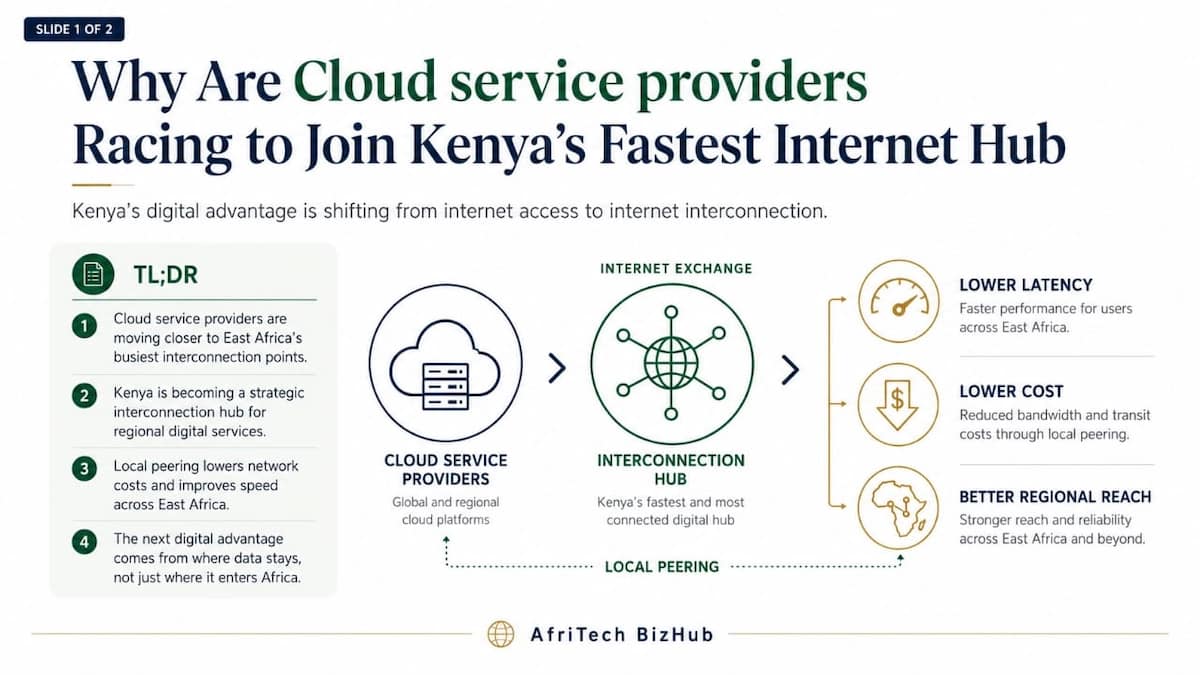
- Kenya’s digital advantage is shifting from internet access to internet interconnection.
- Local peering is lowering costs while improving speed across regional networks.
- The next phase of Africa’s digital economy will be shaped by where data stays, not simply where it enters the continent.
Africa spent years expanding internet access through submarine cables, fibre networks and broadband infrastructure.
That race no longer defines digital leadership on its own.
Competitive advantage is increasingly determined inside the network, where internet traffic is exchanged, enterprise applications are delivered and data remains closer to the people and businesses using it.
That shift explains why Cloud service providers are concentrating around Kenya’s interconnection infrastructure.
The commercial opportunity is no longer limited to connecting Africa with the global internet.
It increasingly depends on keeping African traffic inside African networks, allowing digital platforms to improve performance while reducing the cost of delivering cloud-based services across the region.
Why Are Cloud Service Providers Expanding Across Kenya Now?
Africa’s digital economy is creating demand for infrastructure that moves data more efficiently rather than simply transporting larger volumes of internet traffic.
Enterprise cloud adoption, streaming services, artificial intelligence applications and financial technology platforms all perform better when users connect to nearby digital infrastructure instead of relying on distant international routes.
As digital activity becomes more regional, Cloud service providers are positioning themselves where network traffic naturally converges.
Kenya has emerged as one of those strategic locations because its growing Interconnection hub allows providers to serve multiple East African markets from a well-connected ecosystem.
Instead of creating demand, Cloud service providers are following existing concentrations of internet operators, content networks, enterprises and data centres.
Interconnection has become one of Africa’s most valuable digital infrastructure assets because it improves service quality while lowering the cost of delivering applications across regional markets.
How Does An Internet Exchange Improve Network Performance?
Businesses invest in an Internet exchange because network efficiency has become a commercial advantage.
Faster delivery of applications improves customer experience, supports enterprise software, strengthens financial transactions and enables digital services to scale without unnecessary international routing.
As more business activity moves online, reducing network delays creates measurable economic value for both providers and customers.
An Internet exchange also allows more regional traffic to remain within local infrastructure instead of travelling through overseas networks before returning to neighbouring countries.
That improves network resilience, reduces transit expenses and gives Cloud service providers greater control over service quality.
The competitive advantage therefore comes from stronger digital infrastructure that supports faster and more reliable enterprise connectivity rather than simply increasing available bandwidth.
Why Is LINX Nairobi Attracting More Regional Networks?
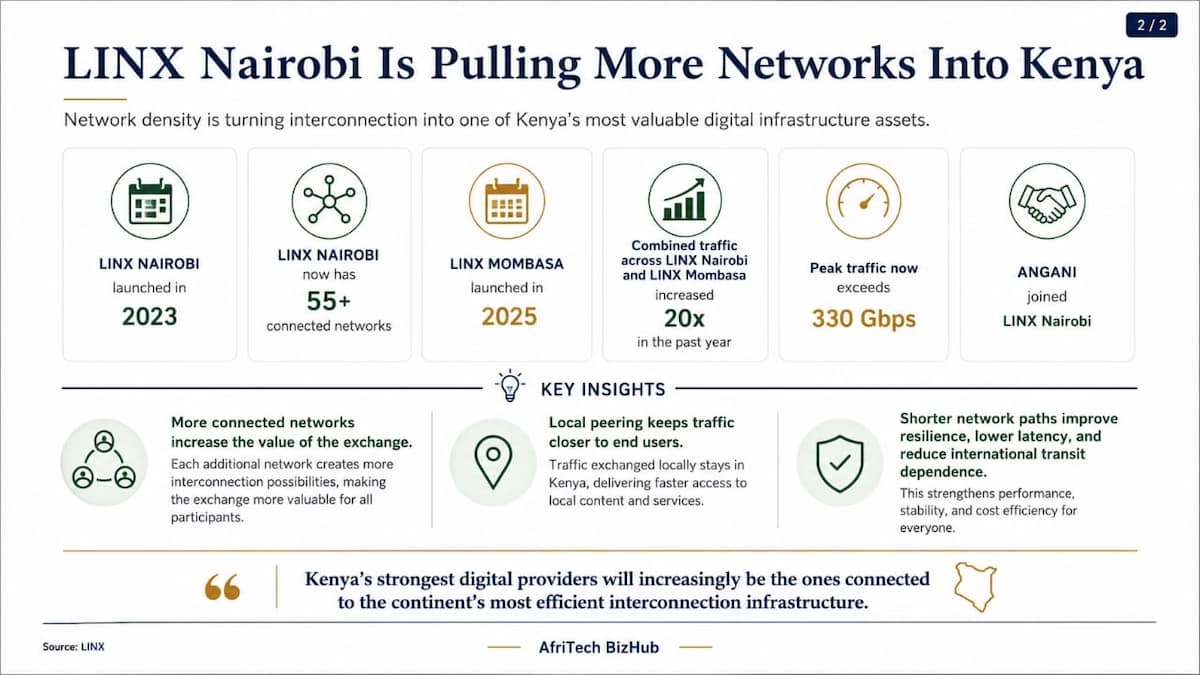
Every additional participant connected to LINX Nairobi increases the commercial value of the exchange for existing and future members.
Internet service providers, content delivery networks, Cloud service providers and enterprises all benefit when they gain direct access to a larger community of interconnected networks through a single location.
The expanding ecosystem creates stronger incentives for additional organisations to join because each new connection opens access to more potential partners and customers.
The network effect is already becoming visible across Kenya’s interconnection market.
LINX Nairobi now supports more than 55 connected networks, while combined traffic across LINX Nairobi and LINX Mombasa has increased twenty-fold over the past year to exceed 330 Gbps at peak usage.
Recent additions, including regional cloud provider Angani, demonstrate that network density is becoming a decisive factor in infrastructure investment because greater participation improves connectivity, resilience and commercial opportunities for every member of the exchange.
How Does Local Peering Reduce Internet Delays And Costs?
Local peering reduces internet delays by allowing networks to exchange traffic closer to the people and businesses using digital services.
Instead of sending regional traffic through international transit routes, LINX Nairobi allows internet service providers, content networks, enterprises and cloud service providers to connect directly inside Kenya’s interconnection ecosystem.
That shorter route improves latency, strengthens reliability and gives cloud-based platforms a faster path to customers across East Africa.
The commercial case is just as important.
LINX says its Kenya exchange points have seen combined traffic grow twenty-fold over the past year, reaching a peak of more than 330Gbps, while Angani’s connection to LINX Nairobi strengthens its ability to support low-latency, locally hosted cloud services.
For cloud service providers, local peering lowers dependence on expensive international transit and improves control over service quality.
The stronger Kenya’s peering ecosystem becomes, the more digital traffic can stay closer to African users instead of leaving the region unnecessarily.
Which is the Best Internet Provider in Kenya?
The quality of internet service increasingly depends on the infrastructure supporting providers rather than headline download speeds alone.
Networks connected to efficient interconnection ecosystems can deliver faster applications, lower latency and more reliable digital experiences because data follows shorter and more resilient routes.
Strong interconnection has become as important to network performance as fibre deployment or international bandwidth.
Kenya’s growing digital exchange ecosystem reflects a broader shift taking place across Africa’s internet economy.
As more Cloud service providers, enterprises and network operators concentrate around major interconnection hubs, digital competitiveness will depend less on where internet access begins and more on how effectively data moves between African networks.
The strongest providers will increasingly be those connected to the continent’s most efficient interconnection infrastructure.


Recent Comments