


Featured Summary:
- Africa Digital Economy 2026 is facing a fiscal contradiction as governments promote digital inclusion while raising costs on digital access
- Kenya’s proposed VAT measures on phones, devices, and electric motorcycles show how revenue pressure can hit digital participation
- Nigeria’s IMF Article IV update adds the broader fiscal context: governments are under pressure to improve revenue and budget discipline
- The question is whether African states can fund themselves without slowing the digital economy they claim to be building
Africa’s digital economy has been built on a simple assumption: more people connected means more economic participation.
Governments have spent years promoting digital payments, online services, financial inclusion, and technology adoption as pillars of future growth.
Yet recent policy signals point in a different direction.
In Kenya, proposed tax measures could raise the cost of mobile phones, digital devices, and electric motorcycles. In Nigeria, the IMF’s latest assessment highlights the growing pressure on governments to strengthen revenues and tighten fiscal discipline.
Together, the developments expose a deeper tension. As fiscal pressures rise, the tools that power participation in the digital economy are becoming more expensive to access.
The question is no longer whether Africa wants a digital economy. The question is whether governments can expand digital inclusion while increasing the cost of entry into it.
Why Is Digital Access Getting More Expensive in Africa?
Kenya’s proposed Finance Bill 2026 measures have brought a growing tension into focus.
Industry groups warn that higher taxes on mobile phones, digital devices, and electric motorcycles could raise the cost of tools that millions rely on for communication, commerce, financial services, and work.
The significance extends beyond consumer prices.
Across much of Africa, digital participation begins with physical access to devices.
Smartphones connect users to banking services, online marketplaces, government platforms, ride-hailing networks, and digital payments.
When the cost of those devices rises, the barrier to participation rises with it.
That is what makes the current debate important.
Governments continue to promote the Africa Digital Economy as a pathway to growth and inclusion, yet some of the tools required to participate in that economy are becoming more expensive to acquire.
When Did Smartphones Become Economic Infrastructure?
For years, mobile phones were viewed primarily as consumer devices. That assumption no longer reflects how much of Africa’s economy operates.
Across the continent, a smartphone increasingly serves as a bank branch, a marketplace, a communications network, and a business tool at the same time.
Small merchants receive payments through mobile applications. Drivers depend on digital platforms for customers. Farmers access market information through mobile services.
Freelancers, creators, and remote workers rely on internet-connected devices to participate in the economy.
In many cases, access to a smartphone determines access to economic opportunity itself.
That shift changes the policy conversation.
When digital devices function as productive infrastructure, the debate is no longer only about consumer affordability. It is also about the cost of participating in the Africa Digital Economy.
How Are Fiscal Pressures Reshaping Africa Digital Economy 2026?
Governments do not raise taxes in isolation. Debt obligations, public spending commitments, infrastructure needs, and budget deficits all require financing.
As fiscal pressures increase, policymakers are forced to identify sectors capable of generating reliable revenue.
The digital economy has become one of those sectors.
Unlike large informal cash economies, digital devices, platforms, and transactions operate within systems that are easier to monitor, regulate, and tax.
Nigeria’s latest IMF consultation reflects the broader push for revenue mobilisation and fiscal discipline taking shape across several African economies.
The contradiction is increasingly visible.
The Africa Digital Economy is expected to expand inclusion, productivity, and innovation, yet it is also becoming a growing source of fiscal revenue.
The question is whether governments can pursue both objectives without creating new barriers to participation.
What Happens When Revenue Goals Collide With Digital Inclusion?
Most African governments do not view digital inclusion and revenue mobilisation as competing objectives.
The challenge is that policies designed to achieve one can sometimes affect the other.
The stakes are significant.
Research by Google and the International Finance Corporation projected that Africa’s internet economy could contribute nearly $180 billion to the continent’s economy and reach as much as $712 billion by 2050, provided digital adoption continues and supportive policy conditions remain in place.
This creates a difficult balancing act.
Governments need resources to fund public priorities, but the Africa Digital Economy grows through broader participation, affordable access, and sustained adoption.
The tension is not whether states should raise revenue. It is whether revenue strategies can expand without slowing the very digital activity expected to drive future economic growth.
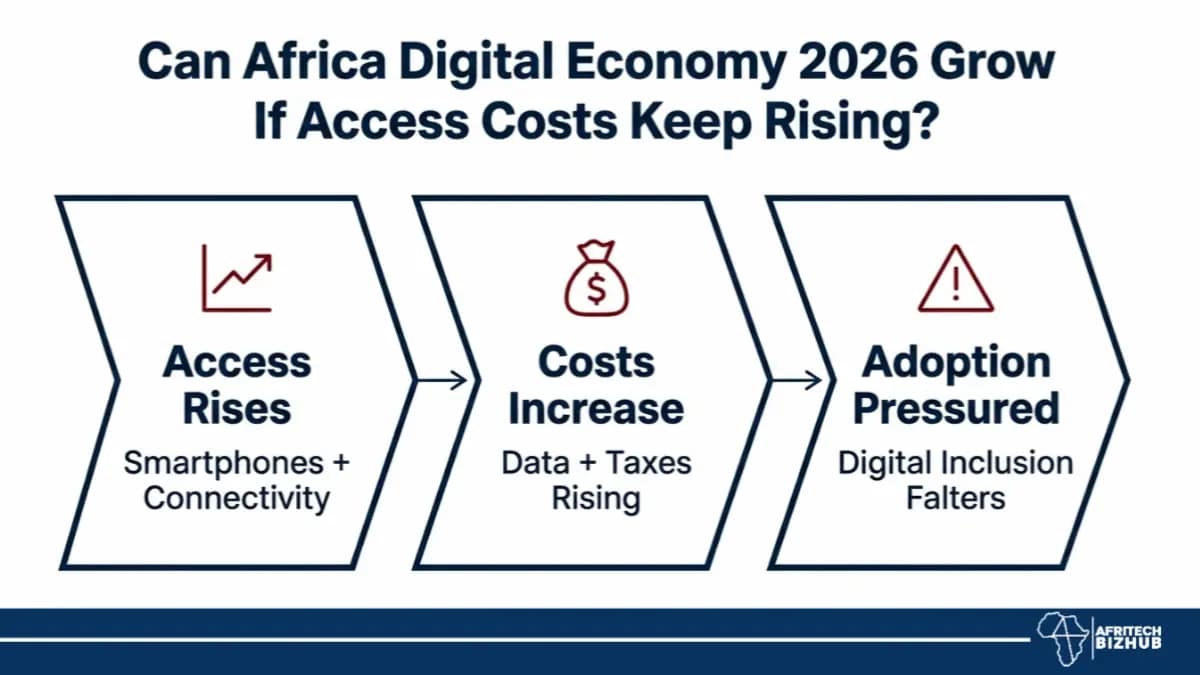
Can Africa Digital Economy 2026 Grow If Access Costs Keep Rising?
Africa’s digital ambitions are no longer constrained by vision.
Governments, investors, and institutions broadly agree that digital participation will play a central role in future economic growth.
The challenge is ensuring that more people can enter that economy, not fewer.
The Africa Digital Economy grows when access expands.
Smartphones, connectivity, digital payments, and online services are no longer peripheral tools; they are becoming part of the infrastructure through which millions earn, transact, learn, and build businesses.
When the cost of participating rises, adoption inevitably faces pressure.
Governments will continue pursuing revenue. Fiscal realities make that unavoidable.
But the long-term success of Africa Digital Economy 2026 may depend on whether revenue policies and digital inclusion objectives move in the same direction.
The countries most likely to benefit from digital growth may be those that expand participation while strengthening public finances, rather than forcing one objective to compete with the other.


Recent Comments