


Last updated: June 10, 2026
Featured Summary:
- Africa digital economy is turning digital access into a recurring monthly expense.
- Digital payments are reducing transaction friction while multiplying everyday payment obligations.
- SMEs are digitising faster than ownership economics, margins, and cash flow are improving.
- Fintech growth is expanding access while deepening monthly cost exposure for consumers and businesses.
Africa’s digital economy solved one problem and introduced another.
Connectivity expanded.
Mobile money scaled.
Digital payments accelerated.
Small businesses moved online.
But the next pressure point is now visible beneath the growth numbers: participation increasingly requires continuous spending rather than one-time ownership.
Consumers and SMEs now pay repeatedly for mobile data, software access, platform fees, device financing, financial services, cloud tools, and digital operations.
Mastercard projects Africa’s digital payments economy could reach $1.5 trillion by 2030, while McKinsey estimates African fintech revenues could reach $47 billion by 2028.
Scale is accelerating.
So is the cost of staying inside the system.
Is Africa’s Digital Economy Driving Recurring Consumer Payments?
Africa digital economy is moving from access economics into recurring payment economics.
The first phase of digital growth focused on connection: buy a device, buy data, join the network.
That model has changed.
Consumers now maintain digital participation through repeated spending on mobile data, transaction fees, subscriptions, app ecosystems, digital finance, streaming, and connected services.
That shift changes the economics of inclusion.
Ownership absorbs cost once.
Subscription models extend cost indefinitely.
The result is not less access.
It is a subscription trap where digital participation increasingly behaves like a utility expense.
The risk is not connectivity.
The risk is that digital access expands faster than purchasing power.
Why Are Digital Payment Costs Rising Across Africa?
The cost pressure now sits inside the infrastructure required to make digital payments work.
Banks process transactions.
Telecom operators provide access.
Fintech firms intermediate payments.
Fintech firms intermediate transactions.
Platforms collect commissions.
Software providers charge access fees.
Each layer lowers friction.
Each layer also extracts value.
Digital payments improve convenience and reduce informal barriers.
They do not automatically reduce household cost pressure.
Higher transaction volume can coexist with higher total payment exposure when charges accumulate across transfers, merchant payments, withdrawals, subscriptions, and platform participation.
The stronger question is no longer whether users can pay digitally.
It is how many times users pay to remain digital.
Can Subscription Economy Models Sustain African SMEs Long-Term?
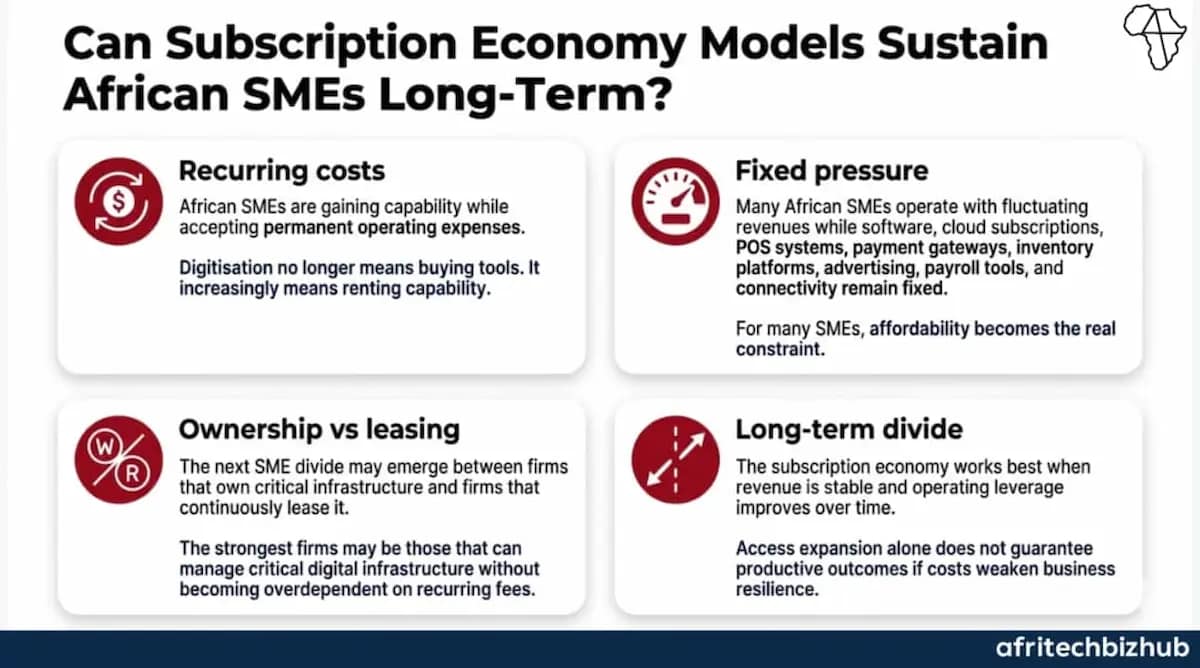
The test is whether recurring digital costs make African SMEs more productive than they make them financially exposed.
SMEs across Africa now depend on accounting platforms, inventory systems, cloud storage, payment software, digital advertising, cybersecurity tools, marketplaces, and operational software as recurring business inputs rather than one-time purchases.
The International Finance Corporation and the World Bank continue to identify digital capability as a major enabler of SME growth, while also highlighting financing constraints and operating-cost pressure facing smaller firms.
The subscription economy does not automatically weaken SMEs.
But digital participation becomes fragile when software, connectivity, and platform costs rise faster than revenue generation.
How Is Fintech Growth Increasing Africa’s Recurring Expenses?
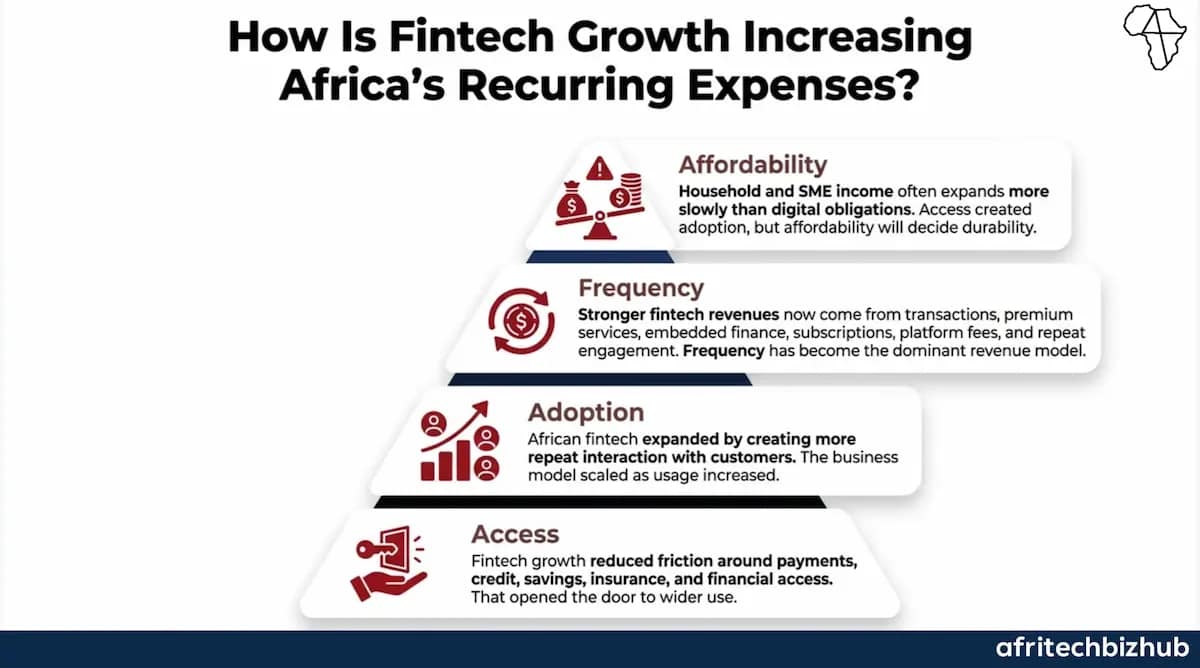
Fintech growth increasingly monetises frequency rather than ownership.
It expanded by reducing friction around payments, savings, credit, insurance, remittances, merchant services, and business operations.
That model created access.
It also created more financial touchpoints tied to repeated usage.
The revenue engine is increasingly built around transaction activity, embedded financial services, merchant infrastructure, credit servicing, premium features, and recurring customer behaviour.
Fintech growth is not creating the subscription trap on its own.
It is accelerating an economy where more services renew, more charges repeat, and more financial relationships remain permanently active.
The forward test is now unavoidable.
Africa digital economy will keep expanding, but growth will become more fragile if recurring costs rise faster than income, margins, and productivity.
The next phase will not be judged by how many people enter the digital system.
It will be judged by whether they can afford to remain inside it.


Recent Comments