


Featured Summary:
- Nigeria South Africa commercial ties continue strengthening despite recurring political tensions.
- Rand Mutual Assurance’s partnership signals deeper private-sector integration across Africa.
- Worker protection now forms part of Africa’s broader economic infrastructure.
- Business ties are pushing regional integration faster than politics.
Nigeria and South Africa often meet each other through tension before trade gets a chance to speak.
Xenophobic incidents, diplomatic discomfort and public mistrust continue to shape how citizens view the relationship between Africa’s two largest economies.
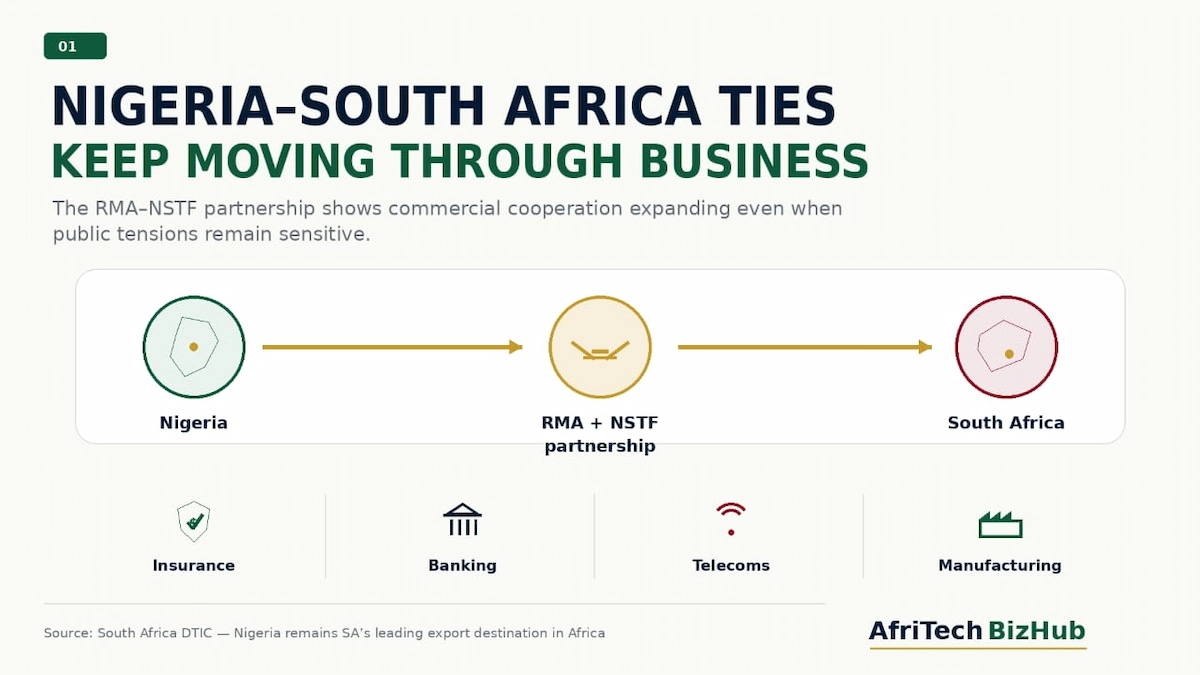
Yet behind that strained public mood, companies and institutions from both countries keep building partnerships in banking, telecoms, insurance, professional services and investment.
Rand Mutual Assurance’s partnership with Nigeria’s NSTF fits that quieter commercial story.
It shows how business cooperation can keep moving even when political relations remain sensitive.
Worker protection may look like a narrow insurance matter, but it sits inside a larger shift: African institutions are linking expertise across borders to support safer workplaces, stronger labour systems and deeper regional markets.
Nigeria South Africa ties are not only defined by public tension; they are also being shaped by the practical needs of companies, workers and institutions that must operate across the continent.
What Is Rand Mutual Assurance Nigeria Deal About?
This agreement reaches beyond a standard insurance partnership.
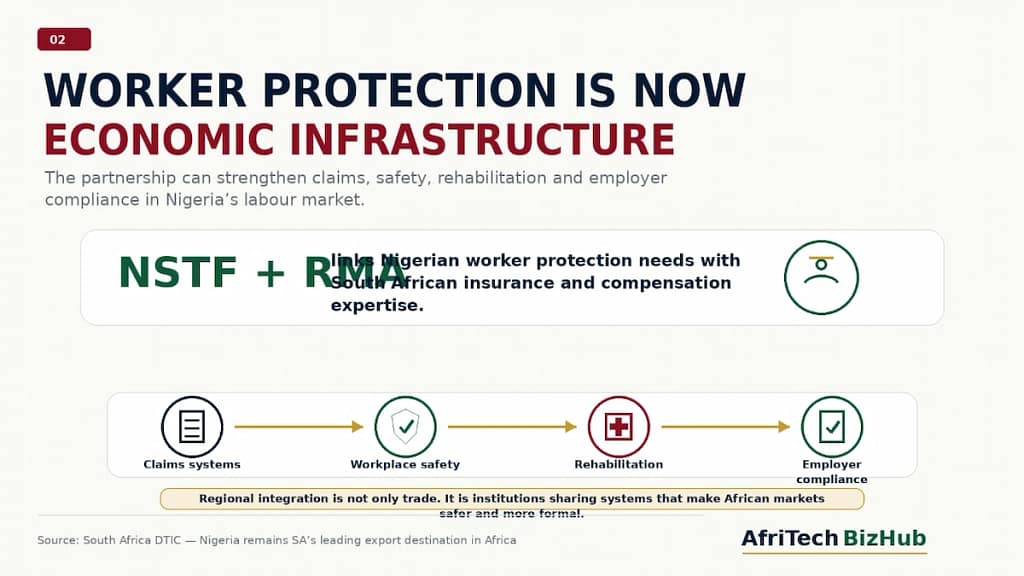
Rand Mutual Assurance brings long experience in occupational injury cover and workers’ compensation, while Nigeria’s NSTF needs stronger systems for claims administration, workplace safety, rehabilitation and employer compliance.
The deal gives both sides a platform to exchange technical knowledge in an area that affects workers, businesses and regulators.
Its wider value lies in what it says about African commercial integration.
Insurance and social protection are no longer only domestic policy concerns.
As companies operate across borders and African markets formalise more jobs, worker protection needs better institutions, data systems and risk-management standards.
For Nigeria, the partnership can support a more effective compensation system.
For South Africa, it shows that institutional expertise built at home can carry commercial and developmental value in another major African market.
Can Social Security in Africa Reach New Heights?
Social security now carries more economic weight than many governments once gave it.
A stronger worker protection system helps reduce uncertainty for employers, protects injured workers from falling into poverty and gives investors more confidence that labour markets have predictable rules.
In fast-growing economies, that matters because productivity depends not only on jobs created, but also on how safely and fairly those jobs are managed.
Africa’s challenge has always been the gap between economic activity and worker protection.
Informal employment remains large, safety enforcement varies by sector, and compensation systems can struggle with slow claims or weak records.
Partnerships like the Rand Mutual Assurance-NSTF agreement can help close part of that gap by improving technical capacity and exposing institutions to stronger operating models.
If applied well, social security can support safer workplaces, healthier labour markets and more resilient businesses.
Why NSTF Signals New Worker Protection Change?
NSTF’s role points to a more structured approach to workplace protection in Nigeria.
Employee compensation requires more than paying claims after accidents.
It involves prevention, employer registration, risk assessment, medical support, rehabilitation, data management and return-to-work systems.
Those functions need disciplined institutions and technical depth.
Nigeria’s economy needs that shift because growth without worker protection leaves businesses and employees exposed.
Construction, manufacturing, logistics, mining, retail and formal services all carry workplace risks that require clear compensation frameworks.
A stronger NSTF can help employers manage obligations while giving workers more reliable protection when injuries occur.
The partnership with Rand Mutual Assurance therefore matters because it can help Nigeria move from basic compensation administration toward a more complete workplace safety and insurance system.
How Nigeria South Africa Partnership Links Grow?
Commercial ties between Nigeria and South Africa have survived because both economies offer what the other needs.
Nigeria provides scale, population, energy demand, financial opportunity and one of Africa’s largest consumer markets.
South Africa brings corporate depth, banking experience, insurance expertise, telecoms strength, manufacturing capacity and professional services.
South Africa’s Department of Trade, Industry and Competition has described Nigeria as South Africa’s leading export destination in Africa and noted that the 2024 trade deficit with Nigeria was largely driven by oil and gas imports.
The department also identified automotive manufacturing, electric mobility, pharmaceuticals, agriculture and green energy as areas where both countries can diversify trade.
That official position shows why Nigeria South Africa business links continue to matter: the relationship already goes beyond politics and now cuts across goods, services, investment and institutional cooperation.
What Does South Africa Trade With Nigeria?
The trade relationship still carries a strong goods component.
Nigeria sells energy products that influence the trade balance, while South Africa exports manufactured goods, vehicles, machinery, chemicals, plastics, food products and industrial inputs.
Oil and gas remain important, but they no longer tell the full story of the commercial relationship.
Services and institutional partnerships now add more depth to the bilateral corridor.
South African banks, telecoms firms, insurers, retailers and professional service companies have long viewed Nigeria as a market that cannot be ignored.
The Rand Mutual Assurance-NSTF partnership adds worker protection to that wider map of cooperation.
A stronger Nigeria South Africa relationship will depend on this broader mix: trade in goods, investment in services, institutional knowledge exchange and private-sector confidence that can hold even when political tensions rise.


Recent Comments