


Featured Summary:
- China market demand is accelerating Zimbabwe’s commercial blueberry industry.
- Commercial farming is strengthening Zimbabwe’s export earnings beyond mining.
- Blueberry exports are expanding Zimbabwe’s position in global agricultural trade.
- Agriculture is becoming a stronger driver of investment and economic diversification.
Zimbabwe’s next export opening is coming from a crop that demands cold chains, careful farming, strict market standards and buyers willing to pay for premium quality.
Blueberries are giving Zimbabwe a chance to prove that agriculture can earn serious foreign exchange when production is commercial, export-ready and connected to high-value consumer markets.
The China market raises the stakes because it turns a fast-growing horticulture niche into a much larger trade opportunity.
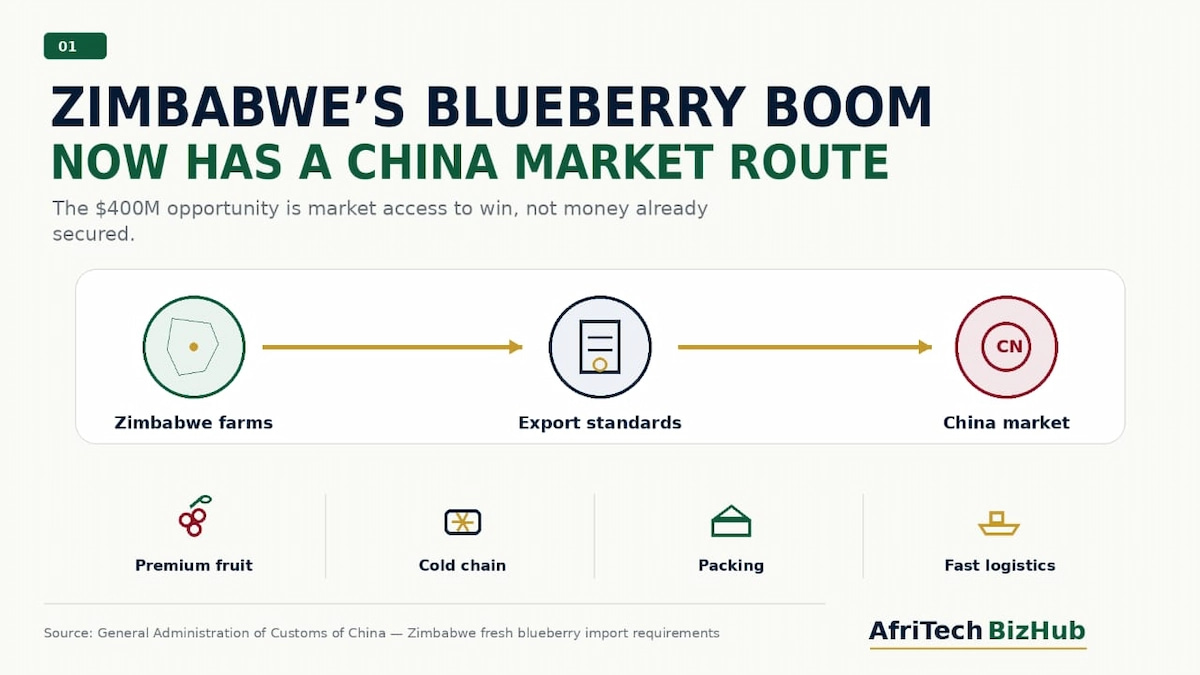
The $400 million figure should be read as the size of the market Zimbabwe is trying to enter, not money the country has already secured.
That distinction matters. China gives Zimbabwe access to demand, but Zimbabwe still has to win that demand through scale, quality, logistics and compliance.
If growers can meet those conditions, blueberries could become one of the clearest signs that Zimbabwe’s export future does not have to depend on minerals alone.
How Will China Market Transform Blueberry Growth?
Premium demand is pushing Zimbabwean blueberries beyond the limits of ordinary agriculture.
The China market can reward growers that deliver consistent quality, reliable volumes and fruit that meets strict inspection standards.
That changes the business model because blueberry farming is capital-intensive, technical and export-driven.
It requires irrigation, skilled labour, cold storage, packaging systems, traceability and fast logistics.
Farms are no longer only places where crops are grown; they become part of a wider trade system involving certification, packhouses, freight routes, buyers and retail standards.
China’s demand can encourage producers to expand acreage and improve yields, but it also raises the bar.
Zimbabwe will benefit only if its blueberry industry can move from promising production to dependable supply at commercial scale.
Can Zimbabwe Exports Increase Global Blueberry Supply?
The country is not trying to become the world’s largest blueberry exporter.
Its opportunity is to supply premium fruit during seasonal windows when Northern Hemisphere production is weaker and buyers are looking toward Southern Hemisphere producers.
That makes Zimbabwe useful in global blueberry trade even before it reaches the scale of larger exporters.
Zimbabwe’s advantage is timing, not dominance.
This seasonal position gives Zimbabwe exports a practical route into higher-value food markets.
The country already sells blueberries into destinations such as Europe, the Middle East and parts of Asia.
China adds a larger and more competitive demand centre.
The opportunity is not only to ship more fruit, but to become a trusted supplier of premium fruit at the right time of year.
In global agriculture, reliability can be as valuable as size.

Will Export Earnings Rise Through Agriculture?
Blueberries are important because they widen Zimbabwe’s export conversation beyond mining.
Minerals remain central to foreign exchange earnings, but reliance on extractive sectors exposes the economy to price cycles, policy risk and limited job creation outside mining corridors.
High-value horticulture gives Zimbabwe a different type of export engine, one that can connect farms, packhouses, freight companies, input suppliers and rural employment.
The earnings opportunity will depend on scale and financing.
Current shipments to China are a breakthrough, but export growth needs more hectares, long-term capital, modern irrigation, cold-chain capacity and reliable routes to market.
If those pieces improve, agriculture can contribute more meaningfully to foreign exchange resilience.
The larger economic point is that blueberries are not just a farm story.
They are a test of whether Zimbabwe can build export industries that spread value across more parts of the economy.
What Chinese Companies Are Operating in Zimbabwe?
China’s role in Zimbabwe already runs through mining, energy, infrastructure and industrial processing, which places the blueberry opening inside a broader commercial relationship.
Chinese-linked companies have been active in lithium, chrome, construction and power-related projects, while Zimbabwe has continued to look to China for investment, equipment, export markets and industrial partnerships.
Agriculture is now entering that same commercial corridor, but with a different test: meeting premium food-import standards rather than extracting minerals.
China’s General Administration of Customs approved the import of fresh blueberries from Zimbabwe under GACC Announcement No. 187 of 2025, published in English through the China-Africa SPS Cooperation Information Platform.
The announcement permits fresh blueberry imports from Zimbabwe that comply with phytosanitary requirements agreed between China’s customs authority and Zimbabwe’s agriculture ministry.
That access gives Zimbabwe a formal route into the China market, but only farms, packhouses and exporters that meet quarantine, registration, pest-control, packaging and certification standards can convert that opening into export earnings.
Market access has been granted. Commercial scale now depends on compliance.
Which Countries Are Investing in Zimbabwe?
Zimbabwe’s investment base is wider than China, even though China remains one of the most visible players in mining, infrastructure and industrial processing.
South African capital remains important through trade, services, retail, finance, mining and regional business links.
The United Arab Emirates has become more visible in gold trade, finance, logistics and investment flows.
India is active through pharmaceuticals, manufacturing, trade and technology-linked services, while European and development-finance partners remain relevant in agriculture, climate resilience, private-sector support and export standards.
That wider capital map matters because the blueberry opportunity cannot be built by market access alone.
China can create demand, but Zimbabwe needs financing from multiple partners to expand farms, irrigation, packhouses, cold storage, freight systems and export certification.
A healthier investment model would reduce dependence on one commodity and one buyer.
If mining keeps earning foreign exchange while agriculture builds new export channels, Zimbabwe can move toward a more balanced growth model.
The strongest outcome is not only blueberries entering China.
It is commercial farming becoming a serious pillar of Zimbabwe’s long-term export economy.


Recent Comments