


Featured Summary:
- China Infrastructure Africa is moving local as Chinese machinery firms expand servicing and spare parts networks across African markets
- Infrastructure competition is shifting beyond construction delivery into equipment uptime and operational continuity
- Morocco is strengthening its position as a machinery support and regional servicing hub across North and West Africa
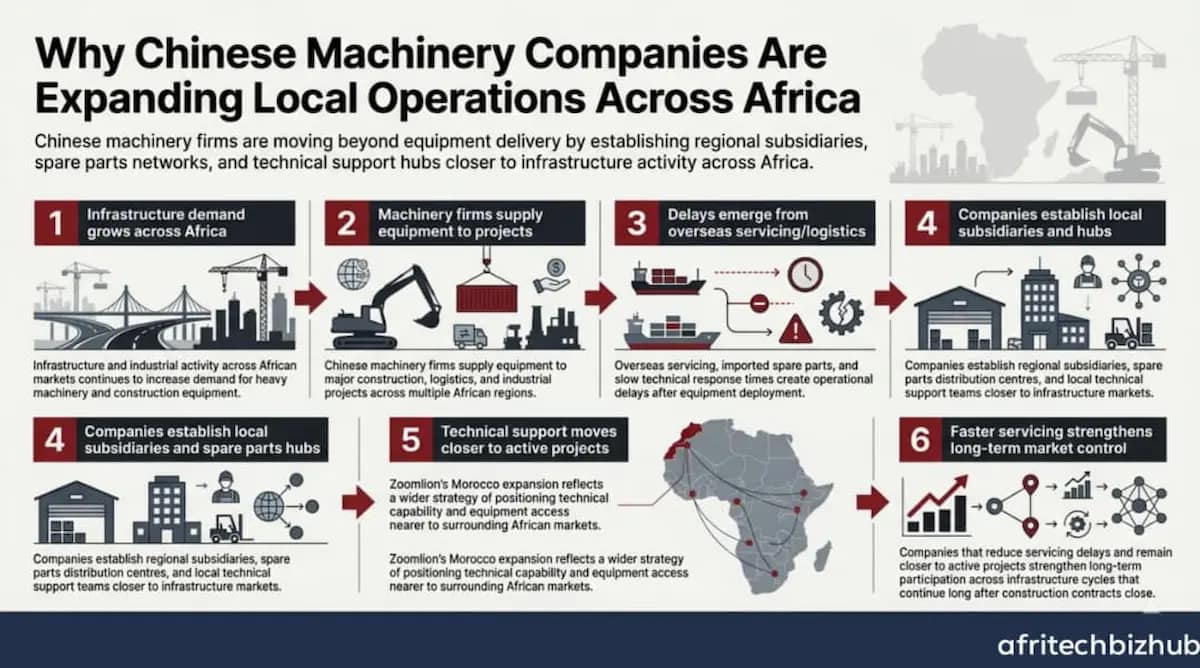
Chinese machinery companies are extending their position inside African infrastructure markets through localized servicing, spare parts distribution, and maintenance systems designed to remain active long after construction projects close.
Firms such as Zoomlion have expanded regional operating capacity, including Morocco-based support infrastructure, to improve equipment continuity across surrounding markets.
The shift is redefining China Infrastructure Africa around operational presence rather than one-time project execution.
Why Are Chinese Machinery Companies Expanding Local Operations Across Africa?
China Infrastructure Africa is moving closer to where infrastructure demand actually exists.
Chinese machinery firms are expanding local subsidiaries, spare-parts distribution, technical servicing, and regional support operations to remain active after equipment delivery.
Zoomlion’s Morocco positioning reflects that direction by placing technical capability and equipment access nearer to infrastructure and industrial demand across surrounding African markets.
The larger shift extends beyond maintenance.
Machinery firms increasingly compete not only for equipment sales but for long-term control over servicing cycles, replacement demand, technical relationships, and operational continuity that continue after construction contracts end.
Equipment creates market entry. Local presence extends market influence.
Why Is Infrastructure Maintenance Becoming a Competitive Layer of the Machinery Market?
Infrastructure spending creates physical assets. Maintenance determines whether those assets continue producing economic output.
Construction machinery operating across transport, industrial, logistics, and energy projects depends on repair speed, replacement access, and equipment readiness over years of operation.
That reality is creating a larger competitive layer around machinery support.
China Infrastructure Africa is increasingly extending into that phase as equipment providers compete to remain inside the operating life of infrastructure rather than limiting activity to equipment delivery alone.
Companies capable of reducing downtime and shortening repair cycles increasingly gain stronger positions across future infrastructure procurement.
Why Is Morocco Becoming a Strategic Machinery Gateway for China Africa Infrastructure?
Morocco is strengthening its position as a regional machinery and logistics base connecting infrastructure demand across North Africa and parts of West Africa.
Its industrial footprint, transport connectivity, manufacturing base, and access to major trade routes allow equipment providers to support multiple markets from a single operating location.
Zoomlion’s decision to establish operations in Casablanca reflects that advantage.
For China Infrastructure Africa, regional reach increasingly depends less on where equipment enters the continent and more on where machinery networks are positioned to support active infrastructure systems over time.
How Is Machinery Localization Reshaping Africa’s Infrastructure Equipment Market?
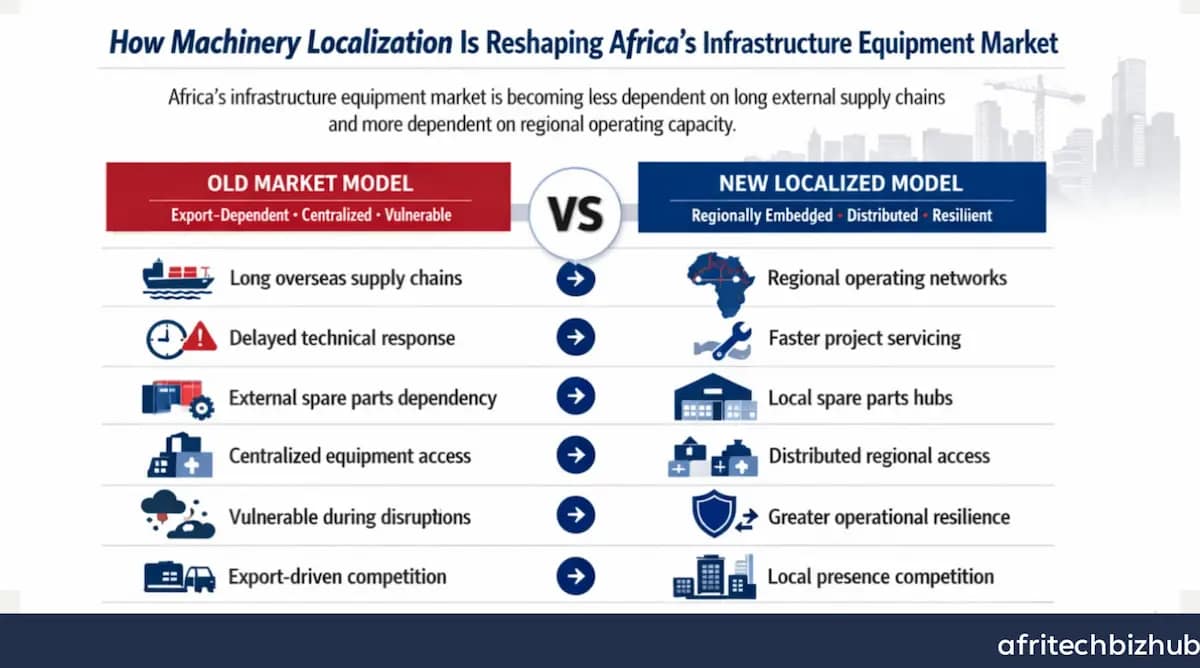
Africa’s infrastructure equipment market is becoming less dependent on long external supply chains and more dependent on regional operating capacity.
Machinery providers positioned closer to infrastructure activity gain faster response capability, stronger equipment availability, lower servicing delays, and greater resilience during project interruptions.
This broader direction aligns with findings in the State of Africa’s Infrastructure Report 2026 – Africa Finance Corporation, which identifies stronger infrastructure systems, industrial capability, and operational resilience as increasingly important to long-term infrastructure performance.
Machinery localization reflects one commercial response to that wider operating environment.
What Decides Infrastructure Strength After Construction Ends?
Infrastructure performance is tested after construction ends.
Roads, industrial facilities, ports, transport networks, and energy assets continue depending on machine access, repair capability, servicing cycles, and equipment replacement throughout their operating life.
China Infrastructure Africa is becoming more visible inside that phase through localized machinery networks designed to remain active after project delivery.
Infrastructure advantage increasingly comes from systems that keep assets functioning consistently over time, not only from those capable of building them first.


Recent Comments