


Featured Summary:
- Category creation determines market influence, allowing startups to define demand rather than fight for existing share.
- Product design limits growth when companies replicate competitors instead of addressing unmet needs.
- Product leadership in Africa succeeds when leaders identify opportunities before competitors recognize them.
- Startup scale expands markets and ecosystems, rather than simply redistributing customers among existing players.
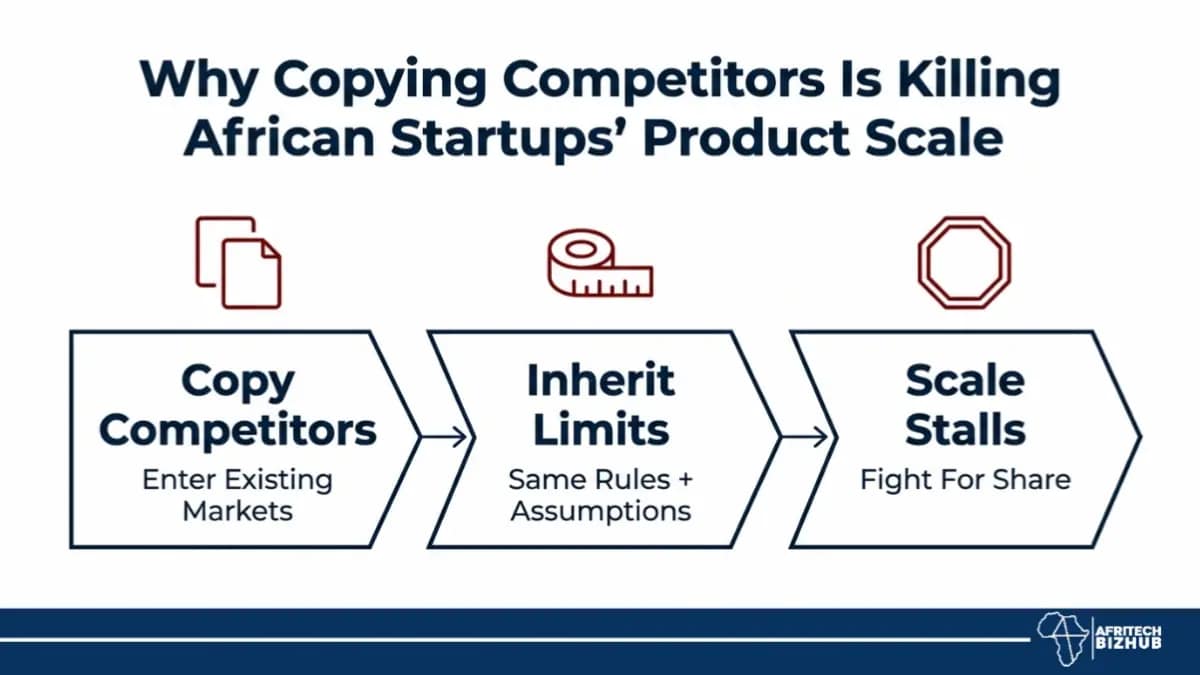
African startups are encouraged to study successful companies, but learning becomes limiting when it turns into copying.
Founders often enter markets with established products, familiar behaviors, and clearly defined customer expectations.
The result is visible across the continent: growth slows, acquisition costs rise, differentiation erodes, and competition becomes relentless.
Observed patterns indicate that execution alone does not guarantee scale.
Strategy itself — the choice to follow versus define — often sets the boundaries for what a startup can achieve.
How Does Category Creation Shape Startup Dominance?
Category creation allows startups to redefine how customers perceive a problem or solution.
Entering an existing market forces companies to compete within pre-defined parameters, often focusing on price, marketing, or convenience.
Startups that create new categories shift the conversation itself, introducing solutions, behaviors, or ways of thinking that competitors have not yet imagined.
Observed patterns show that category creators often become the reference point for the market, forcing others to adapt.
Dominance frequently emerges long before market leadership becomes obvious.
In Africa, where many markets are fragmented, startups that define categories influence adoption patterns, investor expectations, and ecosystem development in ways that follower companies cannot.
Can Product Design Limit African Startup Success?
Product design becomes a constraint when founders start with competitor research rather than customer research.
Observed behavior indicates that replicating existing structures often copies hidden assumptions about users, journey, and business model.
The consequence is strategic ceiling: products may gain users and revenue, but differentiation is minimal.
African startups that build around competitor models inherit limitations imposed by prior market definitions rather than unlocking new demand.
Growth slows not because execution fails, but because the market has already been delineated by someone else.
What Defines Strong Product Leadership in Africa?
Product leadership succeeds when curiosity drives exploration of unmet needs.
Observed patterns suggest that leaders who focus on friction points, overlooked behaviors, and latent demand create strategic advantage.
By observing user behavior rather than competitors, product leaders identify opportunities for new categories.
They shape market expectations, influence adoption trends, and define the rules that followers later obey.
The distinction between reactive and proactive leadership often determines whether a startup competes or defines the ecosystem.
How Does Startup Scale Influence Market Growth?
Startup scale affects more than revenue.
Observed evidence from the World Bank indicates that scaling businesses expand ecosystems, attract investment, influence supplier networks, and increase productivity.
Large startups create market-wide spillovers that smaller, copied models rarely achieve.
In African contexts, companies that scale by defining new categories unlock opportunities for entirely new customers, business models, and service offerings.
Research demonstrates that scale becomes a mechanism for ecosystem development rather than just internal growth.
Does the Ecosystem in Africa Enable Category-defining Innovation?
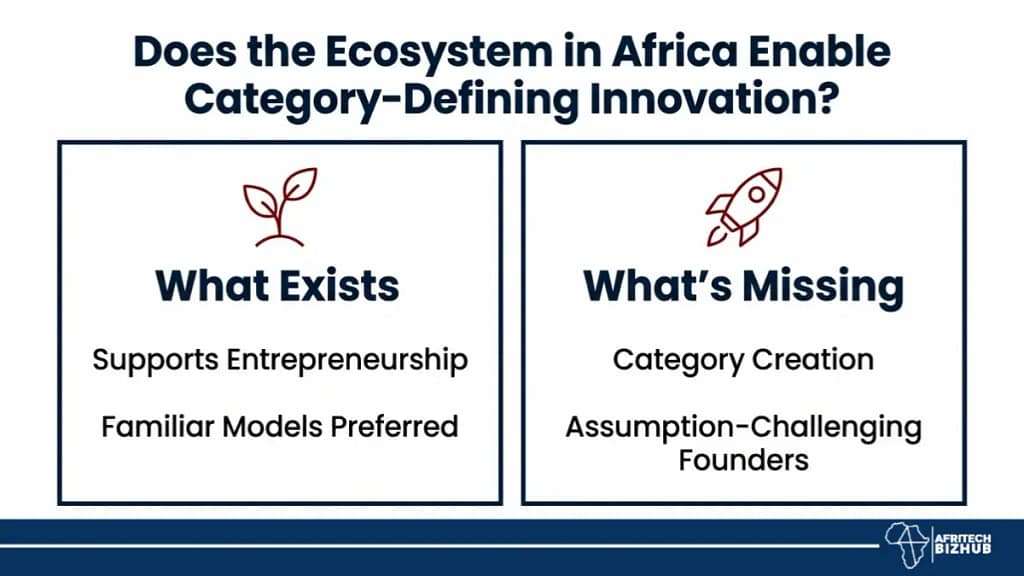
The African ecosystem supports entrepreneurship, but observed patterns show that investors often prefer familiar models and customers gravitate toward known solutions.
This environment makes copying attractive, yet limits strategic potential.
Startups that challenge assumptions and create new categories expand markets, shape ecosystems, and influence adoption across the continent.
Observed patterns suggest that Africa’s next wave of impactful companies will be those that define opportunities rather than follow competitors, creating structural advantages for scale and long-term impact.


Recent Comments