


Featured Summary:
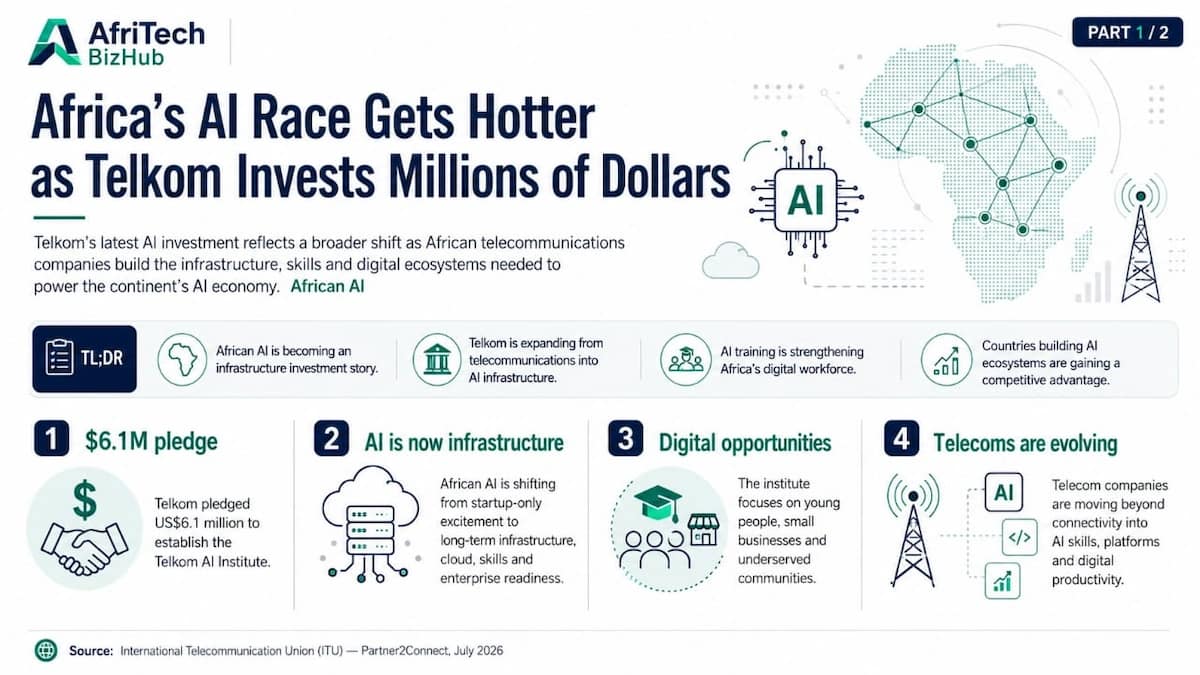
- African AI is becoming an infrastructure investment story.
- Telkom is expanding from telecommunications into AI infrastructure.
- AI training is strengthening Africa’s digital workforce.
- Countries building AI ecosystems are gaining a competitive advantage.
Africa’s AI race is no longer being shaped by startups alone.
Telecommunications companies are investing in the infrastructure, connectivity and digital talent that artificial intelligence depends on, turning AI into a long-term economic strategy rather than a technology experiment.
Telkom’s US$6.1 million pledge for the Telkom AI Institute places South Africa’s telecom sector directly inside that shift.
The move gives African AI a clearer infrastructure frame.
Connectivity alone no longer defines digital competitiveness.
The next advantage will belong to countries and companies that can combine networks, cloud capacity, skills, governance and enterprise adoption.
Telkom’s investment points to a wider transition in which telecom companies are not only carrying data traffic but helping build the workforce and platforms that AI economies need.
How Is Telkom AI Creating Digital Opportunities?
Telkom AI is creating digital opportunities by moving the company beyond traditional telecommunications into AI skills, digital capability and enterprise readiness.
The Telkom AI Institute is designed to equip South Africans with practical AI and digital skills, with a focus on young people, small businesses and communities that remain underserved in the digital economy.
That makes the investment part of a wider shift from network access to productive digital participation.
Telecom companies were once judged mainly by coverage, subscribers and connectivity.
That measure is changing as artificial intelligence increases demand for cloud services, data infrastructure, digital talent and smarter business tools.
Telkom’s move shows how connectivity can become the foundation for AI-driven economic growth.
African AI will scale faster where networks are matched by people who can use them to build businesses, improve services and raise productivity.
Why Is South African AI Gaining Global Attention?
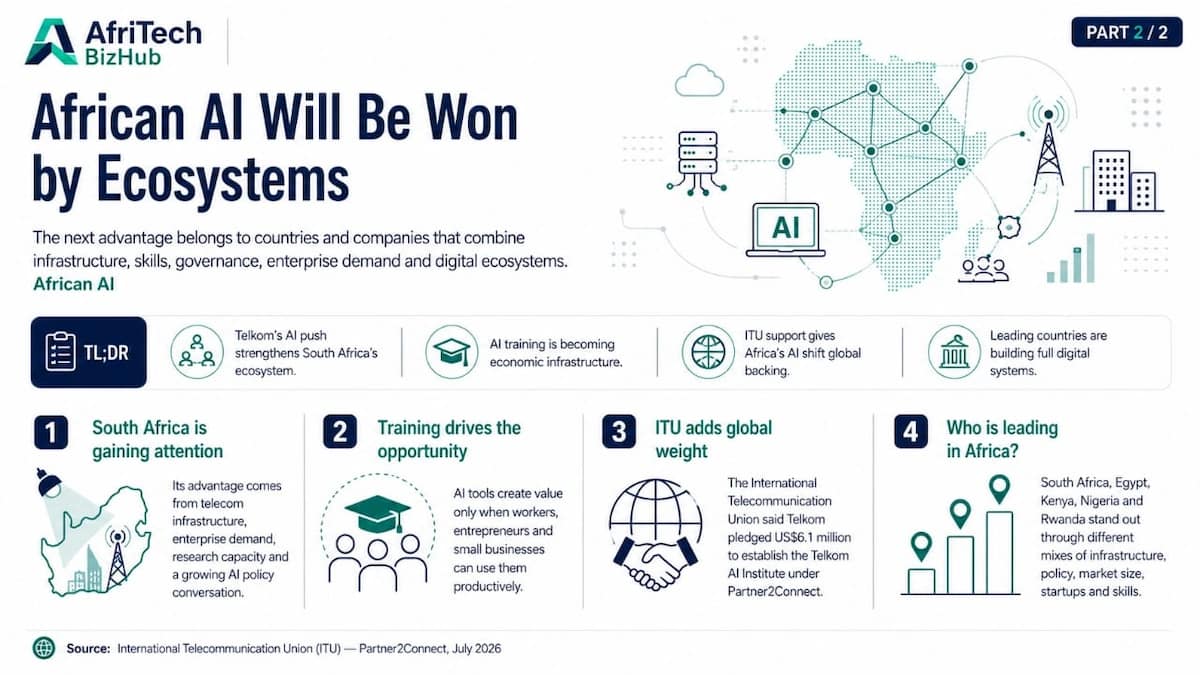
South African AI is gaining attention because the country combines telecom infrastructure, enterprise demand, research capacity and a growing policy conversation around artificial intelligence.
Large companies, universities, technology providers and public institutions are beginning to treat AI as an economic capability rather than a narrow software trend.
That gives South Africa a stronger base than markets where innovation remains isolated from infrastructure and skills.
AI leadership is no longer defined only by global technology companies.
Countries with stronger digital ecosystems are becoming more competitive because they can support adoption across finance, telecoms, mining, healthcare, public services and education.
South Africa’s advantage sits in that mix of infrastructure, corporate demand and institutional capacity.
Telkom’s investment strengthens the skills side of that ecosystem, which is becoming one of the clearest measures of AI readiness.
How Will AI Training Transform Digital Economy Opportunities?
AI training is becoming economic infrastructure because technology alone cannot create a competitive digital economy.
Businesses need workers who can use AI tools, manage data, automate processes, protect systems and apply digital skills to real commercial problems.
Without that human capacity, investment in software and connectivity delivers limited value.
Telkom’s AI Institute places workforce development at the centre of the opportunity.
Training young people, small businesses and underserved communities can widen participation in the digital economy instead of concentrating AI benefits among already-connected firms.
The stronger outcome is not only more AI users.
It is a larger pool of workers, entrepreneurs and businesses able to turn artificial intelligence into productivity, employment and innovation.
What Role Will International Telecommunication Union Play?
The International Telecommunication Union is becoming important to Africa’s AI future because digital transformation now depends on standards, partnerships and trusted infrastructure as much as private-sector investment.
AI development is no longer shaped only by companies building models or applications.
Global institutions are influencing how countries build connectivity, close digital divides, strengthen skills and deploy technology responsibly.
ITU’s Partner2Connect Digital Coalition gives Telkom’s investment a wider international frame.
ITU said Telkom pledged US$6.1 million to establish the Telkom AI Institute as part of commitments to expand digital skills, innovation and inclusive participation in the digital economy.
For African AI, that matters because governance, standards and cooperation are becoming part of competitiveness.
Countries that build trusted AI ecosystems will be better placed to attract investment, scale digital services and connect local talent to global technology markets.
Which African Countries Are Leading in AI?
Africa’s AI leaders are increasingly being defined by ecosystem strength rather than single innovation projects.
South Africa stands out through telecom infrastructure, enterprise adoption, research depth and policy development.
Egypt combines state-backed digital strategy, technology investment and a large talent base.
Kenya has built strength around digital public infrastructure, startup activity and emerging national AI strategy.
Nigeria carries scale, developer talent, fintech adoption and one of Africa’s largest technology markets.
Rwanda remains important because of its policy ambition, digital-governance focus and early moves around AI readiness, while Mauritius, Morocco and Tunisia are also part of the wider competitiveness picture.
The leading countries are not identical.
Some are stronger in policy, others in startup activity, infrastructure, research, market size or skills.
The common thread is ecosystem building.
African AI leadership is moving from isolated projects toward national systems that can support infrastructure, talent, governance, investment and digital exports over the long term.


Recent Comments