

Featured Summary:
- AI in Africa is becoming a development opportunity, but skills will decide whether the continent builds value or only consumes imported tools
- AI innovation Africa can improve education, health, agriculture, public services, and business productivity when local capacity is strong enough
- AI jobs Africa will reward workers who can use digital tools, analyse information, solve problems, and adapt to changing workplace systems
- AI education Africa is becoming urgent because youth potential cannot translate into innovation without stronger schools, universities, and training pipelines
Africa is not short of young people, ambition, startups, or digital energy. The harder question is whether its education systems are preparing enough learners for the economy AI is already shaping.
Classrooms, universities, vocational centres, and workplace training programmes are now under pressure to catch up with tools that can change how people learn, work, create, and compete.
That is the concern behind Tomorrow Foundation’s warning. AI in Africa can support development, but it can also widen inequality if only a small group gains the skills to use it well.
The continent does not need AI enthusiasm alone. It needs students who can question outputs, workers who can adapt, teachers who can guide digital learning, and institutions that can connect technology to real problems.
Without education reform, Africa may participate in the AI race without controlling enough of its value.
Is AI in Africa Driven By Skills?
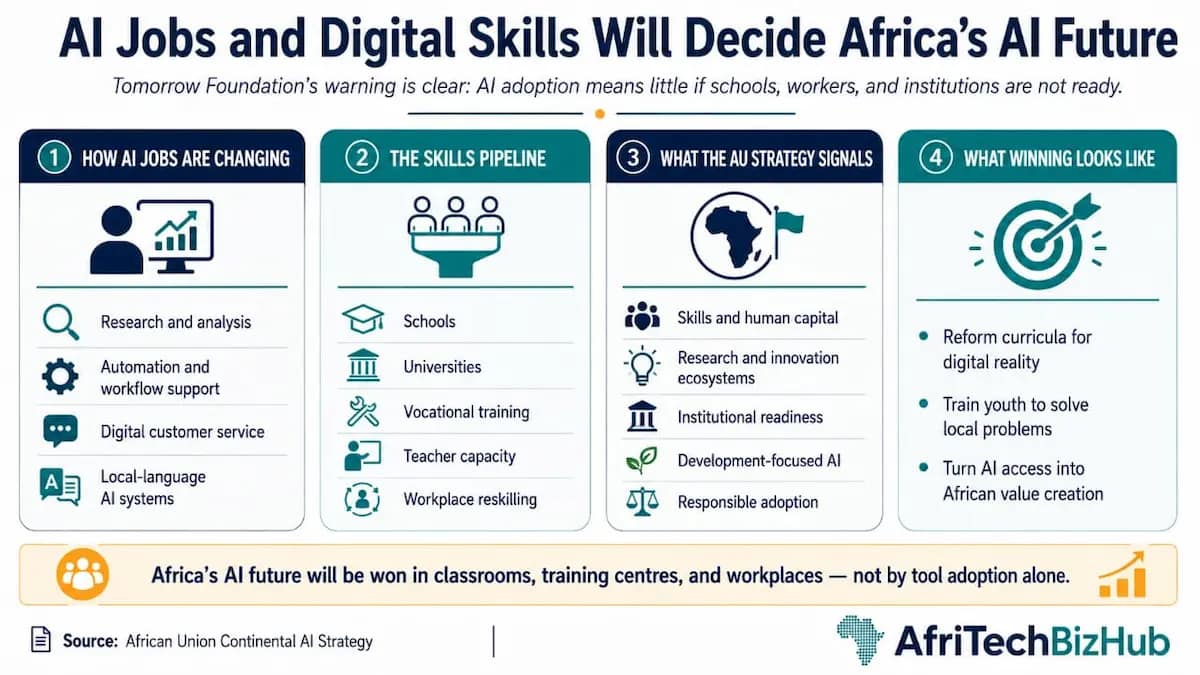
The strongest AI advantage will not come from access to tools alone. It will come from people who know how to use those tools with judgement, creativity, and technical confidence.
AI platforms can spread quickly, but the ability to apply them across schools, businesses, public services, and local industries depends on skills.
That makes talent the centre of AI in Africa. Coding is important, but the skills base must be wider than software development.
Students need digital literacy, data awareness, research discipline, ethics, communication, problem-solving, and practical exposure to AI tools.
Workers need to understand how AI can improve tasks in finance, agriculture, health, logistics, media, education, governance, and small business.
A country can import AI software in weeks. It takes years to build an AI-ready workforce.
Can AI innovation Africa Transform Development Outcomes?
Development impact will depend on whether AI is built around African problems rather than imported as a finished solution.
The continent has urgent needs in education, healthcare, agriculture, public administration, transport, fraud prevention, climate adaptation, and local-language access.
AI innovation Africa becomes useful when it reduces these pressures in practical ways.
A well-designed AI tool can help teachers personalise learning, support health workers with early screening, help farmers interpret weather risks, improve tax systems, speed up document processing, and help small businesses understand customers.
But impact will depend on data quality, electricity, internet access, affordability, trust, regulation, and local skills.
AI innovation can transform development outcomes only when it is connected to systems people already use and institutions that can maintain it.
Will AI jobs Africa Reshape Employment Opportunities?
The labour market is likely to change through task redesign before it changes through mass replacement.
Employers will increasingly value workers who can research faster, analyse information, automate routine work, communicate clearly, and use digital systems responsibly.
That creates new openings for young Africans with adaptable skills, but it also raises the risk of exclusion for those without digital access or training.
AI jobs Africa will not be limited to engineers. Opportunities can grow around data labelling, AI operations, prompt development, cybersecurity, digital customer support, product testing, content workflows, compliance, education technology, health technology, and local-language AI systems.
Existing roles will also shift. Teachers, accountants, analysts, journalists, designers, civil servants, traders, and technicians will need to understand how AI changes their work.
The jobs opportunity is real, but it will favour people prepared to learn continuously.
Are Digital Skills for Africa the Priority?
The foundation of Africa’s AI future is not a model, an app, or a conference.
It is the ability of millions of people to read, calculate, use digital tools, interpret information, and solve problems in a changing economy.
Digital skills for Africa have moved from a technology-sector issue to a national development priority.
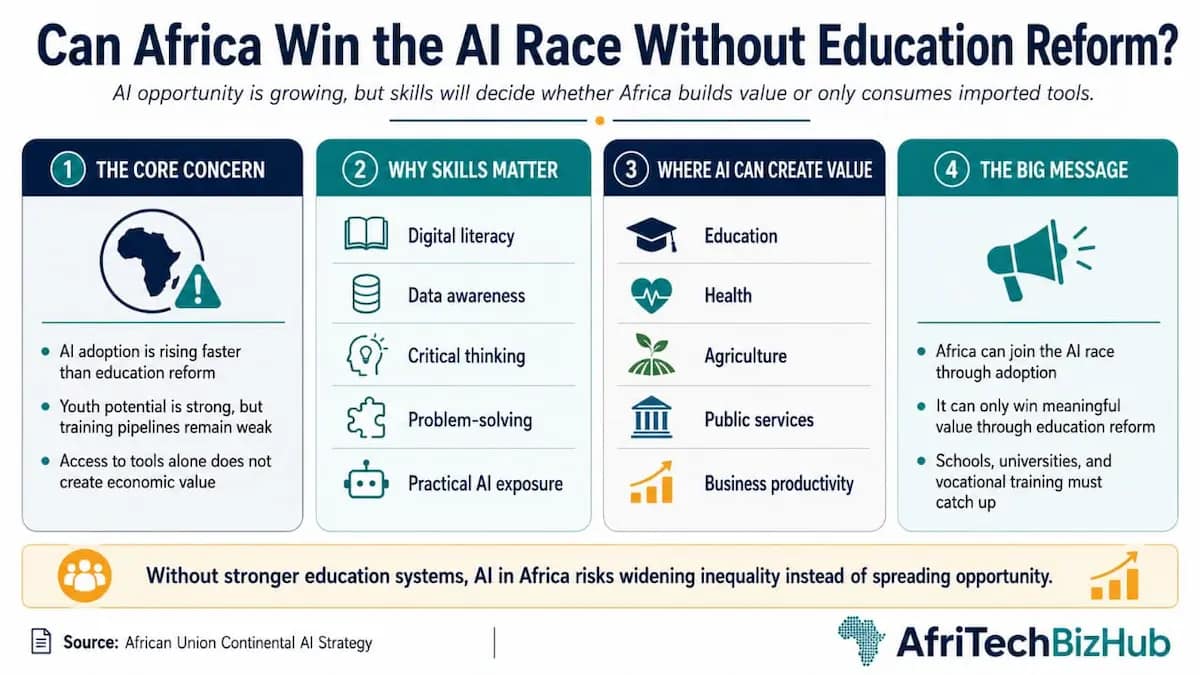
The African Union’s Continental Artificial Intelligence Strategy places education, skills, human capital, research, innovation ecosystems, and institutional readiness at the centre of Africa’s AI direction.
It also frames AI as a tool for development across education, health, agriculture, infrastructure, governance, and other sectors.
That makes the skills question central to the whole article: AI in Africa cannot scale responsibly if schools, universities, training centres, and public institutions are not prepared to build the talent pipeline behind it.
Does AI Education Africa Unlock Youth Potential?
Africa’s youth population becomes an advantage only when education turns numbers into capability.
A large generation of young people can drive AI innovation, entrepreneurship, research, public-sector reform, and new business models.
But that promise weakens if learners leave school without digital confidence, practical problem-solving ability, or exposure to the tools shaping the future of work.
AI education Africa is therefore not just about teaching students how to use chatbots or coding platforms.
It is about preparing them to think critically, work with data, understand risks, build useful products, and apply technology to local realities.
Tomorrow Foundation’s concern points to the real test ahead: Africa can join the AI race through adoption, but it can only win meaningful value through education reform.
The countries that act early on skills, teachers, curricula, research, and youth training will have a stronger claim on the next phase of AI innovation and AI jobs.


Recent Comments