

Featured Summary:
- Electric vehicles in Africa are taking hold first in major commercial centres
- Weak power, roads and charging networks are limiting adoption beyond those markets
- Technical skills and local servicing capacity are still too thin for a wider EV economy
- Africa has the resources to build more of the industry instead of importing most of its value
China sold more than 13 million electric cars in 2025, taking EVs to nearly 55% of new-car sales. The United States sold about 1.5 million, equal to just under 10% of its market.
Across Africa, sales reached only about 25,000, up from roughly 4,000 in 2023. Global electric-car sales passed 20 million during the year.
Johannesburg, Cape Town, Nairobi, Lagos, Accra, Casablanca and Cairo have become some of the continent’s earliest EV markets.
They offer better electricity supply, stronger road networks, dealerships, financing, digital services and a larger pool of consumers able to buy newer vehicles. Outside these commercial centres, access to those services is far less consistent.
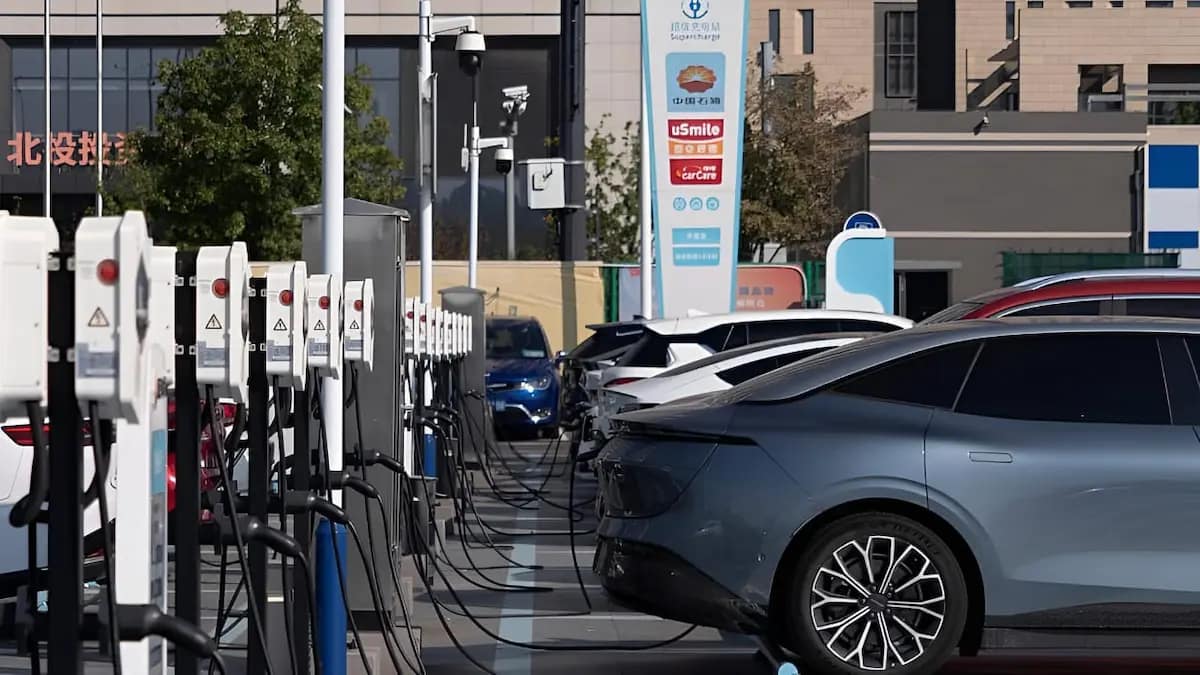
More than 7 million public charging points were operating worldwide by the end of 2025, including over 4.7 million in China alone.
Across much of Africa, public charging remains sparse and uneven, especially outside the main cities and intercity routes.
Electric vehicles are entering African markets, but adoption still depends heavily on location.
Large cities are moving first, while many secondary cities, peri-urban areas and rural communities still lack the road, power, servicing and financing conditions needed for wider use.
Africa’s Largest Cities Are Building the First EV Markets
South Africa has the continent’s most developed passenger-vehicle market, with Johannesburg, Pretoria and Cape Town already supporting a larger share of EV activity.
These cities have established dealerships, denser charging coverage, stronger commercial electricity connections and more consumers able to finance new vehicles.
Chinese brands are adding more models, but private passenger EV ownership remains concentrated among higher-income buyers.
Kenya’s charging plans extend beyond Nairobi into Mombasa, Naivasha, Nakuru, Eldoret, Kisumu and other towns, with later expansion into additional county centres. The rollout follows the country’s main transport and electricity corridors.
In Nigeria, Saglev produces electric vehicles from semi-knocked-down components at its Ikorodu plant in Lagos. Finance, logistics, power costs, charging and limited local component supply continue to constrain expansion.
Morocco has moved further into EV manufacturing. In July 2026, the African Development Bank approved €100 million for the first phase of Gotion Power Morocco’s battery project, designed to produce 10 GWh of lithium iron phosphate cells and packs annually.
EV activity remains concentrated where automotive infrastructure, electricity, finance and consumer demand are strongest. Outside those areas, charging, servicing and reliable power become much less consistent.
Africa’s EV Infrastructure Thins Out Beyond Its Commercial Centres
Mission 300 is targeting electricity connections for 300 million additional Africans by 2030, while large parts of the continent are still expanding basic power access for homes, businesses and public services.
Outside the main commercial centres, charging points are fewer, roads are less reliable and servicing networks are thinner across many secondary cities, peri-urban areas and rural communities.
Vehicle finance, spare parts, battery diagnostics and trained technicians are also harder to find.
Kenya’s charging plan extends beyond Nairobi into major transport routes, county headquarters and secondary towns, widening access outside the capital.
Advanced driver-assistance systems depend on reliable mapping, clear road markings, communications networks and predictable traffic systems.
China and the United States are already building around those requirements, while many African markets are still dealing with unreliable power and weak road networks.
Electric mobility will remain concentrated around the best-served routes until power, roads, charging and servicing reach a wider part of the continent.
Public transport, commercial fleets, taxis, motorcycles and intercity corridors are the most practical places to expand first.
Africa’s Technology Gap Is Also a Human-Capital Gap
About 464 million people in Sub-Saharan Africa were living in extreme poverty in 2024, according to the World Bank.
The region’s working-age population is expected to increase by about 740 million by 2050. Around 12 million young people enter the labour market each year, while only about 3 million formal wage jobs are created annually.
Electric mobility will need battery technicians, electricians, high-voltage mechanics, charging installers, software specialists, grid engineers and manufacturing workers.
Those skills remain limited across many African markets, leaving more vehicles, components and specialised maintenance dependent on expertise and supply chains outside the continent.
The employment gap makes that dependence more consequential. Africa is adding millions of workers each year while formal job creation remains far behind the pace of labour-force growth.
Training more of that workforce for vehicle servicing, charging infrastructure, battery systems, software and manufacturing would place more Africans inside the industries that are beginning to reshape transport.
Poverty also limits how quickly new technology reaches households. The World Bank’s latest update put 46% of Sub-Saharan Africa’s population below the $3-a-day extreme-poverty line in 2024.
Africa’s EV market will remain narrow if the continent expands vehicle imports without expanding the skills required to maintain, assemble and eventually produce more of the technology locally.
Africa Has the Resources to Build More of the Technology It Imports
Buses, taxis, ride-hailing fleets and electric two- and three-wheelers are already emerging as some of the more active parts of Africa’s electric-mobility market because they are used more intensively and can recover fuel savings faster than private passenger cars.
The World Bank has highlighted those segments, while the African Development Bank’s Green Mobility Financing Facility is backing electric buses, two- and three-wheelers, charging, battery swapping and EV manufacturing. The facility received $13.46 million in GEF funding in 2026.
Africa also supplies minerals used in batteries and electricity systems, but much of the processing, component production, software and vehicle manufacturing still takes place elsewhere.
Morocco is moving further into battery production alongside its established automotive industry, while assembly, charging and fleet services are expanding in other markets.
Countries with mineral resources, established automotive capacity or large transport markets are entering electric mobility from different starting points, and local value will depend on how much processing, assembly, servicing and technical capability develops alongside demand.
Electricity, roads, finance and skills still sit underneath that expansion. Africa already contributes part of the material base for global electric mobility, but a larger share of the economic value will stay on the continent only as more of the processing, engineering and production is done there.


Recent Comments