

Last updated: June 16, 2026
Featured Summary:
- Africa data centers are becoming the continent’s new infrastructure bottleneck as digital demand expands faster than local compute capacity
- Africa connected faster than it built the inland systems needed to keep, process, and monetize its own data
- Data localization laws are spreading across Africa while regulated data continues flowing into foreign-operated hosting environments
- The next digital infrastructure cycle is shifting inland—from subsea cables to power systems, terrestrial fibre, edge compute, and regional cloud hubs
Africa’s digital economy is no longer constrained by internet access. It is increasingly constrained by the inland infrastructure required to keep, process, and monetize its own data.
Over the last decade, subsea systems including 2Africa, Equiano, and PEACE expanded Africa’s international connectivity footprint and reinforced the perception that the continent was closing its digital infrastructure gap.
That perception now looks incomplete. Africa accounts for nearly one-fifth of the global population but still represents less than 1 percent of global data centre capacity.
The continent connected to global networks faster than it expanded the infrastructure needed to retain digital value at home.
The old infrastructure problem was connectivity. The new one is control.
Why Are Africa Data Centers Still Critically Undersupplied?
The dominant assumption was that more international bandwidth would naturally produce digital readiness.
That assumption underestimated compute and hosting capacity. Telecom expansion accelerated. Mobile usage expanded. Financial services digitized.
Government platforms multiplied. Cloud adoption widened. Yet the infrastructure layer responsible for storing, processing, and monetizing digital activity expanded far more slowly than demand.
This imbalance is becoming structural. Local hosting remains concentrated in a limited number of markets including South Africa, Nigeria, Kenya, Egypt, and Morocco while much of the continent continues exporting workloads abroad.
Africa data centers are increasingly becoming infrastructure assets that determine who captures value, who controls uptime, and who governs digital markets. Capacity is becoming power.
Can Data Sovereignty Survive Africa’s Broken Power Grids?
Data sovereignty is increasingly an electricity question. Server capacity, AI inference, payment systems, government cloud environments, and enterprise platforms depend on uninterrupted power, predictable pricing, and operating continuity.
Those conditions remain uneven across many African markets. Data infrastructure therefore absorbs higher costs through backup generation, cooling redundancy, and private energy arrangements that reduce competitiveness.
This is becoming a defining constraint behind Africa data centers expansion. Markets with stronger electricity reliability increasingly attract digital infrastructure concentration while weaker grids lose hosting investment before projects begin.
Data sovereignty is not being decided in legislation alone. It is being decided in transmission networks, generation reliability, and energy economics. Legal control without energy capacity cannot scale.
Why Are Subsea Cables Not Solving Africa’s Inland Infrastructure Gap?
Subsea cables solved entry into global networks. They did not solve movement inside African markets.
This is where the bottleneck moved inland. Africa’s terrestrial fibre inventory exceeds two million kilometres, yet operational gaps, fragmentation, weak cross-border integration, and Right-of-Way economics continue to limit efficiency.
Industry analysis shows that Right-of-Way charges and fragmented permitting structures can push inland routing costs materially above external routing alternatives in certain markets.
The implication is uncomfortable. Data can enter Africa faster than it moves across Africa.
The West African cable disruption exposed that imbalance when financial services, telecom operators, and digital platforms experienced widespread degradation despite expanded cable access.
Connectivity created access. Inland infrastructure determines whether value stays.
How Is Data Localization Driving African Data Hosting Abroad?
Data localization is exposing infrastructure scarcity rather than solving it.
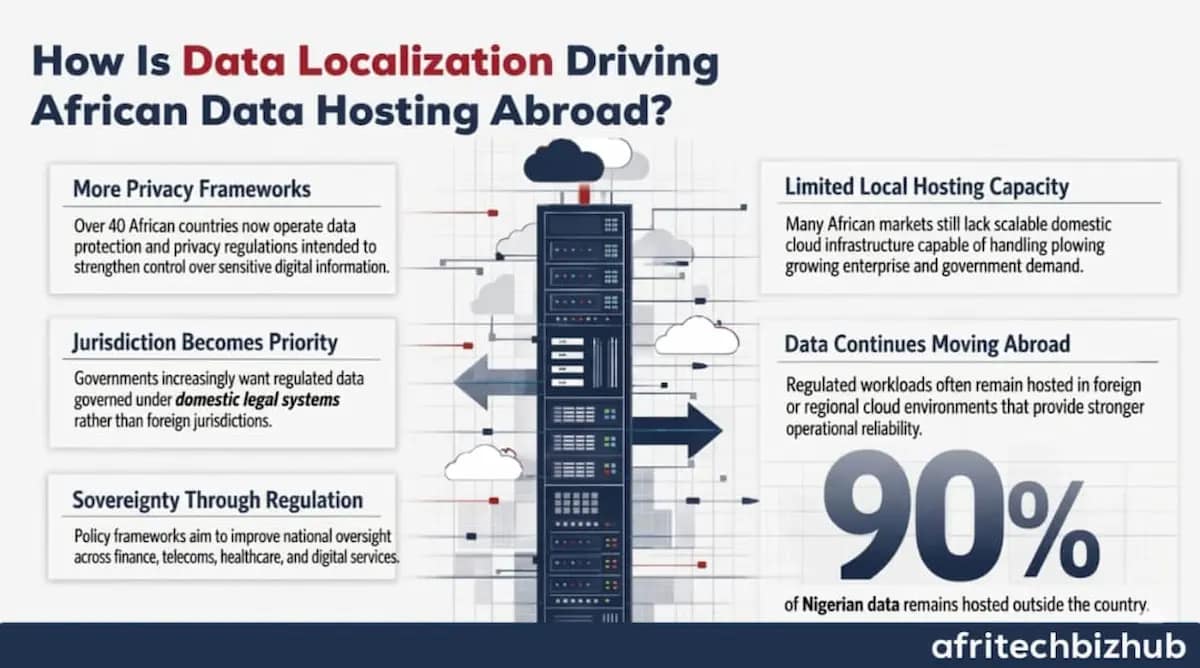
More than 40 African countries now operate data protection and privacy frameworks intended to strengthen jurisdiction over sensitive information.
The policy direction is clear. The infrastructure underneath remains uneven.
In markets where local hosting capacity remains limited, regulated workloads frequently continue relying on regional or foreign-operated cloud environments that satisfy operational requirements while reducing domestic infrastructure capture.
Nigeria illustrates the tension. Public remarks from the Nigeria Data Protection Commission in 2026 suggested that a large majority of data generated in Nigeria continues to rely on hosting environments located outside the country, highlighting the gap between data governance ambitions and domestic infrastructure availability.
The World Economic Forum has separately argued that digital sovereignty depends on local infrastructure, scalable hosting environments, and shared digital foundations rather than regulation alone.
Legal sovereignty and infrastructural sovereignty are not the same thing. Regulation can define jurisdiction. Infrastructure determines whether that jurisdiction is exercised.
Is Africa Losing Control of data hosting to Global Cloud Giants?
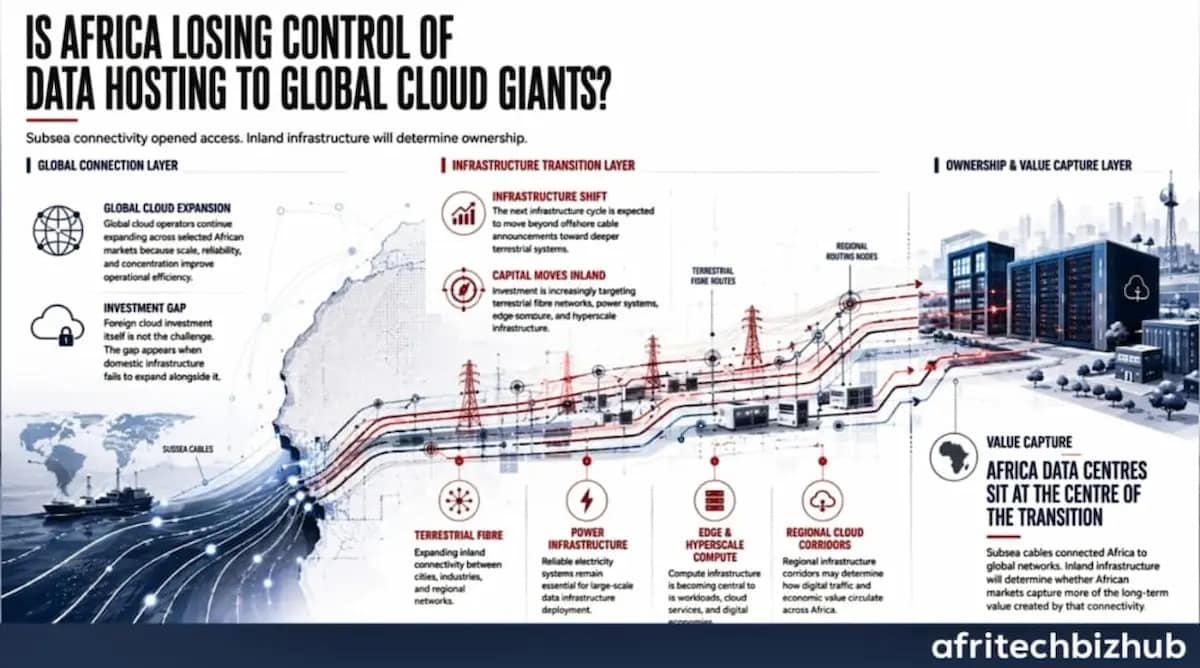
Africa is not losing access to cloud infrastructure. It risks participating in the cloud economy without capturing enough of the infrastructure value underneath it.
Global cloud operators continue expanding across selected African markets because concentration improves economics, scale, reliability, and deployment speed.
That investment is not the problem. The problem emerges when domestic infrastructure fails to expand alongside it.
The investment signal is becoming clearer. The next infrastructure cycle is unlikely to be led by offshore cable announcements alone.
Capital is beginning to move toward terrestrial fibre expansion, power systems for data infrastructure, edge and hyperscale compute, and regional cloud corridors.
Africa data centers sit at the center of that transition.
Subsea cables connected Africa to global networks. Inland infrastructure will determine whether Africa owns more of the value created by that connection.


Recent Comments