


Last updated: July 31, 2026
Featured Summary:
- Payment infrastructure has become one of the biggest constraints on Africa’s digital economy.
- Mobile money growth has exposed weaknesses in settlement, interoperability, and cross-border payments.
- Digital payments in Africa now depend on infrastructure efficiency as much as customer adoption.
- The next fintech leaders will build the systems moving money rather than only the applications receiving it.
Across the continent, one of the world’s most active digital payment markets has emerged, yet moving money remains slower, more fragmented, and more expensive than that progress suggests.
Mobile wallets, banking applications, and fintech platforms have brought millions of people into formal and semi-formal payment systems, but transactions still encounter disconnected networks, multiple intermediaries, and national systems that do not communicate efficiently across borders.
The infrastructure beneath those transactions now determines how much economic value digital finance can create.
Africa has made significant progress in helping people pay electronically, but the harder task lies in moving that money instantly between wallets, banks, businesses, and countries.
Payment infrastructure now carries the same economic importance as roads, ports, and electricity because every digital transaction depends on the systems operating below the customer interface.
Why Does Africa Need Modern Payment Infrastructure Now?
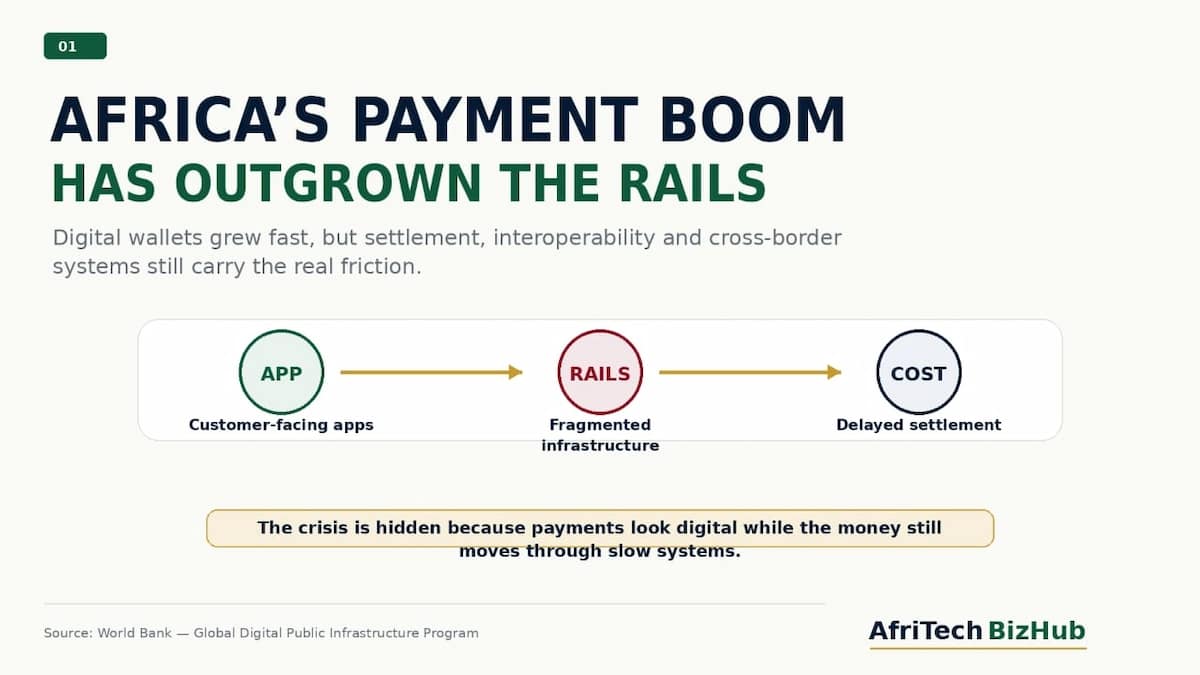
The deepest weakness in Africa’s payment market lies between the moment a customer authorizes a transaction and the moment the recipient gains final access to the money.
Fragmented clearing systems, limited interoperability, and reliance on correspondent banks can turn a simple transfer into a chain of conversions, approvals, and settlement delays.
Digital applications may create the appearance of instant payment while the underlying institutions still reconcile and settle obligations through slower infrastructure.
Modern payment infrastructure reduces those frictions by connecting financial institutions to shared switching, clearing, and settlement systems.
Efficient rails allow businesses to receive funds faster, manage working capital more accurately, and trade across borders without carrying unnecessary transaction costs.
The World Bank describes fast and inclusive payment systems as a central part of digital public infrastructure, alongside digital identity and secure data exchange, because the wider digital economy cannot operate efficiently without trusted systems for moving value.
How Are Mobile Money Operators Reshaping Africa’s Payments Ecosystem?
Mobile money operators solved a large part of Africa’s financial access problem by allowing customers to hold and transfer value without depending on conventional bank branches.
Mobile money services processed more than US$2 trillion globally in 2025, a 23% increase from the previous year, while Sub-Saharan Africa retained its position as the industry’s largest regional market.
That scale has moved mobile money far beyond a basic inclusion tool and placed it at the center of everyday commerce.
Customer growth, however, does not guarantee infrastructure maturity.
A mobile wallet delivers limited economic flexibility when users cannot transfer funds easily to another operator, settle with a bank account, or make an affordable payment across national borders.
Mobile money operators now depend on interoperable systems that connect wallets with banks, national switches, and other payment providers.
Their next commercial advantage will come from how widely money can move across the financial ecosystem, not simply from the number of accounts registered.
Why Is Digital Payments Africa Experiencing Rapid Transformation?
Businesses now require payment systems that support trade rather than merely replace cash at the point of sale.
Suppliers need faster access to working capital, merchants need reliable settlement, and companies trading across African borders need payment rails that avoid repeated conversion through foreign currencies and correspondent banks.
The transformation beneath digital payments in Africa therefore centers on instant settlement, regional interoperability, and direct connections between domestic financial systems.
The Pan-African Payment and Settlement System addresses that requirement by connecting central banks, commercial banks, payment service providers, and national switches through a shared cross-border infrastructure.
PAPSS supports instant payments, pre-funding, and net settlement in local currencies, reducing dependence on external correspondent banking routes.
By July 2025, the system reported connections across 17 countries, 14 national switches, and more than 150 commercial banks, giving regional commerce a clearer route between domestic payment networks.
How Can Secure Online Payment Systems Reduce Fraud Risks?
Payment infrastructure cannot support larger transaction values without systems that establish who initiated a payment, whether the instruction is legitimate, and how risks are managed across participating institutions.
Fraud weakens more than individual accounts; it raises compliance costs, increases transaction scrutiny, and discourages businesses from moving high-value activity into digital channels.
Secure online payment systems therefore provide the trust required for digital commerce to operate at scale.
Digital identity, reliable authentication, and coordinated risk controls allow financial institutions to verify customers while reducing opportunities for impersonation and unauthorized transactions.
These safeguards also help providers respond consistently when payments move between separate networks.
Trust operates as financial infrastructure because consumers and businesses commit more value to digital channels only when they believe the systems beneath them can identify participants, protect information, and resolve failures.
What Is Driving the Future of Digital Payments in Africa?
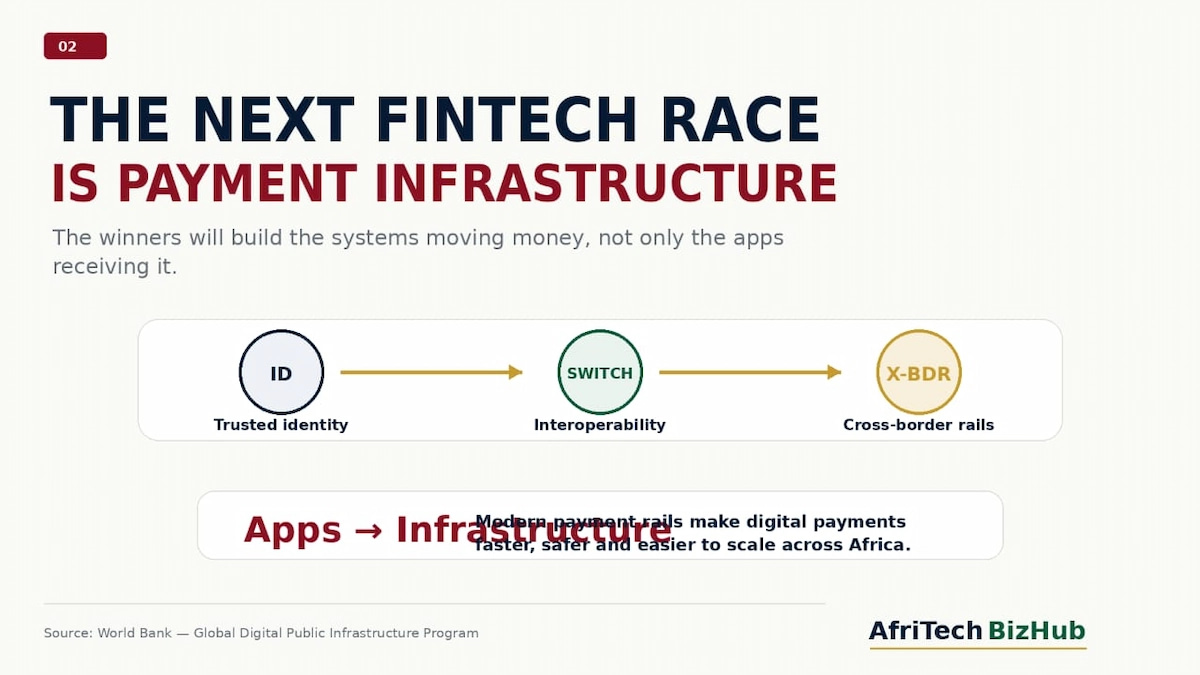
Africa’s next fintech race will take place beneath the applications customers see.
Payment apps compete through pricing, design, and customer acquisition, but settlement rails, switches, digital identity systems, and interoperability networks gain value each time another institution connects.
Like roads, ports, and electricity grids, those systems support entire markets rather than a single product, allowing their economic importance to compound across every transaction.
The decisive question is not whether Africa will digitize payments, but whether it will build the infrastructure to support a truly integrated financial market.
Fragmentation cannot scale indefinitely, and without deliberate coordination between regulators, central banks, and private providers, today’s growth risks hardening into structural inefficiency.
The winners will be those who invest early in interoperable, cross-border systems that reduce friction at scale, while laggards may find themselves locked into isolated networks with diminishing relevance.
In that sense, payment infrastructure is no longer a backend concern, it is the strategic battleground that will determine how far Africa’s digital economy can expand.


Recent Comments