

Last updated: June 19, 2026
Featured Summary:
- Afreximbank Q1 2026 results strengthened the institution and exposed the financing limits around it.
- AfCFTA expanded regional trade ambition faster than balance sheets expanded industrial risk appetite.
- PAPSS improved payment movement but did not solve wholesale industrial liquidity.
- Africa’s next growth cycle depends less on raising capital and more on mobilising it.
Afreximbank Q1 2026 results delivered numbers strong enough to reinforce confidence and uncomfortable enough to expose a continental constraint.
Net income rose 25 percent year-on-year to $268.9 million.
Total interest income reached $813.6 million.
Net interest income climbed 24 percent to $510 million.
Total credit exposure expanded to $42 billion.
The bank also launched a $10 billion Gulf Crisis Response Programme to support African and CARICOM economies facing external pressure.
Those figures confirm institutional strength while revealing a deeper imbalance.
AfCFTA expanded trade ambition.
PAPSS improved payment connectivity.
Industrial capital still moves too slowly through African financial systems.
One development institution is increasingly carrying trade liquidity and industrial financing pressure that domestic markets continue approaching cautiously.
Africa’s problem is no longer simply access to capital.
It is whether capital moves into production at the speed integration now demands.
Why Is AfCFTA Still Missing Industrial Capital Flows?
Trade integration moved faster than financing behaviour.
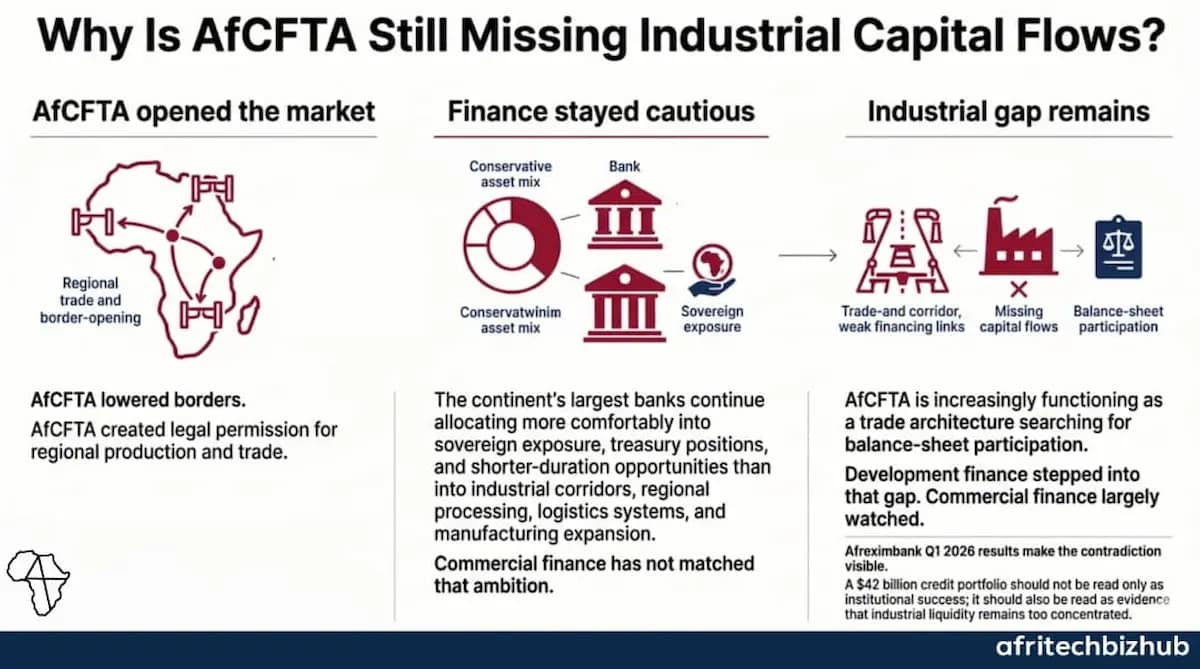
AfCFTA reduced barriers and created legal conditions for regional production and cross-border value chains.
The financial response has remained uneven.
Afreximbank Q1 2026 results make that contradiction visible.
A $42 billion credit portfolio should not be interpreted only as institutional success.
It should also be read as evidence that industrial liquidity remains concentrated inside a narrow set of balance sheets.
Across the continent, commercial institutions continue allocating more comfortably into sovereign exposure, treasury positioning, and shorter-duration opportunities than into industrial corridors, logistics systems, regional processing, and manufacturing expansion.
AfCFTA increasingly looks like a trade architecture searching for deeper financial participation.
Development finance moved first. Commercial finance followed more slowly.
Can African Banking Sustain Industrial Growth Without Development Finance?
Industrial expansion becomes fragile when market acceleration depends too heavily on institutions designed to catalyse rather than substitute for private capital.
Afreximbank’s profitability strengthened while its stabilisation role widened.
The bank’s $10 billion Gulf Crisis Response Programme was created to support economies facing pressure from shipping disruptions, liquidity constraints, energy exposure, commodity volatility, and tourism sensitivity.
That reveals where shock absorption increasingly sits.
African commercial banking increasingly relies on multilateral balance sheets to absorb financing complexity that private capital still approaches cautiously.
Currency volatility, shallow long-duration funding markets, and defensive balance-sheet behaviour explain part of that caution.
They do not remove the consequence.
Development finance increasingly finances complexity while private capital waits for certainty.
Why Are Cross-Border Payments Still Not Unlocking Industrial Trade Finance?
Movement improved. Settlement depth did not.
PAPSS strengthened African payment connectivity and reduced friction around local-currency settlement across participating markets.
That progress matters for trade execution.
But payment efficiency and industrial finance are not the same system.
Industrial trade operates under different conditions.
Mineral processing, refining, energy inputs, regional manufacturing, and multi-market production depend on liquidity pools, guarantees, underwriting depth, settlement confidence, and long-duration capital.
PAPSS improves movement of money.
It does not automatically create wholesale industrial liquidity.
Those constraints continue pushing industrial participants toward offshore settlement structures, external liquidity pools, and foreign underwriting capacity.
The friction is not that African payment rails do not function.
The friction is that industrial finance still clears through financial structures built outside African production systems.
That gap continues weakening local processing, value addition, and cross-border industrial expansion.
How Is Afreximbank Driving African Trade Finance Growth?
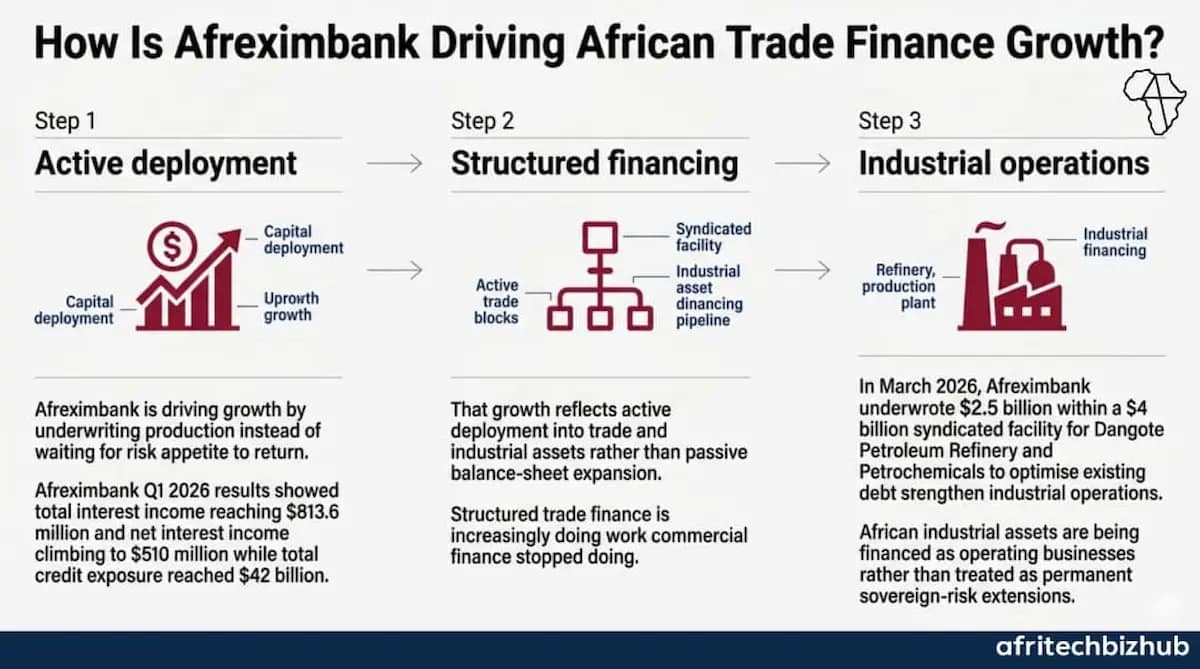
Where private risk appetite remains cautious, Afreximbank is increasingly underwriting production directly.
Afreximbank Q1 2026 results showed total interest income reaching $813.6 million and net interest income reaching $510 million while total credit exposure expanded to $42 billion.
That growth reflects deployment into trade and industrial assets rather than passive balance-sheet accumulation.
The operating logic became clearer in March 2026 when Afreximbank underwrote $2.5 billion inside a $4 billion syndicated facility for Dangote Petroleum Refinery and Petrochemicals to optimise debt structure and strengthen industrial operations.
That transaction explains why the institution continues expanding.
Structured trade finance is increasingly doing work portions of commercial finance remain reluctant to do.
Industrial assets are being financed as operating businesses instead of being treated as permanent sovereign-risk extensions.
Will Infrastructure Bonds Finally Unlock Industrial Liquidity?
One balance sheet cannot industrialise a continent.
Afreximbank Q1 2026 results showed financing demand continuing to outrun domestic mobilisation.
That model eventually reaches limits.
Africa’s institutional capital base spans pension assets, insurers, sovereign assets, and banking liquidity running into trillions of dollars.
The issue is not absence.
The issue is structure.
Long-term capital remains concentrated in lower-risk allocations while industrial projects continue competing for shorter-duration funding structures.
Infrastructure bonds, asset-backed securities, corridor-linked financing vehicles, and credit-enhanced industrial instruments are becoming less of a policy discussion and more of a liquidity requirement.
Africa does not need another industrial strategy document.
AfCFTA created demand. PAPSS improved movement.
The remaining bottleneck is capital mobilisation.
Africa now needs financial structures capable of moving long-term African capital into trade corridors, mineral processing, logistics, manufacturing, and production at scale.


Recent Comments