


Featured Summary:
- Government cybersecurity came under renewed scrutiny after hackers defaced Kenya’s presidential website and demanded five Bitcoin.
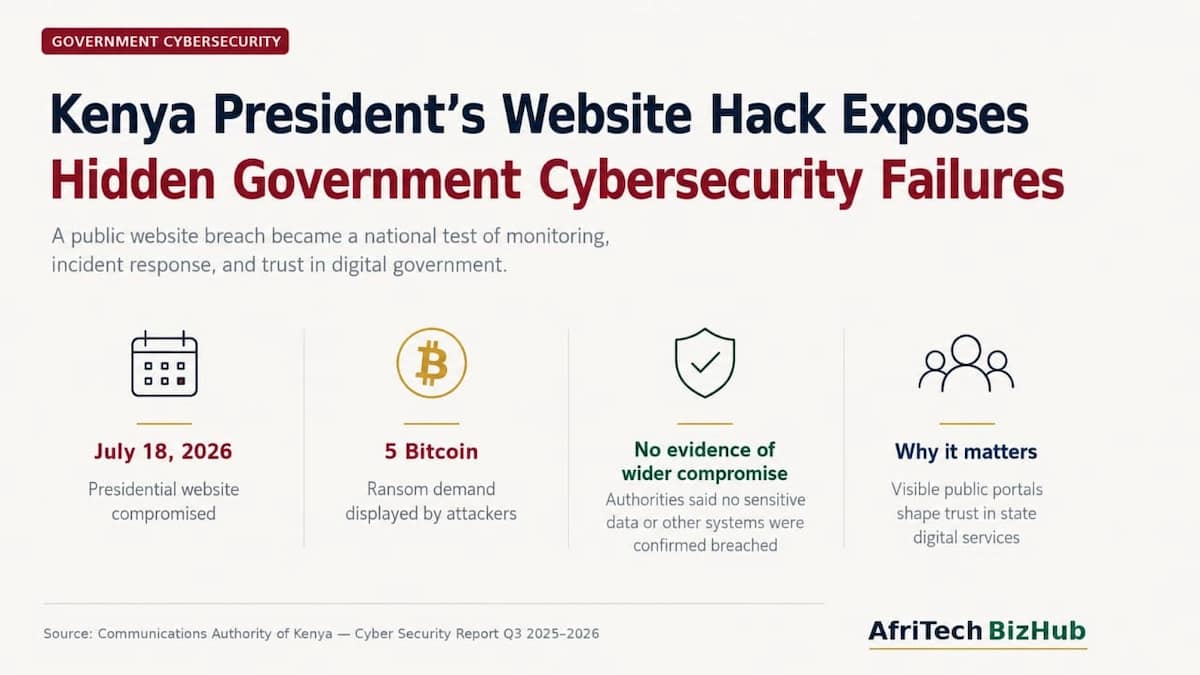
- Kenyan authorities said they found no evidence that sensitive information or wider government systems had been compromised.
- The incident shows why high-profile public websites remain attractive targets for attackers seeking disruption, ransom, or political visibility.
- Stronger government online services require continuous monitoring, secure system design, and coordinated incident response rather than restoration after an attack.
Hackers compromised Kenya’s official presidential website on July 18, 2026, replaced its homepage with messages directed at President William Ruto, and demanded a ransom of five Bitcoin.
The government temporarily restricted access while its cybersecurity teams investigated and restored the portal, saying there was no evidence that sensitive data had been stolen or that other state systems had been affected.
The distinction between a website defacement and a deeper network intrusion is important, but it does not remove the institutional significance of the incident.
Government cybersecurity now protects more than official communication.
As public administration moves online, weaknesses in visible government platforms can undermine confidence in digital services, expose gaps in monitoring, and test whether institutions can contain an attack without disrupting wider operations.
Why is Government Cybersecurity Failing Against Modern Website Hackers?
The confirmed failure was that an attacker gained enough control to alter the presidential website before the intrusion was detected and contained.
No official technical assessment has yet identified whether the breach involved compromised credentials, outdated software, a third-party service, or another vulnerability.
The available evidence, therefore, supports a website compromise but not claims that Kenya’s entire government network was penetrated.
That limited finding still matters because the presidency’s website serves as an authoritative source of state communication.
Attackers who control such a platform can publish false information, redirect visitors, or cast doubt on legitimate government announcements.
Government cybersecurity fails institutionally when agencies cannot quickly establish how access was obtained, determine whether related systems are exposed, and communicate the boundaries of an incident clearly enough to preserve public trust.
How Are Cybersecurity Threats Targeting High-Profile Government Websites?
Government websites are attractive targets because their political and reputational value can exceed their technical importance.
A successful defacement gives attackers immediate public visibility, allows them to embarrass officials, and creates the impression that the state has lost control of its digital infrastructure.
In Kenya’s case, the ransom demand and direct messages aimed at the president turned a website intrusion into a national political event.
The attacker’s objective may be disruption, ransom, propaganda, intelligence gathering, or proof of technical capability.
A visible defacement does not establish that sensitive files were accessed, but it can still weaken confidence in government online services by making citizens question whether other platforms are secure.
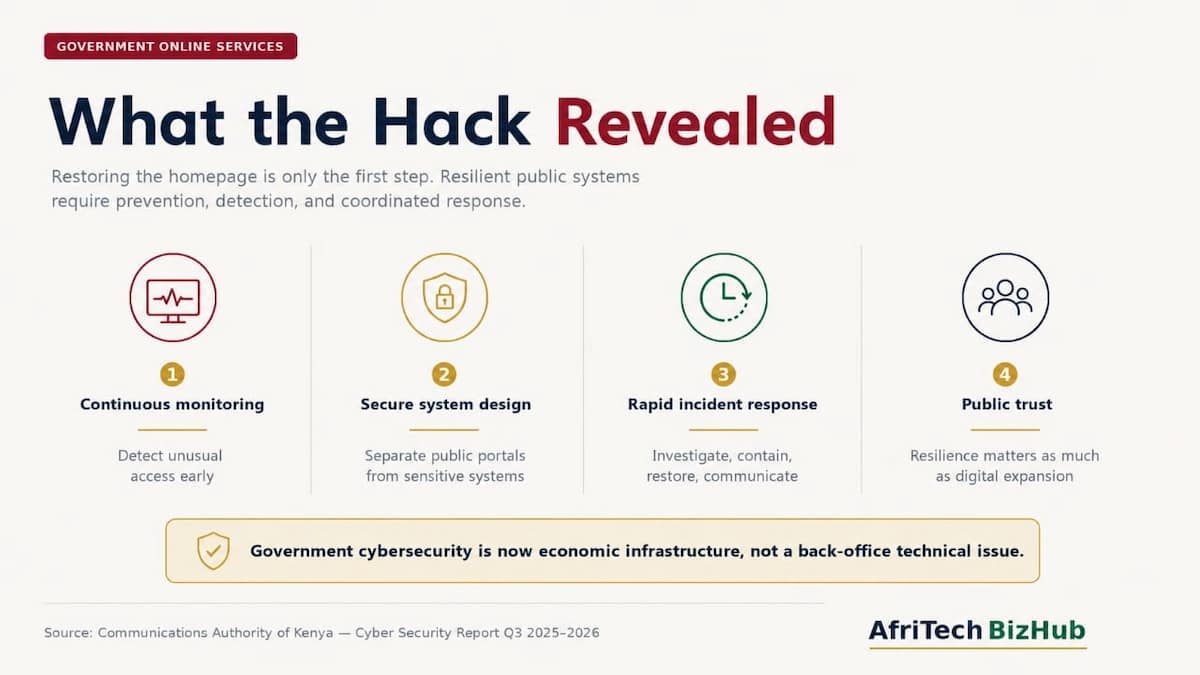
This is why restoring the homepage is only the first response; institutions must also review access logs, revoke compromised credentials, inspect connected systems, and determine whether the same weakness exists elsewhere.
Can AI-Powered Cyberattacks Outsmart Traditional Government Security Defenses?
There is no verified evidence that an AI-powered cyberattack was used against Kenya’s presidential website.
Artificial intelligence, nevertheless, changes the wider threat environment by helping attackers produce convincing phishing messages, automate reconnaissance, identify exposed systems, and adapt social-engineering attempts to specific employees or institutions.
Kenya’s National KE-CIRT/CC reported that phishing campaigns during January to March 2026 included AI-generated emails and spoofed domains.
AI does not automatically defeat government security, but it reduces the time and cost required to test large numbers of targets.
Defenses built around manual review, predictable rules, and delayed patching can struggle against automated attacks that change quickly.
Governments, therefore, need security operations that also use automation to detect unusual access, identify changes to website files, prioritize high-risk alerts, and stop compromised accounts before attackers move across connected systems.
Why Are Cybersecurity Threats in Africa Increasing So Rapidly?
Cybersecurity threats in Africa are rising as governments, businesses, and citizens place more economic and administrative activity online.
Kenya’s Communications Authority reported billions of detected cyber threat events between January and March 2026, including malware, brute-force attempts, system vulnerabilities, and web-application attacks.
These figures represent detected events rather than successful breaches, but they illustrate the volume of activity directed at connected infrastructure.
The regional challenge is intensified by uneven institutional capacity.
INTERPOL reported in 2025 that cyber-related offenses accounted for more than 30% of reported crime in parts of Eastern and Western Africa, while 90% of surveyed African countries said law enforcement or prosecution capability required significant improvement.
Expanding connectivity creates valuable government online services, but it also creates more software, identities, and networks to protect without always providing institutions with matching skills, tools, and incident-response resources.
How Can Government Online Services Build Stronger Cyber Resilience?
Government online services require security controls that assume an intrusion may occur and limit the damage when it does.
Zero-trust access, multi-factor authentication, secure software development, timely patching, and separation between public websites and sensitive internal systems can prevent one compromised portal from opening a route into critical infrastructure.
Continuous monitoring should also alert security teams when administrator permissions, website files, or domain settings change unexpectedly.
Technology alone cannot resolve the weakness exposed by the Kenya incident.
Agencies need clear ownership of digital assets, central inventories of government systems, tested backup procedures, and coordinated incident-response plans that identify who investigates, restores services, and informs the public.
The website hack exposed a gap not simply because attackers reached a visible platform, but because resilient government cybersecurity depends on institutions proving that they can detect threats early, contain them quickly, and maintain trust while essential digital services remain available.


Recent Comments