

Featured Summary:
- Information security in Mauritius has moved into a stricter compliance phase for operators managing critical national systems.
- The new cyber framework brings financial services, public services, ICT, broadcasting, energy, water, and transport closer to direct cybersecurity oversight.
- Information infrastructure is no longer being treated as ordinary IT when disruption can affect payments, utilities, transport, public services, and national confidence.
- Africa cybersecurity is entering a harder regulatory era as governments begin treating digital systems as economic and national-security assets.
Mauritius is no longer treating cybersecurity as an internal IT problem.
The country has moved critical digital systems into a harder regulatory perimeter, placing banks, public services, telecoms, broadcasters, energy, water, and transport under sharper scrutiny. The timing is not accidental.
Mauritius sells itself on finance, services, digital trust, tourism, outsourcing, and cross-border business.
A breach in one essential system can now travel through the economy faster than many physical disruptions.
The new rules make that vulnerability a governance issue. For critical operators, information security is no longer only about protecting networks.
It is becoming part of their licence to remain trusted.
How Will Information Security Rules Protect Mauritius?
Mauritius is drawing a line around the systems that keep the country functioning.
Payments, public records, telecom networks, broadcasting systems, power, water, and transport now sit inside the same security conversation.
A weak system in any of those sectors can affect more than one company.
It can interrupt services, expose sensitive data, damage confidence, and pull regulators into a crisis before the public understands the source.
Information security rules make that exposure harder to ignore.
Operators managing essential systems will have to think beyond firewalls and software updates.
Risk assessments, restricted access, incident reporting, security awareness, audits, and regulatory directions now sit closer to daily operations.
The country is putting pressure where it matters most: on the organisations whose digital failure can become a public problem.
Why Is the Cyber Framework Now Mandatory?
Voluntary cybersecurity has become too weak for a digital economy built on trust.
Mauritius cannot depend on banks, utilities, telecoms, broadcasters, public agencies, and transport operators setting their own pace when their systems carry national consequences.
A single breach can move through payments, identity records, service delivery, communications, and public confidence.
The cyber framework gives the state a formal route to identify critical information infrastructure and push operators into a common security discipline.
That changes the posture of Mauritius IT.
Cybersecurity is no longer left to uneven internal standards across sectors.
The framework gives regulators a stronger hand before a breach turns into a national disruption.
It also sends a market signal: Mauritius wants to remain a trusted digital and financial hub, and trust now comes with enforceable controls.
Which Information Infrastructure Sectors Face New Compliance?
The compliance map now covers the sectors that carry daily economic life.
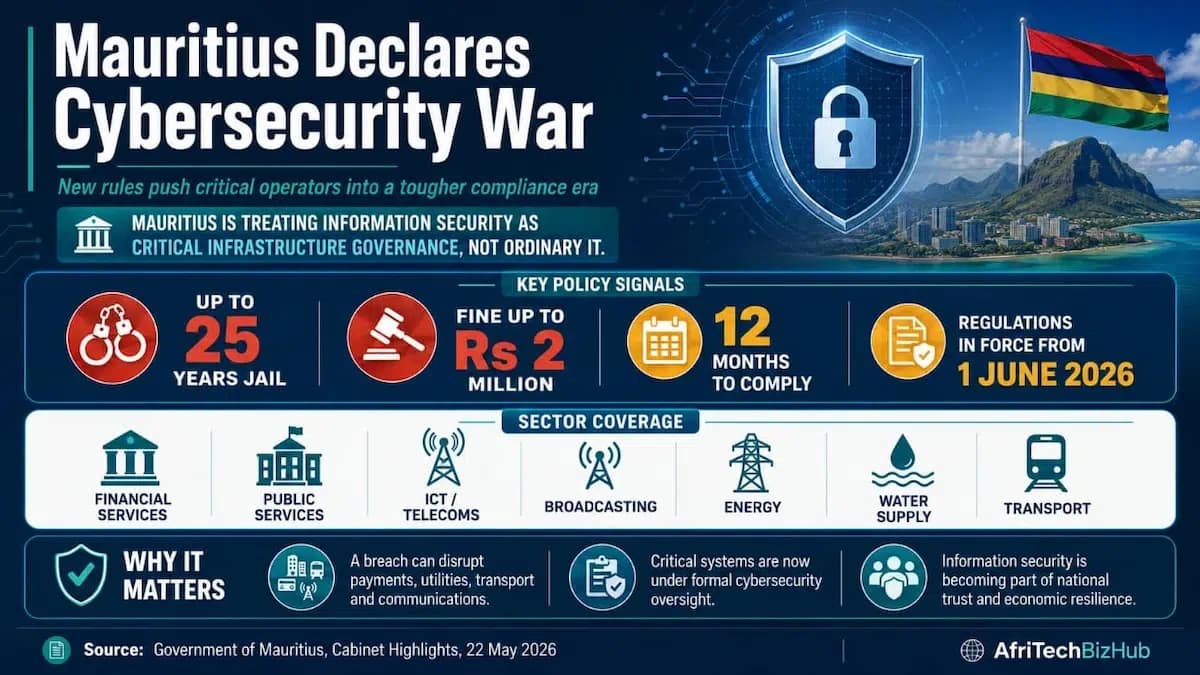
Financial services, banking and non-banking institutions, public service, Information and Communication Technology, broadcasting, energy, water supply, and transport all fall within the new critical information infrastructure designation framework.
These are not peripheral industries.
They are the systems through which money moves, government operates, information circulates, utilities run, and people travel.
Information infrastructure has become the invisible layer beneath national continuity.
A payments outage can freeze commerce. A compromised public system can expose citizens.
A telecom or broadcasting disruption can weaken communication.
A utility breach can move from data risk to public-service risk.
Mauritius is placing those sectors in a category where cyber failure carries wider consequences than ordinary business interruption.
How Do Cyber Regulations Affect Critical Operators?
Cyber regulations now turn critical operators into regulated security actors.
The National Cybersecurity Committee can identify systems as critical information infrastructure after consultation with relevant regulators.
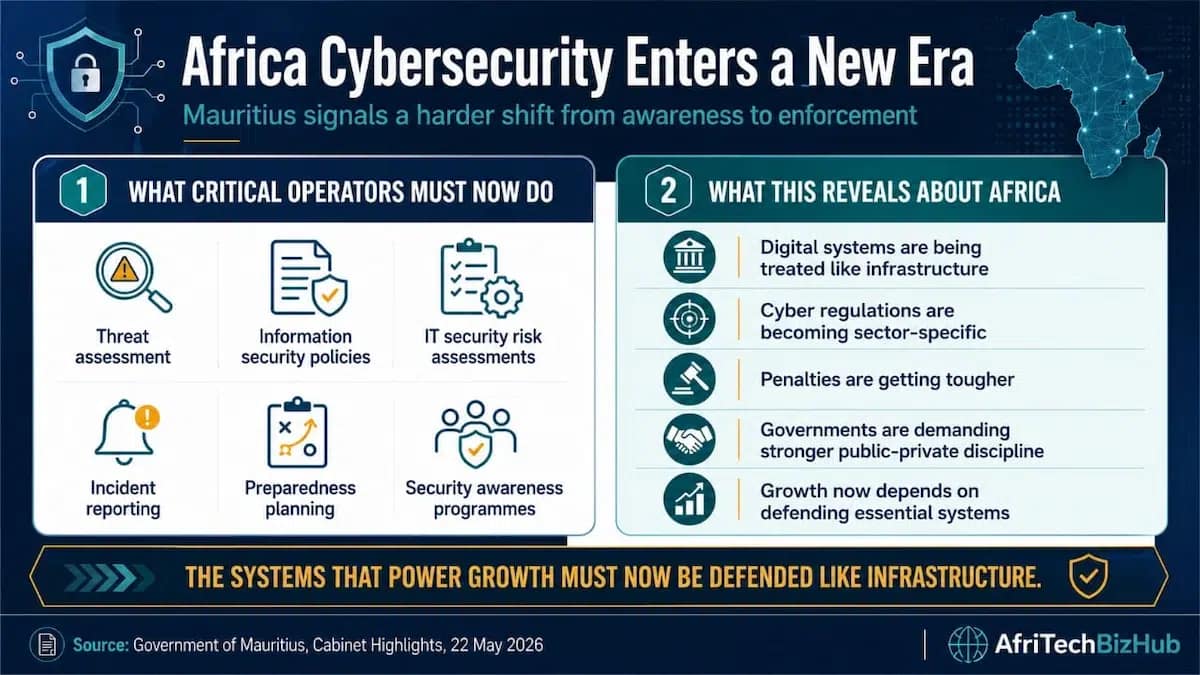
Once designated, owners face directions on threat assessment, preparedness, information security policies, periodic IT security risk assessments, incident-reporting policies, and security awareness programmes.
The legal pressure is heavy. Mauritius’ Cybersecurity and Cybercrime Act provides that specified offences involving critical information infrastructure can attract a fine of up to 2 million rupees and imprisonment for up to 25 years.
Cabinet’s May 2026 decision also placed the new designation regulations into operation from June 1, 2026, with owners of critical information infrastructure given 12 months to comply.
The message to operators is direct without needing to be decorative: critical systems now carry critical liability.
Why Is Africa Cybersecurity Entering A New Era?
Africa cybersecurity is moving from awareness campaigns into enforceable control.
Governments are beginning to treat digital systems the way they treat ports, power grids, financial markets, and transport networks.
The shift is being driven by the same reality across the continent: banks, identity databases, telecom networks, health records, airports, ports, water systems, and energy platforms now carry public risk.
Mauritius is showing the direction of travel.
Cyber regulations are becoming more sector-specific. Penalties are becoming heavier.
Critical infrastructure is being pulled into formal oversight. The next phase will not be won by countries that merely announce digital ambition.
It will be shaped by those that build audit capacity, incident response, regulatory coordination, skilled cyber teams, and stronger public-private discipline around essential systems.
Africa’s digital economy is growing into a harder truth: the systems that power growth must also be defended like infrastructure.


Recent Comments