

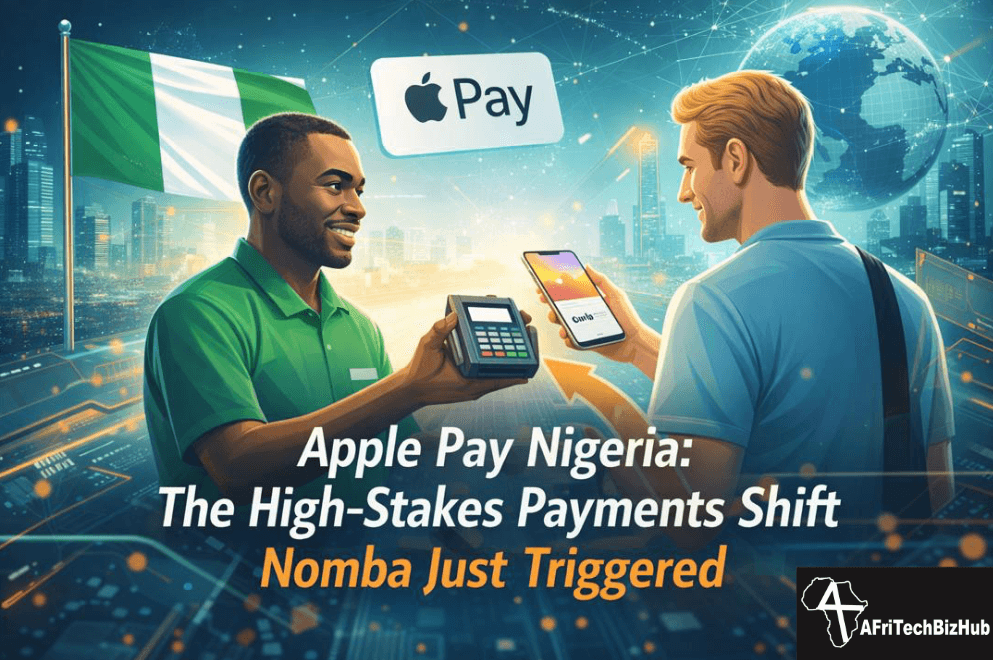
Nomba’s Apple Pay integration signals a structural upgrade in Nigeria’s payments infrastructure, pressuring banks and fintechs to accelerate global card interoperability at retail scale.
Featured Summary:
- Apple Pay’s entry into Nigeria via Nomba marks a shift toward international card acceptance at the POS layer, extending global payment rails beyond ATMs.
- The move unlocks new retail, tourism, and diaspora spending flows across Africa’s largest POS market.
- Apple Pay access remains uneven, dependent on bank card eligibility, POS certification, FX routing, and merchant-level execution.
- Fintechs and banks that upgrade fastest capture transaction flow and merchant trust, while laggards risk losing relevance.
Nomba has enabled Apple Pay acceptance on its payment terminals in Nigeria, marking a significant infrastructure shift in the evolving Apple Pay Nigeria conversation.
This is a merchant-side upgrade—not a consumer rollout—designed to prepare select Nigerian businesses for global card and wallet transactions.
The move pressures banks and fintechs to accelerate interoperability and signals a competitive shift in Nigeria’s payments ecosystem, even as Apple Pay remains unavailable to most Nigerian cardholders.

The Development: What Nomba Has Actually Enabled
Nomba has enabled Apple Pay acceptance at the POS level in Nigeria, a merchant-side infrastructure upgrade in Nigeria payments infrastructure.
This development allows select Nigerian merchants using Nomba terminals to accept Apple Pay transactions from eligible foreign cards and wallets, without changing consumer card eligibility inside Nigeria.
What Apple Pay acceptance means at the POS level:
• Nomba’s POS terminals can now process Apple Pay–initiated, card-present transactions routed through international card networks.
• Transactions are tokenized and authorized via Visa or Mastercard rails, the same way Apple Pay works globally.
• The enablement sits at the acquirer and terminal layer, not at the issuing-bank or consumer-wallet layer.
Merchant-side enablement vs consumer wallet eligibility:
• Merchant-side: Nomba merchants can accept Apple Pay payments from supported foreign cards and wallets.
• Consumer-side: Most Nigerian-issued cards still cannot be added to Apple Pay, because issuer approval and Apple wallet support remain unavailable locally.
Why this reduces friction for specific users:
• Foreign cards: International visitors can pay without cash or physical cards.
• Tourists: Hotels, restaurants, and premium retail gain global payment compatibility.
• Business travelers: Corporate cards and wallets work seamlessly at enabled POS terminals.
Apple Pay acceptance ≠ Nigerian cards working on Apple Pay.
This is a POS and acquiring upgrade, not a consumer rollout. Apple Pay Nigeria, in this context, refers to where payments can be accepted, not who can enroll cards.
Why This Matters in Nigeria’s Payments Landscape
Nigeria’s retail payments system is POS-heavy, transfer-dominant, and driven at street level. POS terminals are the last mile of Nigerian commerce, handling everyday transactions for millions of consumers and merchants.
Apple Pay Nigeria is not a consumer feature story but a merchant-side infrastructure signal. Any upgrade at the POS layer—where most physical transactions occur—has economy-wide implications.
According to NIBSS and Central Bank payment data, POS and transfer channels account for the majority of Nigeria’s retail transaction volumes, far outpacing card usage. This is why changes to POS capability matter more than app launches or wallet announcements.
When POS terminals gain new functionality, it reshapes how money moves at street level, how merchants accept value, and how Nigeria interfaces with global payment rails.
This makes the Apple Pay–related POS enablement a structural payments development, not a minor fintech update.
The Reality on Ground: Who Controls Nigeria’s POS Streets
Nigeria’s POS ecosystem is dominated by a small group of fintech acquirers—Moniepoint, Opay, and PalmPay—that collectively power the majority of Nigeria POS terminals used in daily retail transactions.
Their dominance is structural, not accidental.
Why they control Nigeria’s POS streets:
• Transaction volume: These platforms process massive domestic payment volumes across SMEs, agents, and informal retail.
• Speed and uptime: Their systems are optimized for instant transfers and local card payments, where reliability matters more than feature depth.
• Domestic optimization: Pricing, settlement cycles, and support models are built specifically for Nigeria’s transfer-heavy retail economy.
Why international card acceptance is harder
Enabling Apple Pay Nigeria–style international card acceptance at the POS level introduces materially different economics and risks:
• FX routing complexity: Foreign card transactions require real-time currency conversion and exposure to FX volatility.
• Chargeback liability: International schemes impose higher dispute and reversal risk on acquirers.
• Settlement risk: Cross-border settlement timelines are longer and less predictable than domestic transfers.
• Scheme certification: Visa, Mastercard, and wallet integrations require extensive certification, testing, and ongoing compliance.
• Compliance overhead: AML, sanctions screening, and transaction monitoring costs rise sharply for international flows.
Supporting international card acceptance on Nigeria POS terminals is therefore not a simple software toggle. It requires deeper liquidity access, upgraded risk controls, and higher operational capital than domestic payments.
Most street-level POS providers have optimized for Nigeria’s domestic payments reality.
Apple Pay Nigeria–linked acceptance shifts the cost, risk, and compliance profile of POS operations, creating a competitive opening for players like Nomba that are deliberately targeting international card and wallet rails.
Nomba’s Strategy: Why This Move Makes Sense For Them
Nomba’s Apple Pay acceptance is a deliberate positioning move within Apple Pay Nigeria, not an attempt to compete for street-level transaction volume.
Nomba primarily serves:
• Structured merchants
• Hotels and hospitality groups
• Restaurants and premium dining
• Corporate and formal retail environments
These merchant categories align closely with global Apple Pay usage patterns, where contactless wallets are most widely adopted for higher-ticket, card-present transactions tied to travel, dining, and business spending.
Globally, Apple Pay usage is strongest in hospitality and premium retail environments, where transaction reliability, chargeback control, and settlement predictability matter more than raw volume. That same logic applies in Nigeria’s payments market.
For Nomba, Apple Pay fits because this is about:
• Ticket size, not transaction count
• Reliability, not speed-at-all-costs
• Capturing global card and wallet spend, not domestic transfer volume
Within the Apple Pay Nigeria context, this strategy gives Nomba an early advantage in serving international visitors, corporate spenders, and foreign-linked merchants, segments that generate outsized value per transaction.
Nomba is not chasing street volume. It is positioning to capture global spend at the point where international wallets naturally operate.
Does Apple Pay Nigeria Mean Nigerian Cards Now Work on Apple Pay
This is the most misunderstood part of the Apple Pay Nigeria conversation, and it requires clear separation between card international usage and wallet-level integration.
What has changed
Nigerian banks have:
• Restored international spending limits on debit and credit cards
• Re-enabled foreign transactions for online payments, subscriptions, and e-commerce
This is why many Nigerians can now pay for services like iTunes, SaaS tools, and foreign websites again.
What has not changed
Apple Pay Nigeria is still not live for Nigerian-issued cards.
Apple Pay requires:
• Direct bank-level wallet integration
• Issuer certification with Apple
• Tokenization infrastructure and Apple approval
Without this, a card can work internationally online but still cannot be added to Apple Wallet.
The critical difference Nigerians need to understand
• Online foreign payments (e.g., iTunes, subscriptions, web checkouts) rely on standard card rails
• Apple Pay is a tokenized wallet system that sits above card rails and requires issuer participation
These are fundamentally different layers of the payments stack.
Global card usage does not equal Apple Pay readiness.
Until Nigerian banks complete issuer-level integration with Apple, Apple Pay Nigeria remains a merchant-side acceptance story, not a consumer wallet rollout.
Why This Puts Quiet Pressure On Street Fintechs
As Apple Pay Nigeria begins appearing at select POS terminals through Nomba, it introduces a subtle but powerful shift in merchant expectations across Nigeria’s payments ecosystem.
On the ground, Nigeria’s POS landscape is dominated by fintechs such as Moniepoint, OPay, and PalmPay, which control the majority of street-level retail payments due to:
• High transaction volume handling
• Speed and uptime optimized for domestic transfers
• Deep integration with Nigeria’s transfer-heavy payment habits
According to NIBSS data, POS and transfer channels account for the vast majority of Nigeria’s retail transaction volumes, making POS functionality a critical competitive layer rather than a peripheral feature.
As Apple Pay acceptance becomes visible at the POS level, merchants—especially in hospitality, premium retail, and tourist-facing locations—will increasingly ask a simple question:
“Can your POS accept Apple Pay and international cards?”
That question creates quiet but real pressure on street-focused fintechs because international card acceptance is structurally harder to support. It requires:
• FX routing and settlement across card schemes
• Chargeback and dispute management
• Scheme certification and compliance overhead
• Higher settlement and liquidity risk
This is not reluctance or delay, it is economics.
The result is a new competitive dynamic in Nigeria fintech competition:
POS providers that upgrade faster gain merchant credibility and higher-value transaction flow, while slower movers risk differentiation loss as POS international cards Nigeria becomes a benchmark rather than an exception.
This is not disruption. It is market evolution.

What Nigerians Stand to Gain If This Scales
If Apple Pay Nigeria acceptance expands beyond early merchant deployments, the impact would extend across Nigeria’s retail and payments ecosystem, particularly at the POS level where most everyday commerce occurs.
For consumers, broader international card payments in Nigeria would mean more payment choice, reduced reliance on cash and transfers, and a smoother retail experience aligned with global standards.
For merchants, especially in hospitality and structured retail, accepting wallet-based payments increases transaction reliability, raises average ticket sizes, and unlocks incremental revenue from foreign and premium spend.
At the system level, POS remains Nigeria’s most heavily used retail payment interface, processing hundreds of millions of transactions monthly across the Nigeria POS payments network. Any meaningful upgrade at this layer carries economy-wide implications.
Nigeria’s track record supports this trajectory. When infrastructure becomes reliable—whether smartphones, instant transfers, or POS terminals—consumer adoption accelerates rapidly.
If Apple Pay acceptance scales across more terminals, behavior is unlikely to be the constraint. Infrastructure availability will be.
What Visitors, Diaspora, and Foreign Businesses Gain
For visitors and international operators, Apple Pay Nigeria acceptance at the POS level reduces everyday payment friction where it matters most—retail checkout.
As Nigeria’s commerce is overwhelmingly POS-driven, merchant-side Apple Pay acceptance improves spend confidence without changing local FX rules.
Who benefits and how:
• Tourists & business travelers: Familiar wallet payments at hotels, restaurants, and premium retail reduce reliance on cash and informal FX.
• Diaspora spenders: Short-term visits convert more card and wallet spend into local commerce, improving convenience and traceability.
• NGOs & foreign companies: Cleaner expense management, standardized receipts, and lower operational friction at retail touchpoints.
Nigeria processes hundreds of millions of POS transactions monthly, making retail acceptance the last mile of visitor spending.
Apple Pay acceptance at POS does not enable Nigerian cards on Apple Pay, but it does enable smoother use of foreign cards and wallets, raising confidence, increasing average ticket sizes, and integrating Nigeria’s retail layer more tightly into global card rails.
Execution Risks: Why Apple Pay Nigeria Will Not Scale Overnight
While Nomba’s move advances Apple Pay Nigeria at the merchant level, scaling Apple Pay POS acceptance across Nigeria’s retail ecosystem is constrained by execution realities, not resistance or lack of demand.
Key execution risks include:
• POS firmware and hardware upgrades: Existing terminals must support secure tokenized wallet transactions, requiring coordinated firmware updates across thousands of deployed devices.
• Card scheme certification timelines: Visa, Mastercard, and wallet certifications involve staged testing, security validation, and approval cycles that typically take weeks to months.
• Settlement and FX routing complexity: Apple Pay POS transactions introduce cross-border authorization, FX conversion, and settlement flows that increase operational exposure for acquirers.
• Merchant education and support: Merchants must understand Apple Pay transaction flows, reversals, and dispute handling to avoid service disruption.
• Chargeback and compliance risk management: International card and wallet transactions carry higher chargeback and compliance obligations, raising cost and risk thresholds for POS operators.
This is execution risk, not reluctance. Expanding Apple Pay Nigeria POS acceptance requires infrastructure readiness, certification discipline, and risk controls before it can scale reliably across street-level commerce.
The Bigger Picture: How Apple Pay Nigeria Fits Into Africa’s Payments Trend
Apple Pay Nigeria is best understood not as a standalone fintech update, but as part of a broader shift in Africa’s payments infrastructure, where POS terminals are becoming the final bridge between local commerce and global card networks.
Nigeria sits at the center of this transition. As Africa’s largest retail and payments market, the country processes hundreds of millions of POS transactions monthly, making street-level terminals the most critical interface for consumer spending.
Any change at the POS layer therefore has economy-wide implications.
Globally, card networks are expanding acceptance depth, focusing less on issuing cards and more on ensuring card-present interoperability at retail endpoints.
Apple Pay Nigeria aligns with this strategy by extending global wallet acceptance to compliant merchants, even where consumer-side wallet adoption remains limited.
This shift also connects directly to Nigeria’s regulatory direction.
The Central Bank of Nigeria’s POS directive, broader payments-modernization agenda, and FX transparency goals all point toward the same outcome: bringing informal and semi-formal retail into traceable, interoperable payment rails.
Apple Pay Nigeria is not an isolated development. It is a signal that Nigeria’s POS layer is increasingly being positioned as Africa’s last mile of cross-border retail payments, linking domestic commerce to global card infrastructure.

2025–2026 Outlook: What Apple Pay Nigeria Signals for POS, Cards, and Banks
As Apple Pay Nigeria begins influencing merchant-side acceptance rather than consumer wallets, the next 12–24 months will determine how quickly this infrastructure shift translates into broader retail usage and competitive realignment across Nigeria’s payments ecosystem.
Key signals to watch include:
• Fintech upgrade timelines: How quickly POS providers complete firmware updates, scheme certifications, and settlement readiness.
• Merchant adoption patterns: Uptake among hospitality, retail, and tourism-facing businesses where international card demand is highest.
• International transaction volumes: Growth in foreign card and wallet usage at Nigerian POS terminals.
• Consumer trust and usage: Whether consistent acceptance reduces friction and increases willingness to pay digitally.
• Bank-level Apple Pay readiness: Progress by Nigerian issuers toward wallet integration, tokenization, and Apple certification.
Industry outlooks from institutions such as McKinsey and World Bank–aligned payment studies consistently project rising card usage and digital payments across Nigeria and Africa, driven by urbanization, smartphone penetration, and retail formalization, though wallet-level adoption will remain gated by bank execution rather than merchant technology alone.
Early movers that execute reliably will capture merchant trust and international spend; late movers risk losing relevance as Nigeria’s POS layer increasingly connects to global payment rails.
Nigeria’s POS Layer Is Becoming a Global Interface
Apple Pay Nigeria is not a consumer launch, nor is it a signal that Nigerian cards are universally wallet-ready.
It is a merchant-side infrastructure shift that shows how Nigeria’s POS layer—the country’s most heavily used retail payment interface—is being repositioned for global card and wallet interoperability.
This moment is not about Apple, and it is not about one fintech. It is about how Nigeria connects to global payment rails at street level, how reliably transactions clear, and which providers execute fastest as international card acceptance becomes a competitive requirement.
Execution—not announcements—will determine outcomes. As Nigeria’s payments infrastructure continues to modernize, the POS layer is quietly becoming a global interface for commerce, tourism, and cross-border spend.


Recent Comments