

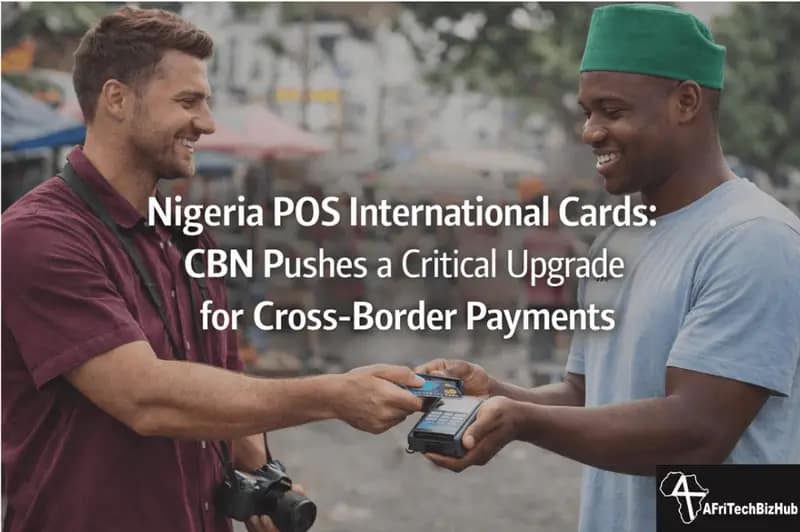
Nigeria’s central bank wants all POS terminals to accept international cards—putting banks and fintechs like OPay, Moniepoint, and PalmPay at the center of the upgrade.
Featured Summary:
- Nigeria is moving street-level POS payments global, as regulators push support for international cards nationwide.
- Banks and fintech POS giants like Opay, Moniepoint, and PalmPay must upgrade systems to meet global card standards.
- The shift enables tourists, diaspora, and foreign businesses to pay seamlessly, expanding merchant demand and retail inflows.
- Regulators set the mandate, fintechs execute it, and Nigerian consumers, merchants, and the broader economy capture the upside.

The Major Shift: Nigeria’s POS Network Is Being Pushed Global
Nigeria’s central bank is forcing a structural change in how payments work at the street level.
Under a new regulatory directive, banks and POS fintech operators are being required to reconfigure Nigeria’s POS network to accept international card schemes, extending global card interoperability beyond ATMs into everyday merchant payments.
This is not a feature update. It is an infrastructure-level reform.
While most Nigerian bank ATMs already support international cards, millions of POS terminals—especially those operated by fintechs—remain configured primarily for domestic transactions.
The Nigeria POS international cards directive targets this gap directly, pushing street-level commerce into global payment rails.
Banks, card acquirers, and leading POS fintechs are now under pressure to upgrade terminal software, certification standards, and settlement processes to meet international scheme requirements.
The shift affects not just hardware, but compliance, FX routing, dispute handling, and merchant onboarding systems.
Heading into 2026, this Nigeria payments upgrade repositions informal and small-scale retail for international interoperability.
When implemented, international visitors, diaspora spenders, and global card networks will be able to transact directly with Nigeria’s street merchants, reducing cash dependence and aligning the country’s retail payments layer with global standards.
The implication is clear: Nigeria’s POS ecosystem is no longer being optimized only for domestic convenience.
It is being re-architected for global card acceptance, and banks and fintech operators that delay execution risk falling behind in a newly internationalized payments environment.
What the CBN Has Directed — And Why This Matters Now
The Central Bank of Nigeria (CBN) has instructed banks and licensed payment service providers to reconfigure POS terminals nationwide to accept international card schemes, extending global card interoperability beyond ATMs into Nigeria’s street-level retail network.
This marks a decisive shift in Nigeria POS international cards acceptance from controlled banking environments to everyday commerce.
What the Directive Requires
• International card acceptance on POS terminals, not just ATMs, including Visa, Mastercard, and other CBN-approved schemes.
• Network, compliance, and routing upgrades by banks and fintech acquirers to enable cross-border authorization, settlement, and FX conversion.
• Operational readiness across existing POS terminals already deployed nationwide, shifting the upgrade burden from small merchants to acquirers and issuing institutions.
Why It’s Happening Now
• Tourism and business travel: Nigeria is aligning retail payments with global expectations, where visitors expect seamless card acceptance at everyday merchants.
• Diaspora spending: Expanded POS acceptance converts inbound card usage into local commerce, reducing reliance on cash and informal FX channels.
• FX transparency: Card payment rails improve traceability, pricing clarity, and settlement discipline compared to ad-hoc cash exchanges.
• Payments modernization: POS terminals process a significant share of Nigeria’s retail transactions; international acceptance closes the last-mile gap.
• FX reform alignment: The directive complements broader FX and payments reforms aimed at widening formal inflows, reducing friction, and strengthening settlement integrity.
This is not a feature update. It is a structural payments reform that integrates informal and SME retail into international card networks, raises technical and compliance standards for acquirers, and creates urgency for banks and fintechs to execute upgrades quickly.
As Nigeria heads into 2026, terminal certification, network uptime, and settlement reliability will determine which institutions capture foreign spend, transaction volume, and long-term relevance in the country’s evolving payments ecosystem.
Why Nigeria Needed This POS Upgrade in the First Place
Nigeria’s payments ecosystem grew rapidly, but unevenly. While Nigeria POS international cards were already supported at bank ATMs, most street-level POS terminals remained limited to domestic cards, transfers, and wallets.
This gap created daily friction across retail, tourism, and foreign-facing commerce.
The Core Problems This Reform Addresses:
- Overreliance on cash and transfers: Despite millions of deployed POS terminals nationwide, everyday retail still defaults to cash or bank transfers, increasing friction and settlement risk.
- International card acceptance gap: Foreign-issued Visa and Mastercard cards typically work at ATMs but fail at POS, making international card acceptance in Nigeria inconsistent and unpredictable.
- Friction for visitors and foreign businesses: Tourists, diaspora visitors, and international firms face routine payment failures at hotels, restaurants, and SMEs—an experience misaligned with global retail norms.
- Missed merchant revenue: Merchants lose high-value card spend when POS terminals reject international cards, pushing transactions back to cash or informal FX channels.
- Lag versus peer markets: Comparable emerging markets have already normalized POS-level international card acceptance; Nigeria’s limitation increasingly stood out as an infrastructure bottleneck.
This was not a consumer preference issue, it was a POS configuration and routing constraint. The upgrade closes that gap by aligning Nigeria’s retail payments layer with international card standards, making everyday commerce accessible to global cards at scale.

Who Must Execute This Shift: Banks vs Fintech POS Providers
Nigeria’s move toward POS international card acceptance places execution responsibility on two distinct layers of the payments stack: traditional banks and fintech-led POS acquirers. The challenge is not willingness, but infrastructure readiness at scale.
Banks: Issuers Ready, POS Still Catching Up
Nigerian banks have long supported international card acceptance at ATMs, where certification, FX routing, and scheme compliance are already established.
However, POS terminals lag behind. Extending Nigeria POS international cards acceptance from ATMs to retail POS requires banks to upgrade acquiring systems, settlement logic, and cross-border authorization workflows across millions of deployed terminals.
Fintechs: Street-Level Scale, System-Level Complexity
Fintech providers — notably Opay POS, Moniepoint POS, and PalmPay POS — now dominate Nigeria’s street-level retail payments, accounting for the majority of everyday POS usage nationwide.
For these platforms, enabling international cards is not a simple software toggle. It involves firmware updates, card-scheme certification, FX handling, dispute management, and new settlement arrangements with global networks like Visa and Mastercard.
For Opay, Moniepoint, and PalmPay POS networks, international card acceptance requires full scheme certification and settlement upgrades, not just merchant-side configuration.
Why This Is Not a Simple Switch
This upgrade must be executed centrally by acquirers — not merchants — and rolled out across millions of terminals already in circulation. Certification timelines, uptime risk, and settlement accuracy will determine which providers execute fastest.
Why this matters:
This is a structural payments upgrade, not a feature launch.
Banks and fintech POS providers that move quickly will capture increased transaction volumes from tourists, diaspora spending, and international commerce as Nigeria enters 2026, while slower operators risk merchant churn and relevance loss in a newly globalized POS ecosystem.
What Nigerians Stand to Gain If This Works
If Nigeria’s POS network fully enables international card payments, the impact goes beyond convenience, it reshapes everyday commerce and retail inclusion across the economy.
Key benefits of Nigeria POS international cards include:
• More payment choice: Consumers and visitors can pay with international cards instead of relying on cash or bank transfers.
• Higher merchant income: Card acceptance increases transaction success rates and captures spend that would otherwise be lost.
• Reduced cash risk: Digital payments lower theft, fraud, and cash-handling exposure for small businesses.
• Integration into global commerce: Local retailers become compatible with global card networks used by tourists, diaspora visitors, and foreign firms.
• Better retail experience: Faster checkout, clearer pricing, and standardized settlement improve trust and customer experience.
CBN and NIBSS data show that Nigeria’s POS network handles hundreds of millions of transactions each month, underscoring why upgrading POS terminals for international card acceptance is a system-level reform, not a marginal change.
If executed at scale, this Nigeria card payment upgrade positions street-level retail for global interoperability, bringing informal commerce into formal international payment rails.
What Tourists, Diaspora, and Foreign Businesses Gain
The expansion of Nigeria POS international cards materially changes how non-residents and foreign-linked users transact inside the country, shifting everyday payments from cash-heavy workarounds to globally familiar card rails.
For tourists and business travelers
• Everyday card acceptance at hotels, restaurants, transport, and retail, reducing reliance on cash or informal FX.
• Predictable pricing and receipts via Visa and Mastercard Nigeria POS terminals, aligning Nigeria with global travel norms.
For the diaspora
• Easier in-country spending using foreign-issued cards, converting diaspora inflows directly into local commerce.
• Nigeria receives tens of billions of dollars annually in diaspora remittances, and POS-level international card acceptance improves how that spending circulates locally rather than through cash leakage.
For international NGOs and foreign firms
• Lower operational friction for staff expenses, field operations, and vendor payments.
• Improved compliance, auditability, and expense tracking through card-based settlement instead of ad-hoc transfers.
Wider acceptance of foreign cards in Nigeria POS networks reduces FX friction at the retail level, aligns Nigeria with peer emerging markets, and makes short-term visits, long-term assignments, and cross-border operations more predictable.
The gain is not convenience alone, it is trust, usability, and integration into global commerce standards.
Execution Risks: Why This Upgrade Will Not Be Instant
Nigeria’s shift toward international card acceptance on POS terminals is a structural upgrade, not a software flip. With millions of POS devices deployed nationwide, execution speed will depend on coordination across banks, fintech acquirers, card schemes, and regulators.
Key execution risks include:
• Certification delays: International card schemes require terminal, firmware, and acquirer certification before live processing.
• Settlement and FX routing complexity: Cross-border authorization introduces FX conversion, settlement timing, and reconciliation risk that many POS stacks were not originally built for.
• Merchant education gaps: Merchants must understand pricing, dispute handling, and acceptance rules to avoid failed transactions.
• Chargeback exposure: International cards raise dispute volumes, increasing operational and financial risk for acquirers.
• Compliance alignment: AML, sanctions screening, and scheme rules must align across issuing banks, acquirers, and processors.
Once these risks are resolved, Nigeria POS international cards unlock full global card interoperability at the street-retail level, bringing SMEs, informal merchants, and everyday transactions into international payment rails as Nigeria heads into 2026.
Why This Puts Pressure on Fintechs — And Creates Opportunity
Nigeria’s push to enable international card acceptance across POS terminals shifts pressure directly onto the Nigeria fintech payments layer that dominates street-level acquiring. This is not a branding challenge; it is an execution test.
Fintechs such as Opay, Moniepoint, and PalmPay control an estimated 70%+ of deployed POS terminals nationwide, according to industry and regulatory market mappings. That scale turns compliance speed into a competitive moat.
What changes now
• Fast adopters gain merchant trust by capturing tourist, diaspora, and foreign-card spend that was previously rejected or routed to cash.
• Slow movers lose relevance as merchants gravitate toward terminals that “just work” for international cards.
• International acceptance becomes a differentiator, not a regulatory checkbox.
This elevates Africa’s payments infrastructure from domestic utility to globally interoperable rails, especially as Nigeria positions retail payments for cross-border usage heading into 2025–2026.
For fintech acquirers, the upside is clear: higher transaction volumes, stronger merchant retention, and relevance in travel- and FX-linked commerce.
The risk is equally clear: delayed certification, routing failures, or FX settlement gaps will push merchants toward faster competitors.
In Nigeria fintech payments, execution speed now determines winners. Compliance unlocks growth; delay erodes market share.

How This Fits Into Africa’s Payments Infrastructure Trend
Nigeria’s POS upgrade is not an isolated regulatory move. It sits within a broader Africa payments infrastructure shift that is unfolding as the continent modernizes retail and cross-border payments heading into 2025–2026.
Nigeria matters disproportionately in this transition. As Africa’s largest retail and consumer market, it processes billions of POS transactions annually, making its terminal network the most consequential last-mile payments layer on the continent.
When Nigeria’s POS rails change, Africa’s card acceptance baseline effectively moves with it.
At the same time, global card networks are expanding acceptance beyond ATMs and formal retail into everyday commerce, pushing interoperability deeper into emerging markets.
POS terminals—already the dominant retail interface in Nigeria—are becoming the last mile of cross-border payments, where international cards, FX conversion, and settlement logic meet informal and SME retail.
This is why the Nigeria POS international cards directive matters beyond Nigeria.
It signals that Africa payments infrastructure is shifting from bank-centric access points to street-level interoperability, aligning Africa card payments growth with global retail expectations rather than local workarounds.
Nigeria’s execution will shape how quickly Africa’s payments infrastructure moves from fragmented acceptance to truly global retail connectivity.
2025–2026 Outlook: What to Watch Next
Heading into 2026, the success of Nigeria POS international cards acceptance will be determined by execution, not policy announcements.
Nigeria already processes hundreds of millions of POS transactions monthly, making rollout quality systemically important for both Nigeria’s payments outlook and Africa’s payments infrastructure more broadly.
Key signals to monitor:
• Fintech upgrade timelines: How quickly banks, Opay, Moniepoint, PalmPay, and other acquirers certify terminals for international card routing.
• Merchant adoption rates: The speed at which street-level merchants enable and actively use international card acceptance.
• International transaction volumes: Growth in Visa/Mastercard POS transactions as tourists, diaspora, and business travelers shift from cash to cards.
• Consumer trust and usage: Whether reliability, uptime, and FX transparency drive repeat card usage at everyday retail points.
The early phase is likely to be uneven, but successful execution would reposition Nigeria as the anchor market for Africa card payments growth, setting a template for wider POS interoperability across the continent.


Recent Comments