


Featured Summary:
- African freelancers are increasingly forming micro-agencies to compete for larger international contracts and higher-value digital work
- Cross-border payment systems and remote-work platforms are accelerating Africa’s position inside the global digital-services economy
- Africa remote jobs are increasingly shifting from solo gig work toward specialized freelance teams handling outsourced business operations
- Collaboration, specialization, and agency-style structures are becoming more commercially valuable than individual freelance work alone
Freelance work across Africa is becoming more structured as independent workers increasingly form small digital teams instead of operating alone.
Designers, developers, writers, marketers, editors, and virtual assistants are building micro-agencies to handle larger contracts, attract international clients, and compete more effectively inside the global remote-work economy.
What started as individual hustle is gradually turning into a more organized business model across parts of Africa’s digital workforce.
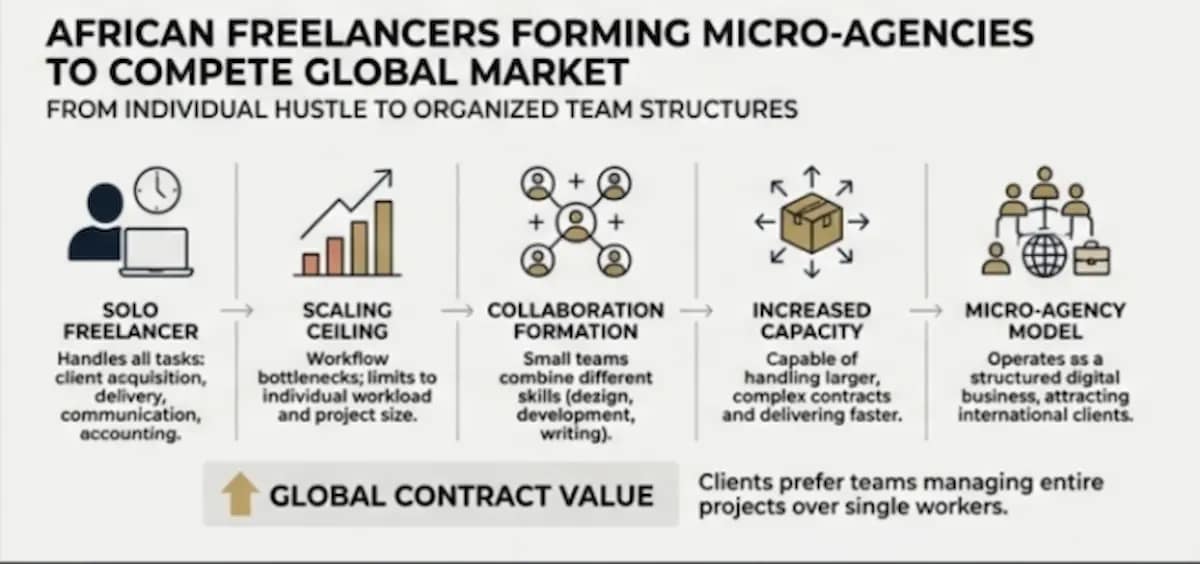
Why Are African Freelancers Forming Micro-Agencies Faster?
More African freelancers are moving toward micro-agencies as solo work becomes harder to scale consistently across increasingly competitive global freelance markets.
Small remote teams are allowing freelancers to combine specialized skills, handle larger contracts, and deliver faster multi-service projects for international clients seeking flexible digital services across design, development, marketing, editing, and operations.
The shift is also changing how freelancers position themselves commercially.
Clients increasingly prefer small teams capable of managing entire workflows instead of relying on individuals handling every stage of project delivery alone.
Across parts of Africa, micro-agencies are increasingly functioning as lightweight digital businesses competing for recurring international contracts inside the global remote-work economy.
How Do Cross-Border Payments Empower African Freelancers?
Cross-border payments have historically been one of the biggest operational weaknesses inside Africa’s freelance economy.
Delayed settlements, high transfer fees, currency restrictions, and banking limitations often reduced how easily freelancers could work with international clients despite growing demand for remote digital services across global markets.
That pressure is easing as fintech infrastructure, digital banking tools, and international payment platforms expand across African markets.
The World Bank has repeatedly highlighted the role of digital financial systems in improving financial access and reducing payment friction across developing economies.
Faster settlement systems are making it easier for African freelancers to receive international payments directly from clients across Europe, North America, the Middle East, and Asia without relying entirely on slower traditional banking structures.
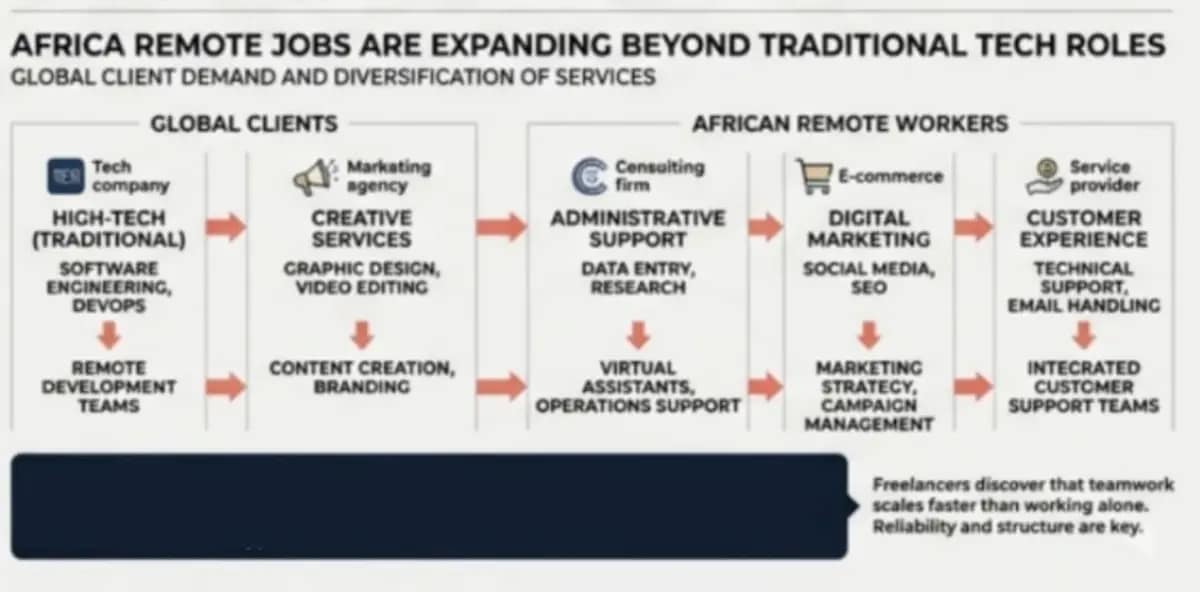
Can Africa Remote Jobs Expand Beyond Traditional Tech Work?
Africa remote jobs are increasingly expanding beyond software engineering and high-level technology roles as international businesses outsource customer support, research, operations, marketing, administration, design, and content work to distributed freelance teams across African markets.
The shift is widening digital-income opportunities outside traditional technology ecosystems concentrated in a few major cities.
Remote collaboration platforms, internet access, and cloud-based workflows are allowing more workers to participate in cross-border digital labor markets without relocating physically.
Across parts of Africa, remote work is increasingly functioning less like temporary gig activity and more like an alternative employment layer operating alongside weaker formal labor markets.
Why Are Freelancers Abandoning Solo Work for Structured Teams?
Freelancers across Africa are increasingly discovering that solo work becomes difficult to scale once project volume, client management, revisions, operations, and delivery timelines begin growing simultaneously.
Micro-agencies are emerging partly from that operational pressure as freelancers build small structured teams capable of handling larger and more consistent international contracts.
The change is also reshaping how freelancers compete commercially.
International clients increasingly prefer reliable delivery systems over individual talent alone, especially for long-term outsourced work requiring speed, communication, and workflow continuity.
The freelancers building repeatable systems, specialized teams, and structured service operations are increasingly positioning themselves less like gig workers and more like export-oriented digital businesses inside the global remote-work economy.


Recent Comments