

Featured Summary:
- Russia and African countries adopted a 2027–2029 cooperation plan at the October 28–29 Moscow summit, alongside new agreements
- Russia–Africa trade exceeded $27 billion in 2025, still below Putin’s $40 billion annual target announced in 2019
- Russian-backed projects have advanced in agriculture and energy, while other infrastructure and industrial commitments remain under development
- African governments continue seeking Russian investment and technology partnerships to expand electricity supply, manufacturing and local production
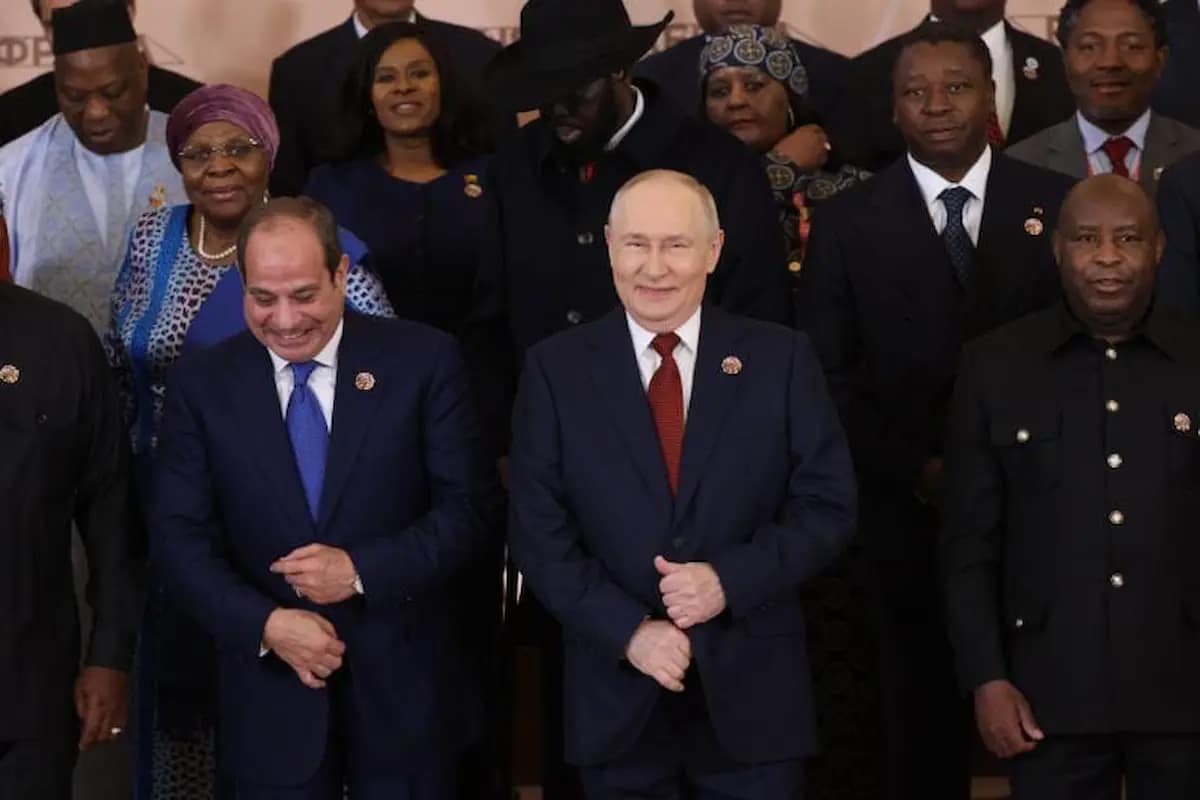
Russia’s October 28–29 summit with African countries produced new cooperation agreements covering trade, mining, energy and industrial development.
Moscow also adopted a 2027–2029 action plan with African partners, setting out priorities for investment and economic cooperation over the next three years.
In Ghana, Russian aluminium producer Rusal agreed with the Ghana Integrated Aluminium Development Corporation to develop bauxite mining and alumina refining operations at Nyinahin.
The proposed joint ventures target annual production of up to 5 million tonnes of bauxite and 1.2 million tonnes of alumina. Rusal is expected to hold majority stakes in the operations.
Ghana also announced Russian support for a proposed 2,000-megawatt nuclear power plant. The project has yet to secure publicly disclosed financing or a construction timetable. Its development would require substantial investment before electricity generation begins.
The latest agreements add to Russia’s existing commercial relationships across Africa, where agriculture and energy have been major areas of cooperation.
The scale of the new commitments makes their financing and implementation important to businesses seeking industrial partnerships, particularly as Moscow continues working towards the $40 billion annual trade ambition Putin announced at the first Russia–Africa summit in 2019.
Putin’s $40 Billion Africa Trade Goal Remains Unmet
Russia’s annual trade with African countries stood at approximately $16.8 billion when Putin announced plans to increase it to $40 billion at the 2019 Sochi summit. Turnover exceeded $27 billion in 2025, leaving a gap of roughly $13 billion against the original target.
Russian exports account for most of the trade. Federal Customs Service figures put exports to Africa at $22.7 billion in 2025, against imports of $4.4 billion.
Egypt accounted for approximately 39% of Russia’s African trade, making it the country’s largest commercial partner on the continent.
Agricultural shipments have contributed to the increase. Presidential aide Yuri Ushakov reported that Russia exported more than 18 million tonnes of grain to Africa in 2025, followed by 13 million tonnes during the first nine months of 2026.
Egypt received 5.9 million tonnes during that nine-month period. Sudan and Kenya were also among the buyers.
Russia has expanded fertiliser sales alongside grain exports. Shipments to African markets exceeded 2.2 million tonnes in 2026, according to figures reported by Russian officials.
The agricultural trade has strengthened Moscow’s commercial relationships with African countries that depend on imported wheat and fertilisers.
Russia’s New Africa Agreements Set Out Industrial Investment Commitments
Russia and the African Union Commission signed a 2027–2029 action plan covering 19 areas of cooperation, including energy, transport, agriculture, investment and industrial development.
African Union Commission Chairperson Mahmoud Ali Youssouf and Russian Foreign Minister Sergey Lavrov signed the document on October 28. The programme provides for annual reviews of implementation, although it is not legally binding.
Lavrov also signed an action plan with the Southern African Development Community (SADC), represented by Executive Secretary Elias Magosi.
The agreement covers mining, industrialisation, transport and energy. Moscow concluded separate cooperation memorandums with the East African Community, COMESA and the African Continental Free Trade Area Secretariat.
The Russia–Africa programme includes proposals for mineral processing, metallurgy and fertiliser production. Agricultural cooperation covers drought-resistant crops, land reclamation and technology exchanges. Transport priorities include modernising ports, airports and railway networks.
The new regional agreements have not been accompanied by publicly disclosed financing packages for these industrial and transport projects. Their implementation will require further negotiations with participating governments, investors and project developers.
African Leaders Seek Russian Investment for Domestic Production
African Union Chairperson and Burundi President Évariste Ndayishimiye called for Russian investment in African manufacturing during the Moscow summit.
He urged Russian companies to establish joint production facilities, support mineral processing and transfer technology to African businesses. Ndayishimiye also sought identified financing sources and regular assessments of project implementation.
Kenyan President William Ruto called for greater Russian participation in manufacturing, technical training and industrial development. He urged investment in facilities that would allow African countries to process raw materials locally and produce more finished goods.
Ethiopia is pursuing nuclear energy cooperation with Moscow. Prime Minister Abiy Ahmed confirmed discussions on the country’s first nuclear power station, alongside partnerships in artificial intelligence, scientific research and medical applications of nuclear technology.
Rosatom has held negotiations with Ethiopia, although construction financing and a final contract have not been announced.
Egypt’s El Dabaa nuclear power plant is further advanced. Rosatom is constructing four reactors under an agreement supported by a $25 billion Russian state loan.
Egypt is expected to finance the remaining construction costs, with repayment of the Russian loan scheduled over 22 years. The project also includes training Egyptian specialists to operate and maintain the facility.
Russia’s relationship with several African governments dates to Soviet support for independence movements and technical education.
That history remains part of Moscow’s diplomatic engagement, while current negotiations increasingly involve industrial facilities, electricity generation and specialist training.
Russia’s Africa Agreements Face Financing and Construction Deadlines
Egypt’s October 31 summit report identified the Russian Industrial Zone in the Suez Canal Economic Zone as a major area of cooperation with Moscow.
The project is intended to accommodate Russian manufacturers producing goods for Egyptian and regional markets. Its development depends on companies establishing factories, securing equipment and committing capital to production.
Egypt is also pursuing Russian participation in transport infrastructure and logistics development. These proposals form part of Cairo’s efforts to attract industrial investment and expand manufacturing capacity, with further commercial negotiations required before individual projects proceed.
The summit adopted a declaration on cooperation in civilian artificial intelligence, including technology development and specialist training.
Under the 2027–2029 programme, participating governments will have to negotiate the investment arrangements and implementation schedules for projects identified during the meetings.
Russia enters this period with established agricultural trade relationships and major energy investments already underway in Africa.
The latest agreements provide further opportunities for Russian companies to expand their operations, although their contribution to Putin’s $40 billion annual trade ambition will depend on investment commitments becoming operating businesses and sustained commercial transactions.


Recent Comments