


Featured Summary:
- Future workforce skills are becoming more valuable as Zimbabwe’s economy changes.
- University degrees are facing pressure to keep pace with new industries.
- China’s workforce model is shaping Zimbabwe’s conversation around skills and industrial growth.
- Zimbabwe’s future economy will depend on preparing graduates for production, technology and entrepreneurship.
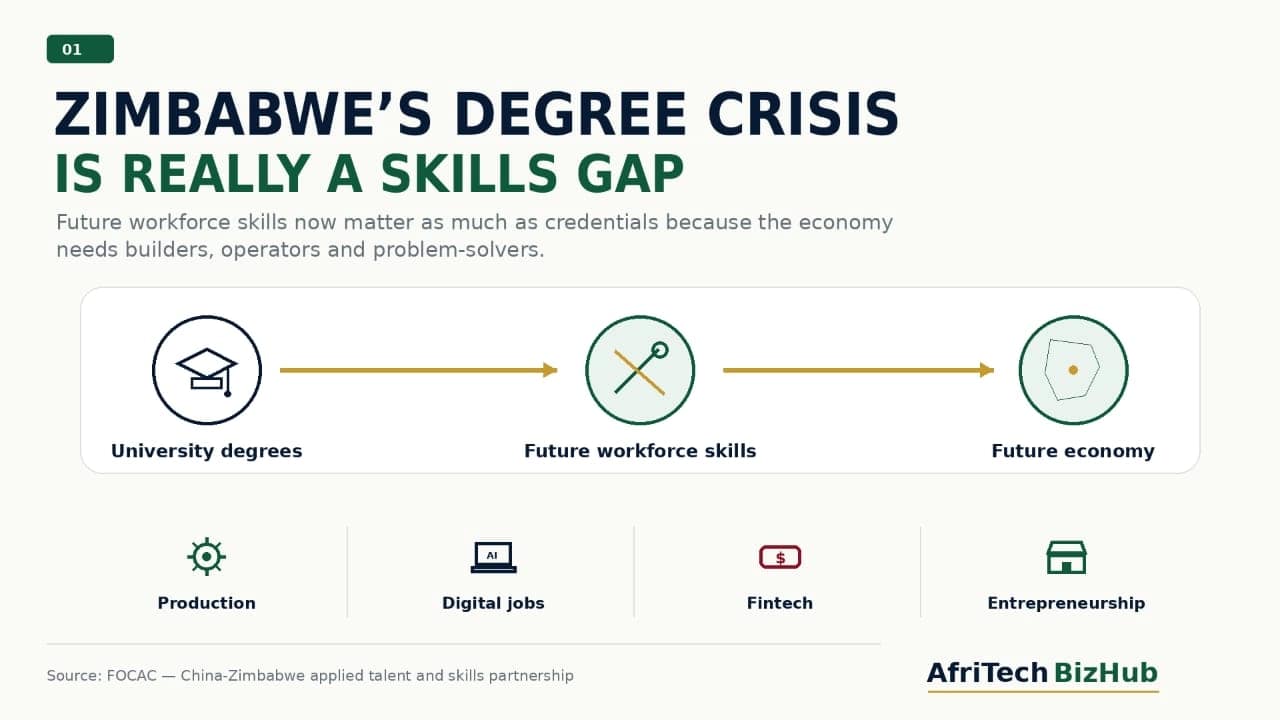
Zimbabwe’s degree problem is not that young people are studying too much.
It is that too many are graduating into an economy that now demands different abilities from the ones traditional education was built to reward.
Employers need people who can operate technology, solve practical problems, build businesses, support production, understand financial technology and adapt quickly as industries change.
A university certificate can open a door, but it no longer guarantees that a graduate is ready for the work behind that door.
Zimbabwe’s future economy needs engineers, technicians, digital workers, entrepreneurs, manufacturers, fintech talent and problem-solvers who can support industrial growth.
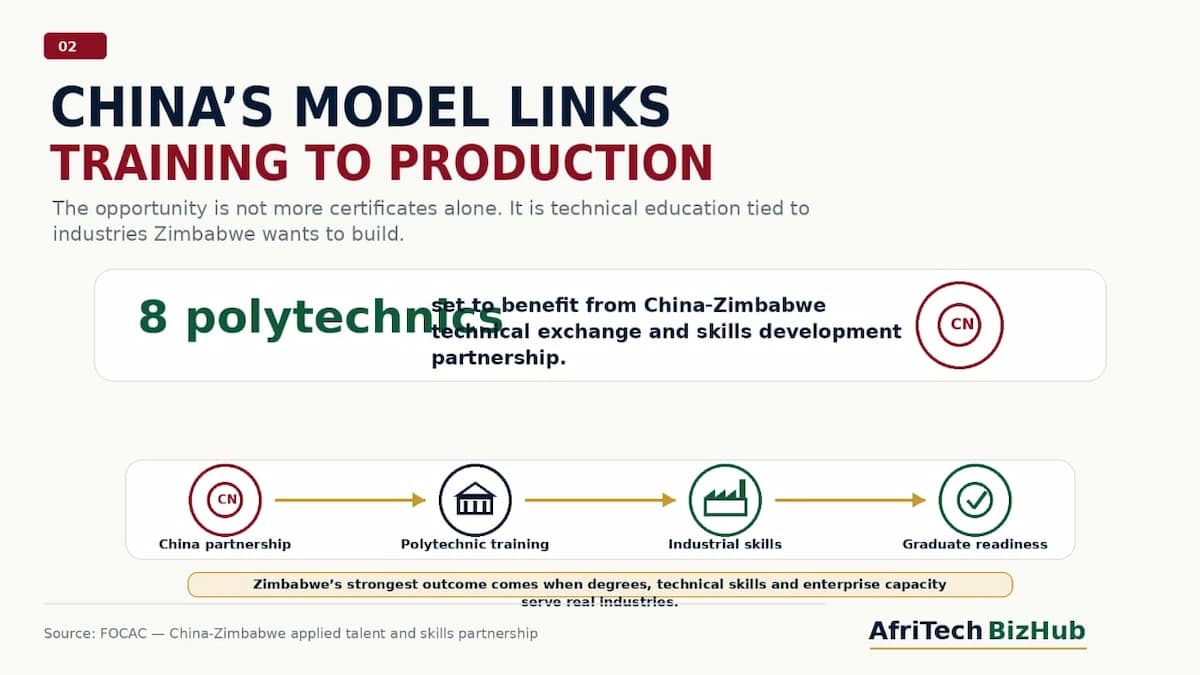
China’s role has become important because its model of linking technical education to production speaks directly to Zimbabwe’s gap: the country does not only need more graduates; it needs graduates whose skills can move the economy.
What Can Zimbabwe Learn From China on Future Workforce Skills?
China’s strongest lesson for Zimbabwe is that education becomes more valuable when it is tied closely to production.
Technical colleges, universities and industries must work together so that students do not leave school with theory alone.
They need exposure to equipment, industrial processes, workplace discipline, entrepreneurship and technology that reflect the economy they are expected to enter.
For Zimbabwe, future workforce skills must be built around what the country wants to produce.
Mining, mineral processing, manufacturing, agriculture, digital services, infrastructure, financial technology and small business growth all require practical capability.
China’s model shows that a workforce strategy cannot depend only on expanding degree access.
It must also build technical confidence, vocational strength and industry-linked training that help graduates become useful faster.
Is Economic Transformation Reshaping Zimbabwe’s University Degrees?
The value of a degree is changing because the economy is no longer rewarding credentials in the same way.
Zimbabwe’s labour market is under pressure from technology, industrial change, informal work, weak job creation and rising employer demand for practical skills.
A degree still matters, but it now has to prove its connection to real economic needs.
This is the contradiction facing universities.
They are producing educated graduates, but the economy is asking for workers who can build, code, repair, analyse, sell, design, manage systems and start businesses.
Economic transformation is therefore forcing higher education to become more responsive.
Courses that do not connect to production, digital services, entrepreneurship or industry needs will face more scrutiny.
The future degree will need to show not only what a student knows, but what that student can do.
Can Digital Economy Jobs Drive Zimbabwe’s Future Economy?
Digital work gives Zimbabwe a route to create jobs without waiting for every traditional industry to recover first.
Financial technology, software support, artificial intelligence tools, digital marketing, online services, data work, cybersecurity, e-commerce and platform-based businesses can create new opportunities for young people with the right skills.
These jobs do not remove the need for manufacturing or agriculture, but they can widen the employment base.
The challenge is access and training.
Digital economy jobs require more than internet use. Graduates need problem-solving, communication, data literacy, coding exposure, product thinking, financial awareness and the ability to work with digital tools.
Financial technology is especially important because it connects payments, savings, lending, business records and small enterprise growth.
Zimbabwe’s future economy will benefit if universities and training centres prepare students to participate in these sectors, not just observe them.
Why Are Chinese Moving to Zimbabwe?
Chinese engagement in Zimbabwe is moving through sectors that require practical skills as much as capital.
Mining, energy, construction, agriculture, industrial processing and digital infrastructure all need technicians, operators, engineers, supervisors and workers who can support machinery, production systems and technology transfer.
That is where the Zimbabwe China relationship is beginning to press directly on the country’s education system.
The Embassy of the People’s Republic of China in Zimbabwe reported that Chinese Ambassador Zhou Ding attended the inauguration of the China-Zimbabwe Engineering Technology Academy and the China-Zimbabwe Silk Road Teacher Capacity-Building Center at Harare Polytechnic on May 19, 2026.
The Embassy said China would expand vocational education exchanges, nurture a skilled technical workforce for Zimbabwe and support the country’s industrialisation and modernisation agenda.
For Zimbabwe, the investment story is no longer limited to projects and capital.
It is also becoming a skills question: who will be trained to work in the industries those projects create?
What Is the Relationship Between Zimbabwe and China?
Zimbabwe’s relationship with China moves beyond diplomacy and infrastructure into workforce development.
China remains important to Zimbabwe through investment, trade, mining, energy, construction, education and political cooperation.
But the deeper question is whether that relationship can help Zimbabwe build the human capacity needed for long-term economic transformation.
The opportunity is clear, but it is not automatic.
Infrastructure and investment can create economic openings, but they do not guarantee that Zimbabwean graduates will benefit unless the education system produces the right skills.
The strongest outcome would come from linking Chinese investment to local training, entrepreneurship, technology transfer, university reform and industrial jobs.
Zimbabwe’s future economy will not be transformed by degrees alone.
It will be transformed when degrees, technical skills and enterprise capacity begin to serve the industries the country is trying to build.


Recent Comments