


Featured Summary:
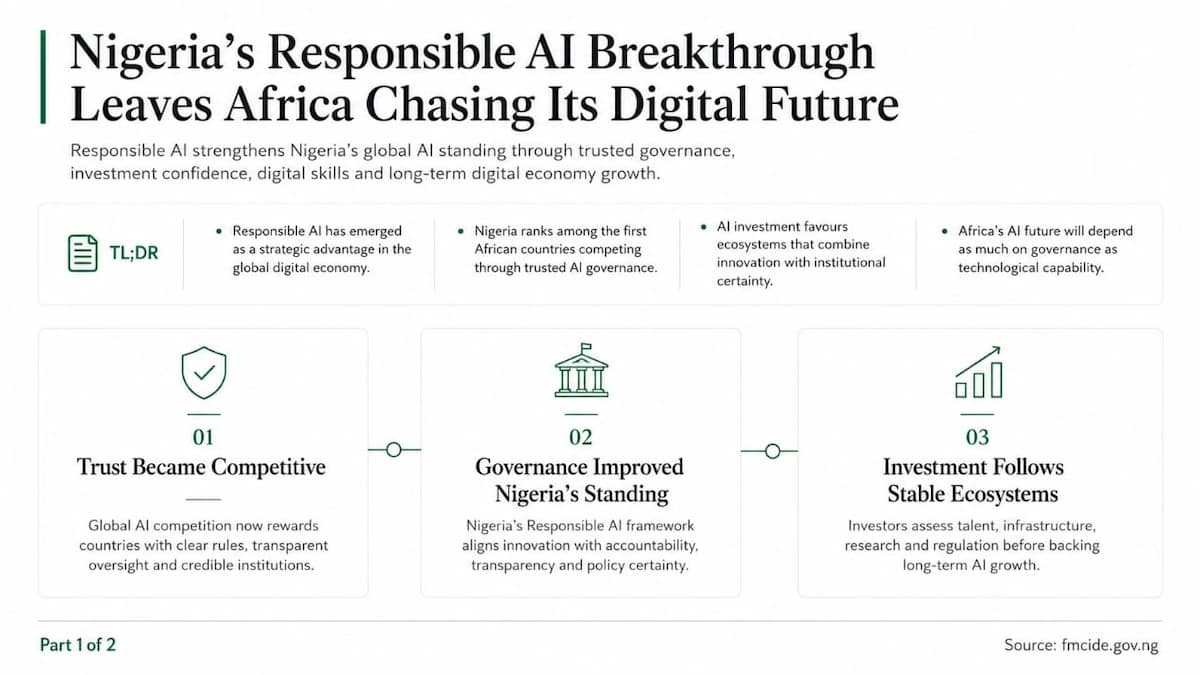
- Responsible AI has emerged as a strategic advantage in the global digital economy.
- Nigeria ranks among the first African countries competing through trusted AI governance.
- AI Investment favours ecosystems that combine innovation with institutional certainty.
- Africa’s AI future will depend as much on governance as technological capability.
Global competition in artificial intelligence no longer revolves solely around building larger models, funding more startups or deploying faster computing infrastructure.
Businesses, investors and research institutions also assess whether countries provide trusted rules for developing and deploying AI.
Confidence in governance now influences where innovation moves from research into commercial adoption.
Nigeria’s Responsible AI framework reflects that evolution.
The country has aligned governance, innovation, workforce development and commercial adoption within a common policy direction instead of treating regulation as a separate exercise.
Leadership in artificial intelligence now depends not only on technological capability but also on the quality of the institutions that support its deployment.
Why Is Responsible AI Transforming Nigeria’s Global Reputation?
International competitiveness in artificial intelligence now depends heavily on trust.
Countries with clear governance frameworks, transparent oversight and predictable regulation provide businesses with greater confidence to develop, test and deploy AI technologies.
Institutional credibility has therefore become a commercial advantage alongside technical innovation.
Nigeria strengthened its international profile through the adoption of a national Responsible AI Framework aligned with globally recognised principles for trustworthy AI.
Rather than slowing innovation, the framework provides greater accountability, transparency and policy certainty for developers, investors and public institutions.
Responsible AI therefore strengthens Nigeria’s international reputation because trusted governance now forms part of global AI competitiveness.
How Does Global AI Governance Reward Nigeria’s AI Progress?
International partnerships increasingly favour countries capable of combining innovation with credible governance.
Organisations such as UNESCO and the OECD encourage governments to establish practical frameworks that promote accountability, transparency, human rights and responsible AI deployment.
Those standards reduce regulatory uncertainty while supporting research collaboration, cross-border investment and commercial partnerships.
Nigeria’s governance framework places the country within that international movement by providing stronger institutional foundations for AI development.
Clear rules improve confidence among technology companies, development partners and investors evaluating long-term opportunities across the Nigeria AI Ecosystem.
Global AI Governance therefore rewards countries whose institutions provide certainty alongside technological ambition.
Why Is AI Investment Flowing Toward Nigeria’s AI Ecosystem?
Long-term AI Investment depends on far more than startup activity.
Investors assess the strength of an entire AI Ecosystem by evaluating technical talent, digital infrastructure, research capability, commercial demand and regulatory stability before committing capital.
Strong institutions reduce uncertainty while improving confidence that innovation can move successfully from development into large-scale deployment.
Nigeria AI Ecosystem combines entrepreneurial activity with expanding digital infrastructure, growing technical expertise and clearer governance.
Responsible AI complements those commercial fundamentals by providing policy certainty that supports innovation over the long term.
Investment therefore follows ecosystems where governance, skilled talent and commercial opportunity reinforce one another instead of operating independently.
How Is Digital Skills Training Powering Nigeria’s Digital Economy?
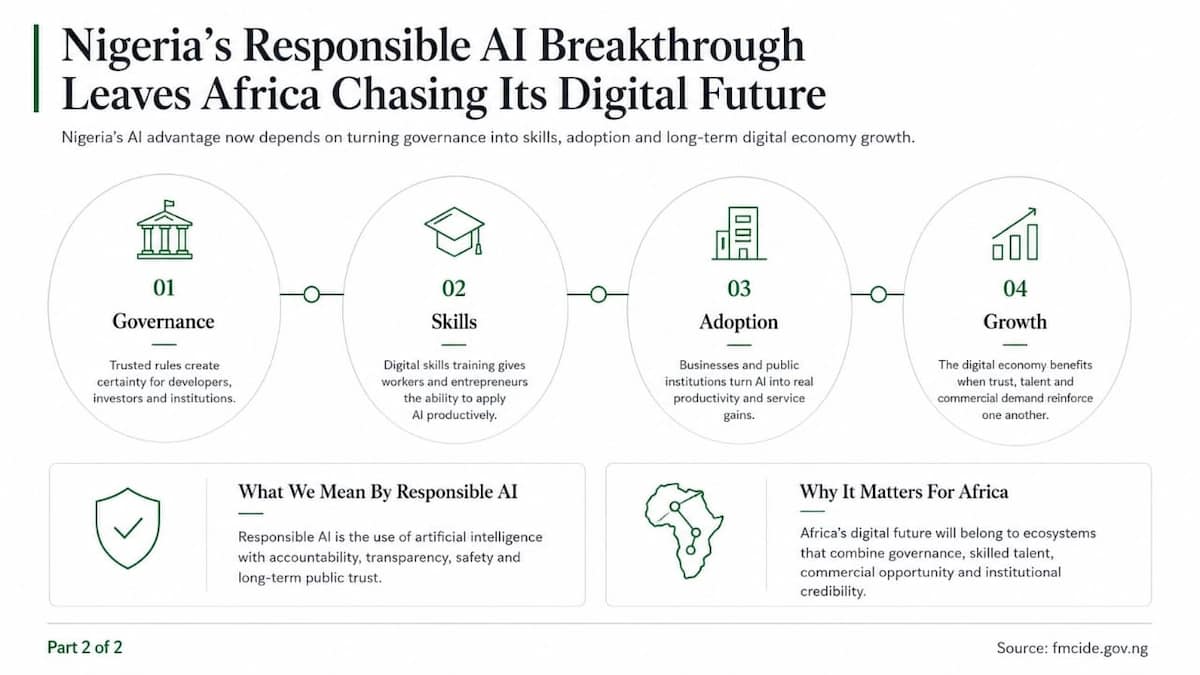
Governance provides direction for AI development, but productive industries depend on people capable of applying those technologies across businesses and public institutions.
Policies alone cannot generate economic value without engineers, researchers, entrepreneurs and workers who possess the skills required to deploy artificial intelligence effectively.
Workforce capability ultimately determines whether innovation reaches the wider economy.
Digital Skills Training provides the practical link between Responsible AI and sustainable economic growth.
A stronger workforce encourages wider business adoption, improves productivity, supports higher-value employment and strengthens innovation across multiple sectors.
Those capabilities allow the Digital Economy to convert responsible governance into measurable commercial outcomes.
What Do We Mean By Responsible AI?
Responsible AI now functions as economic infrastructure rather than simply a governance principle.
It shapes how investors assess markets, how businesses evaluate operational risk, how researchers collaborate across borders and how governments compete for emerging digital industries.
Countries that establish trusted institutions create stronger foundations for innovation because confidence encourages long-term participation across the entire AI value chain.
Global leadership in artificial intelligence increasingly depends on how effectively countries combine governance, skilled talent, commercial opportunity and institutional credibility.
Technical capability alone no longer guarantees advantage.
Stronger outcomes emerge in environments where businesses, investors and citizens can deploy artificial intelligence with confidence, supported by systems that prioritise accountability, transparency and long-term trust.


Recent Comments