


Featured Summary:
- Paystack AI rebuilt business analytics around questions instead of dashboard navigation.
- AI dashboard adoption is rising as businesses demand faster interpretation of operational data.
- Generative AI is moving into payment workflows to reduce reporting friction.
- Business decisions increasingly depend on how quickly companies understand what their own data means.
Business analytics rarely fails because businesses lack information.
The breakdown usually happens later, when teams spend more time locating answers than acting on them.
Transactions grow, dashboards multiply, and reports accumulate, yet decisions still slow because understanding scales more slowly than data.
Paystack’s redesigned dashboard enters that gap.
Rebuilt for the first time in ten years, the platform introduces an AI-native command experience that allows merchants to ask questions directly and receive responses based on their own payment activity.
The redesign shifts analytics away from searching through interfaces and closer to understanding business performance in real time.
How Is Paystack AI Improving Business Analytics Insights?
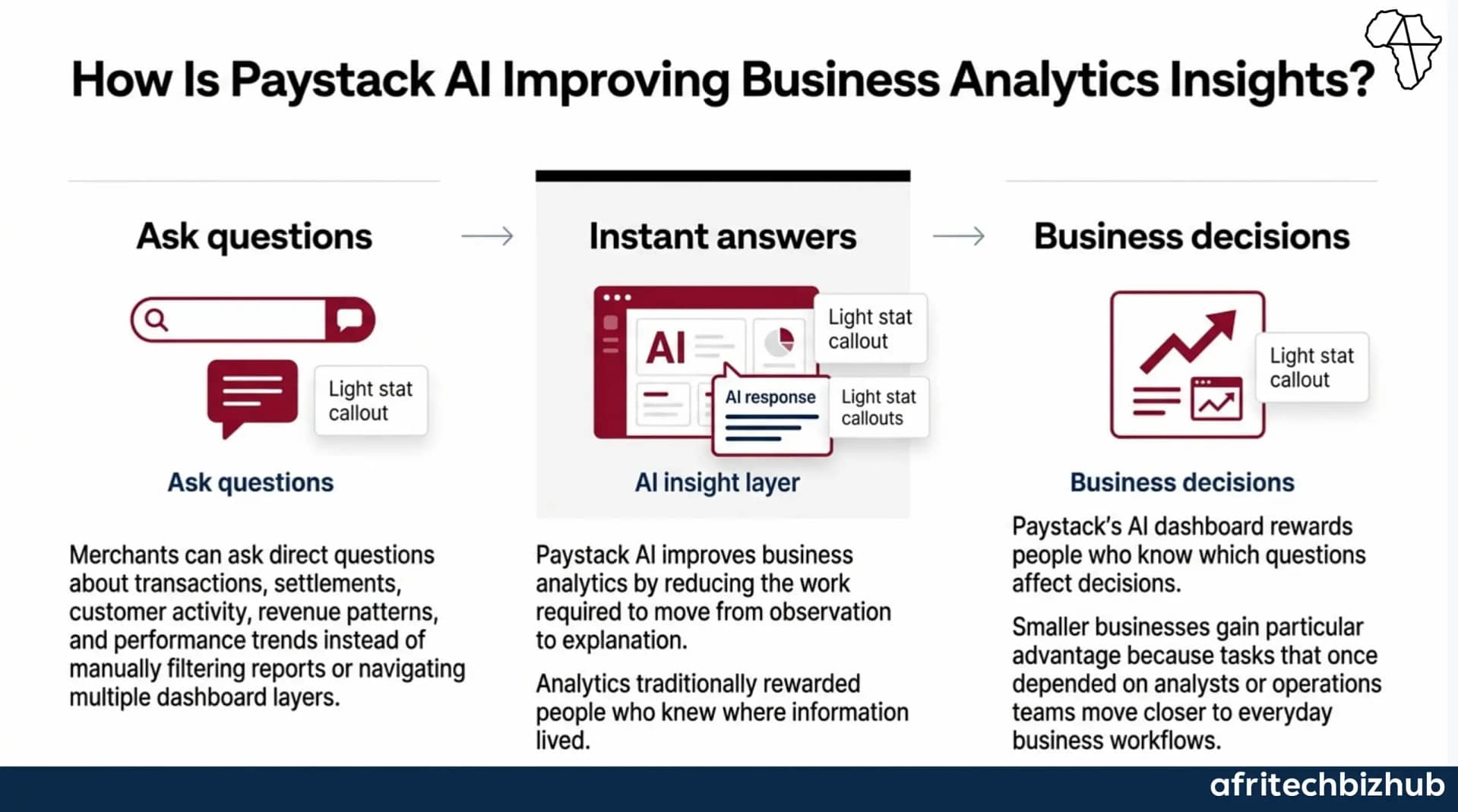
Paystack AI improves business analytics by reducing the work required to move from observation to explanation.
Merchants can ask direct questions about transactions, settlements, customer activity, revenue patterns, and performance trends instead of manually filtering reports or navigating multiple dashboard layers.
That changes what insight means inside businesses.
Analytics traditionally rewarded people who knew where information lived.
Paystack’s AI dashboard rewards people who know which questions affect decisions.
Smaller businesses gain particular advantage because tasks that once depended on analysts or operations teams move closer to everyday business workflows.
Why Is AI Dashboard Adoption Rising Among Businesses?
Businesses are adopting AI dashboards because information volume has started creating the same operational drag as information scarcity.
More reports do not automatically create better decisions.
In many cases, they create more interpretation work.
Paystack’s redesign reflects a broader shift in business behavior.
Merchants increasingly want systems that explain performance instead of displaying activity.
For mobile-first businesses operating across payments, inventory, customer management, and growth decisions simultaneously, reducing interpretation time creates measurable operational value.
How Is Generative AI Changing Payment Analytics?
Generative AI changes payment analytics by reducing the effort required to interpret transaction activity and operational performance.
Instead of switching across transaction histories, settlement records, exports, charts, and reporting views, businesses move closer to asking operational questions directly and receiving structured responses.
Paystack built the dashboard around an AI-native command centre designed to make business data easier to interpret through natural interaction rather than deeper navigation.
The stronger implication is practical: payment platforms increasingly compete not only on transaction processing but also on how quickly merchants turn payment activity into action.
How Does Paystack AI Boost Smarter Business Decisions?
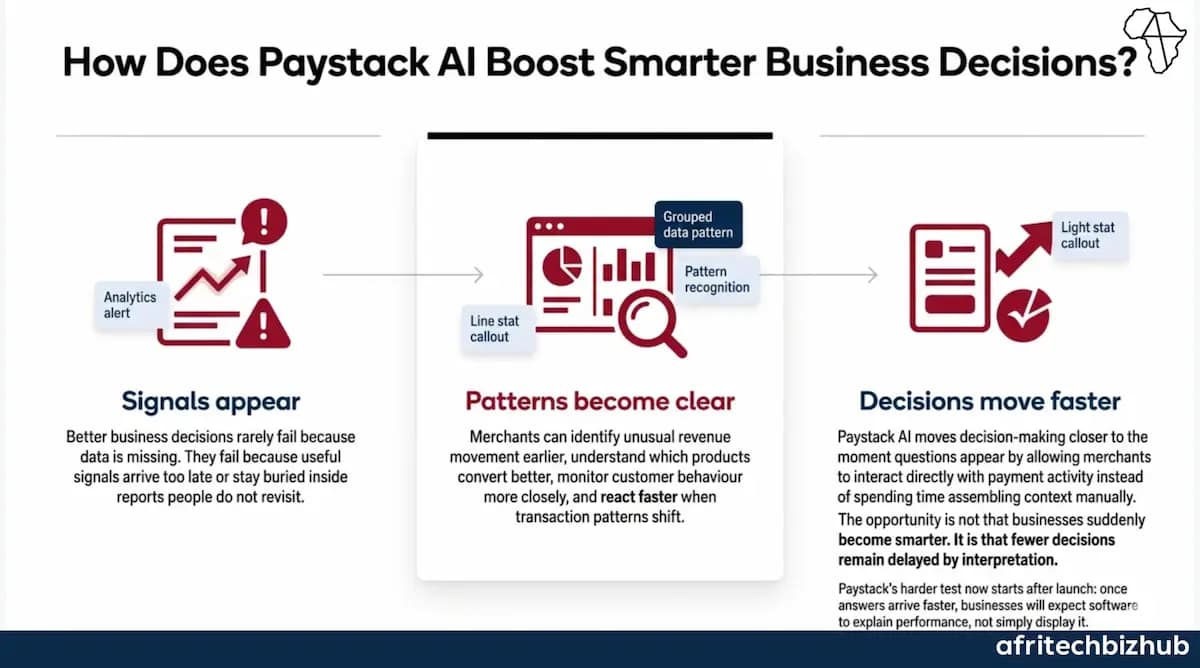
Better business decisions rarely fail because data is missing.
They fail because useful signals arrive too late or stay buried inside reports people do not revisit.
Paystack AI moves decision-making closer to the moment questions appear by allowing merchants to interact directly with payment activity instead of spending time assembling context manually.
That changes the practical use of business analytics.
Merchants can detect unusual revenue movement earlier, understand product performance faster, monitor customer behaviour more closely, and act before reporting cycles catch up.
The opportunity is not that businesses suddenly become smarter.
It is that fewer business decisions remain trapped inside dashboards.
Paystack’s harder test begins after launch: once answers arrive faster, merchants will expect software to explain performance rather than display information.


Recent Comments