

Last updated: June 12, 2026
Featured Summary:
- Payment Fraud is outpacing traditional controls as Digital Payments expand across Nigeria.
- Fraud Detection is shifting from after-the-fact investigation to early risk identification.
- Transaction Monitoring is essential for real-time oversight of rapidly growing payment volumes.
- RegTech and SupTech are enabling continuous supervision to keep pace with modern financial activity.
Every advance in digital payments accelerates the race against Payment Fraud.
Transfers that once took days now settle in seconds, leaving little room for human oversight.
CBN’s Payments System Vision 2028 addresses this challenge by integrating AI, SupTech, and RegTech into transaction supervision.
The tension is clear: Nigeria’s financial system is expanding faster than traditional oversight methods can manage, and regulators must anticipate fraudulent activity before losses occur.
This is not just about security; it is about building a system capable of monitoring millions of transactions in real time without slowing growth.
How Will AI Stop Payment Fraud Across Nigeria?
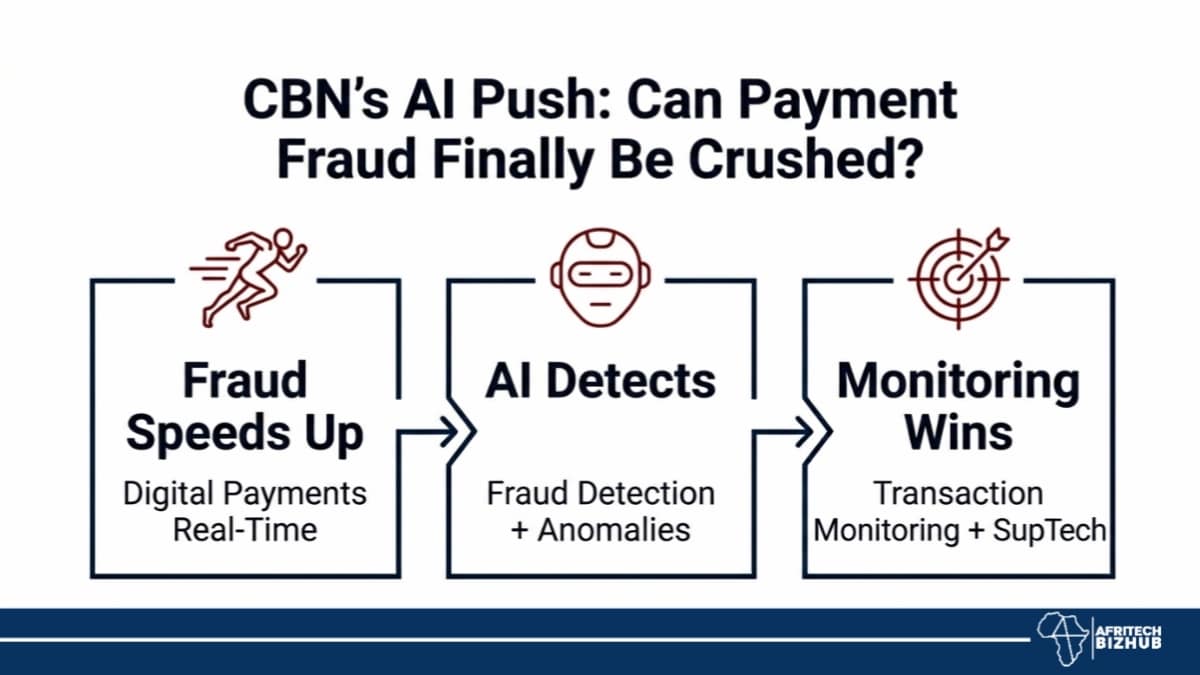
Fraudsters exploit speed.
Suspicious funds can now move through multiple accounts before investigators even begin reviewing activity.
Traditional post-event controls are increasingly inadequate.
Artificial intelligence changes this dynamic.
AI monitors transactions as they occur, identifying anomalies in behaviour, device activity, and unusual patterns across accounts.
The goal is to catch suspicious activity before it succeeds, making detection proactive rather than reactive.
Observed trends show that early intervention through AI significantly reduces potential losses while maintaining transaction flow across banks, fintechs, and payment platforms.
The adoption of AI for Payment Fraud demonstrates that speed, pattern recognition, and automation have become central to financial supervision in Nigeria.
As digital payments expand, AI is no longer an optional tool; it is a necessary layer of resilience.
Can Advanced Fraud Detection Outpace Cybercriminals Today?
Criminals adapt faster than ever.
Automated attacks, social engineering, and account takeovers evolve alongside new detection methods.
Many fraudulent transactions are designed to mimic legitimate activity, making them difficult to detect through human review alone.
Modern Fraud Detection systems focus on behaviour, transaction context, and emerging patterns.
Machine learning algorithms continuously refine their understanding of what constitutes risk.
Observed results indicate that early identification reduces the impact of sophisticated attacks, but vigilance must be continuous.
The real tension is whether defensive systems can evolve faster than the threats they aim to prevent.
Why Is Transaction Monitoring Critical For Digital Security in Africa?
Manual supervision cannot scale to the millions of transactions processed daily across Nigeria’s financial ecosystem.
Every payment leaves a trail, but identifying patterns requires systems capable of analyzing data in real time.
Transaction Monitoring provides visibility into networks, allowing financial institutions to detect coordinated fraud schemes, money laundering, and unusual activity before they escalate.
Across Africa’s growing Digital Payments landscape, monitoring is no longer optional; it is central to trust and financial stability.
The combination of high transaction volume and interconnected financial systems makes monitoring as important as the underlying technology itself.
How Will RegTech Strengthen Compliance And Fraud Prevention?
Many regulatory frameworks were built for slower financial systems, relying on periodic reports and retrospective audits.
The Central Bank of Nigeria (CBN) is shifting oversight toward continuous supervision using technology as part of its Payments System Vision 2028.
RegTech platforms automate compliance, risk analysis, reporting, and anomaly detection.
Observed deployments show that combining RegTech with AI-driven Fraud Detection enables authorities to respond in real time, reducing gaps between suspicious activity and intervention.
The institutional signal is clear: future financial oversight depends on technology that can keep pace with transaction speed.
Can SupTech Transform Oversight of Digital Payments?
SupTech extends the principles of RegTech directly to regulators.
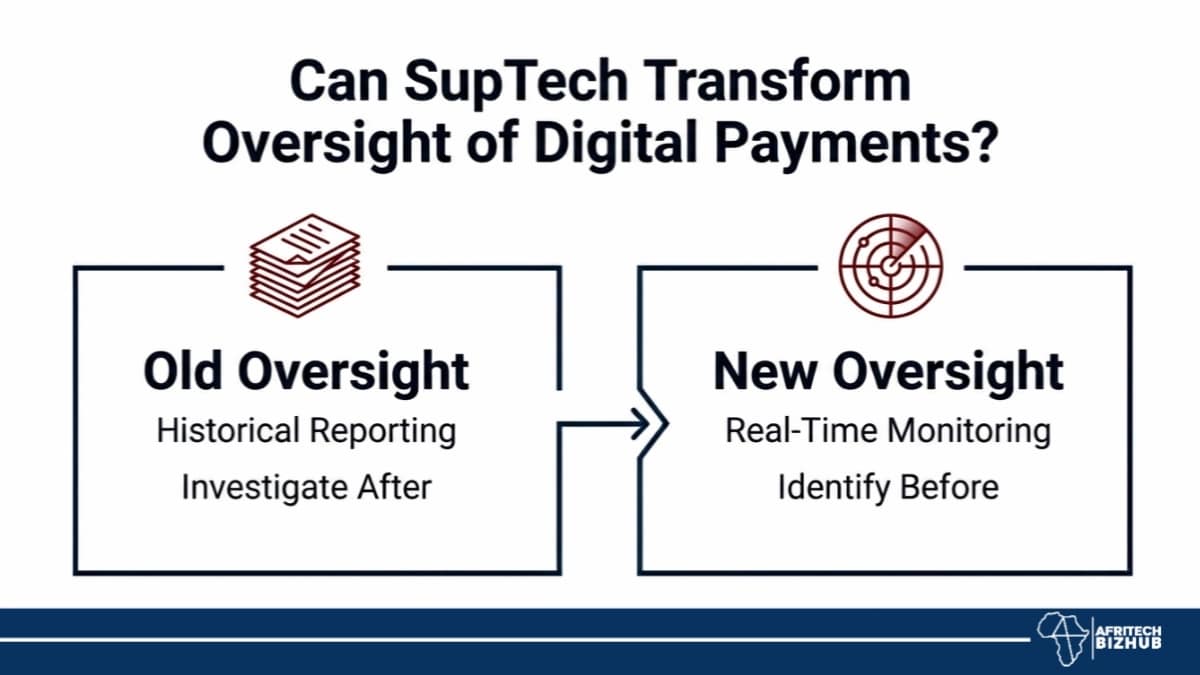
Audits and inspections remain essential but are insufficient for real-time threats.
SupTech allows CBN to monitor systemic risk, detect vulnerabilities, and identify emerging fraud patterns as the financial ecosystem evolves.
Early adoption shows that SupTech, coupled with AI, could redefine supervision.
Payment Fraud in Nigeria is increasingly a challenge of speed, not information.
Systems exist to detect risk, but acting fast enough is the differentiator.
The trajectory set by PSV 2028 indicates a financial oversight model where preventive detection replaces post-facto intervention, setting a new standard for Digital Payments supervision across Africa.


Recent Comments