

Featured Summary:
- EBRD’s $100 million Egypt facility will finance eligible microfinance institutions through the National Bank of Egypt
- Egypt’s MSME bank lending increased 395% between 2015 and 2025, yet financing constraints persist
- The facility provides longer-term funding to lenders serving microenterprises, including women-owned businesses
- Its economic contribution will depend on actual disbursements, lending conditions and business performance
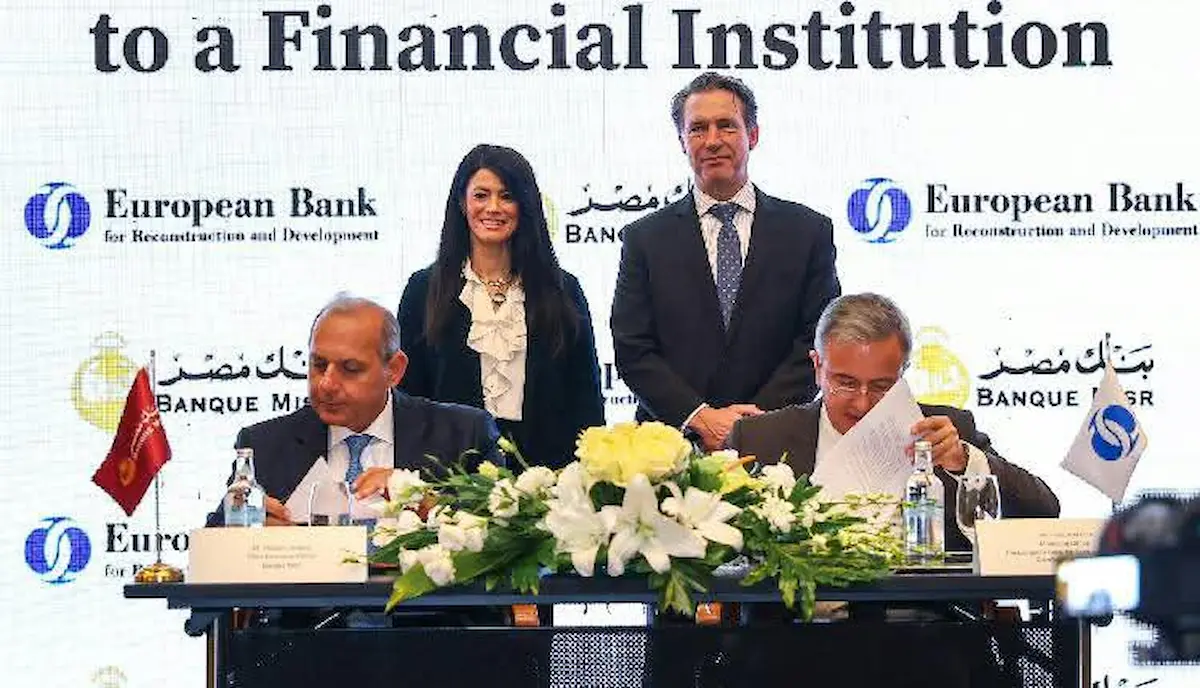
The European Bank for Reconstruction and Development (EBRD) announced a financing facility of up to $100 million for the National Bank of Egypt (NBE) on November 18, 2026.
The agreement includes $75 million in committed funding and a further $25 million under an uncommitted tranche. NBE will lend to eligible microfinance institutions, which will provide financing to smaller businesses, particularly women-owned enterprises and borrowers outside major urban centres.
Bank lending to micro, small and medium-sized enterprises in Egypt increased by 395% between 2015 and 2025, according to the Organisation for Economic Co-operation and Development (OECD).
The EBRD nevertheless identifies limited availability of longer-term funding for microfinance institutions as a constraint in the Egyptian market. The new facility is intended to increase the financing available to these lenders.
Egypt’s Financial Regulatory Authority reported that women accounted for 52.8% of microfinance beneficiaries in June 2026 but held 45.4% of outstanding financing balances.
Women already represent a majority of borrowers in the regulated market, although their share of outstanding credit is smaller. The EBRD’s emphasis on women-led enterprises places the new funding within an existing lending network serving a substantial female customer base.
The EBRD previously arranged $119.5 million in financing for NBE in 2024 and a separate $100 million facility in 2025 to support smaller enterprises.
The November agreement directs funding specifically through microfinance institutions, extending the bank’s earlier support to another lending channel.
The amount of additional credit reaching underserved businesses will depend on participating institutions’ lending capacity, borrower eligibility and the terms offered to enterprises.
Egypt’s Credit Expansion Has Left Smaller Businesses Underserved
Egypt’s microfinance portfolios expanded by 1,478% between 2015 and 2025, according to the OECD’s May 2026 report. By June 2026, the combined microfinance portfolio had exceeded EGP 107 billion, serving more than 3.9 million clients, according to the Central Bank of Egypt.
The expansion reflects substantial growth in regulated lending, although the figures do not establish how many businesses remain unable to obtain credit.
The OECD’s 2025 review found that Egyptian banks financed only 7.3% of investment by businesses employing five to 19 workers in 2020. Smaller enterprises faced high transaction costs, collateral requirements and difficulties providing the financial information lenders needed to assess creditworthiness.
Informal businesses encountered additional restrictions because they often lacked the documentation required for conventional bank financing.
The Central Bank of Egypt increased the mandatory MSME allocation in banks’ credit portfolios from 20% to 25% in 2021, reserving 10% for small enterprises. It also introduced simplified customer-identification procedures and measures to strengthen microfinance providers.
These policies expanded the channels available for business lending, while the EBRD’s November 2026 project assessment identified limited access to longer-term capital as a continuing constraint for microfinance institutions.
Commercial banks are an established source of funding for Egypt’s microfinance providers. The Central Bank permits qualifying lending through these institutions to count towards banks’ MSME financing requirements, encouraging cooperation between the two sectors.
Access to longer-maturity capital remains important for providers seeking to extend credit without relying entirely on shorter-term funding arrangements. The availability of such funding affects their capacity to finance additional microenterprises and manage repayment obligations.
EBRD Directs New Funding Through Egypt’s Microfinance Institutions
The National Bank of Egypt will receive the EBRD financing as a senior unsecured loan repayable over a maximum of four years, including a one-year grace period.
Repayments are scheduled semiannually. The initial $75 million is committed, while the additional $25 million remains uncommitted. These terms govern NBE’s borrowing from the development bank; participating microfinance institutions will receive financing under separate lending arrangements.
NBE will provide funds to eligible private microfinance institutions regulated by Egypt’s Financial Regulatory Authority. Those institutions will finance qualifying smaller enterprises and manage their lending portfolios.
The EBRD identifies the transaction as its first facility under the Financial Intermediaries Framework involving a second intermediary. Participating lenders must comply with applicable consumer-protection requirements, including standards governing debt collection and excessive borrowing.
Earlier EBRD financing for NBE included a $119.5 million arrangement in 2024 and a separate $100 million facility in 2025 supporting micro, small and medium-sized enterprises.
The November 2026 agreement specifically directs development-bank funding through microfinance providers. This allows NBE to finance institutions already operating in the microenterprise lending market rather than relying exclusively on its own lending operations.
The agreement requires NBE to maintain an environmental and social management system and submit annual compliance reports. Participating financial institutions must meet the EBRD’s portfolio-quality and prudent-lending requirements.
The project disclosure identifies no separate technical-cooperation or grant-financing component. Credit assessment, repayment collection and portfolio management will therefore remain central responsibilities for the lenders distributing the funds.
Egypt’s Women Entrepreneurs Remain Central to Microfinance Expansion
Outstanding microfinance balances held by women in Egypt reached EGP 33.7 billion at the end of June 2026, compared with EGP 29.4 billion a year earlier, according to the Financial Regulatory Authority.
The number of female borrowers declined from approximately 1.9 million to 1.8 million during the same period. Average outstanding financing per borrower increased, reflecting a rise in credit balances alongside a smaller customer base.
The OECD’s May 2026 assessment identified collateral and documentation requirements among the barriers facing women-owned enterprises.
Its research found that women received 21% of financing allocated by the Micro, Small and Medium Enterprises Development Agency (MSMEDA) to project owners in 2022, although they represented 30% of recipients. By 2024, women accounted for 34% of the agency’s total financing, indicating a larger share of its lending allocation.
MSMEDA issued approximately 80,000 loans in 2024, with women receiving half, according to the OECD. Women also represented 60% of the agency’s microfinance beneficiaries in 2022, compared with 11% of recipients supported through small-enterprise projects.
The distribution identifies a substantial existing market for microcredit among women, alongside lower participation in financing programmes serving larger businesses.
Egypt’s Financial Regulatory Authority signed a cooperation agreement with the National Council for Women in September 2026 to expand access to non-bank financial services and financial training.
The Central Bank’s 2026–2030 financial inclusion strategy also prioritises underserved groups and smaller enterprises. The EBRD’s new funding will enter a market where women already account for a substantial share of microfinance activity, with additional lending dependent on participating institutions’ borrower selection and credit terms.
EBRD’s Microfinance Expansion Faces Its Lending Performance Test
Egypt’s established microfinance network gives the National Bank of Egypt a channel for distributing the EBRD’s longer-term capital to smaller businesses.
The arrangement could increase the resources available to participating lenders, particularly those serving women-owned enterprises and borrowers outside major cities.
Its contribution will depend on whether those institutions can extend additional credit under terms suited to their customers’ business activities.
Disbursements to eligible microfinance providers will establish how much of the committed funding enters the lending market. The number of enterprises reached, loan maturities and borrowing costs will indicate whether the capital improves access for businesses facing existing credit restrictions. Participation by institutions operating beyond Egypt’s main commercial centres will also be important to the facility’s geographic reach.
Repayment performance and business investment will provide a clearer assessment of the financing’s commercial results. Sustainable lending could help smaller enterprises purchase equipment, increase production and expand operations.
For Egypt, the measure of progress will be the additional productive activity supported by these loans and the ability of participating institutions to maintain lending without weakening their portfolios.


Recent Comments