

Featured Summary:
- EBRD’s $6 billion energy plan opens new industrial opportunities under Türkiye’s $300 billion REACT ambition
- Türkiye’s renewable manufacturers stand to compete for new solar and wind equipment orders
- TEİAŞ’s grid expansion opens further contracts for engineering firms and electrical-equipment suppliers
- New financing approvals will determine which energy projects advance and which suppliers secure orders
The United Kingdom’s 373-megawatt Cleve Hill solar park began commercial operations in July 2025, following debt financing of up to £238.5 million from Lloyds and NatWest.
Developer Quinbrook Infrastructure Partners awarded the engineering, procurement and construction contract to Greece’s METLEN, while Fichtner and DNV provided engineering and technical advisory services. The project brought international contractors and financial institutions into one of Britain’s largest solar developments.
Türkiye’s Ministry of Energy and Natural Resources reported that solar accounted for 22.2% of installed electricity capacity in September 2026, compared with 12.2% for wind.
The government plans to increase combined solar and wind capacity to 175 gigawatts by 2040, requiring further investment in power generation, transmission networks and associated equipment.
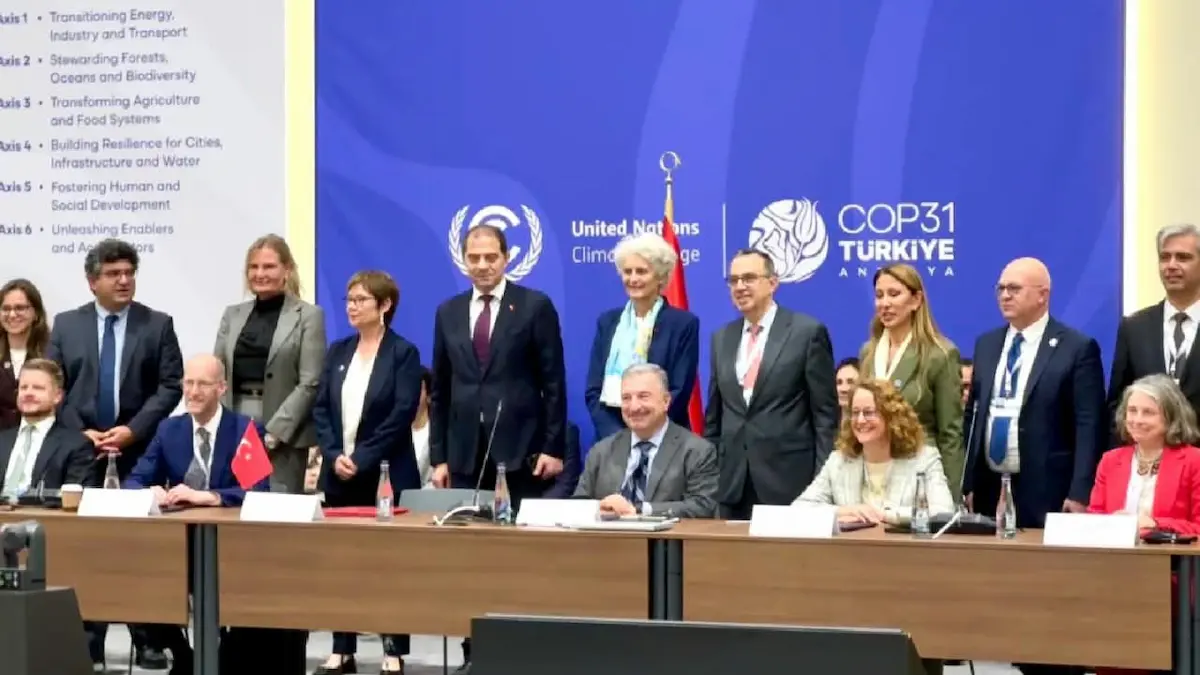
The European Bank for Reconstruction and Development (EBRD) plans to invest $6 billion over five years under Türkiye’s Renewable Energy Acceleration and Clean Transition Platform (REACT).
The initiative targets $300 billion in mobilised investment by 2040, covering renewable generation, electricity grids, storage and industrial development.
Individual financing commitments and equipment contracts will determine how much of that expenditure reaches manufacturers and engineering firms.
Türkiye’s existing solar and wind manufacturing facilities, renewable developers and electrical contractors provide an industrial base for the expansion.
The next commercial opportunities will emerge through YEKA project awards, transmission tenders and financing agreements, with Turkish and international suppliers competing for equipment and construction contracts.
Türkiye’s Renewable Manufacturers Compete for New Equipment Orders
Kalyon Energy’s Karapınar solar plant in Konya has 1,000 MW of electrical capacity and 1,350 MWp of installed solar modules. Completed in 2023 under Türkiye’s Renewable Energy Resource Areas (YEKA) programme, the project used panels manufactured at Kalyon PV’s Ankara facility with 80% local content. The integrated factory produces ingots, wafers, solar cells and modules.
Kalyon PV’s 2025 annual report put its annual solar-panel manufacturing capacity at approximately 1.9 GW, alongside around 1 GW each of ingot, wafer and cell capacity.
The company also outlined a 2026 investment to increase cell production capacity to 2.1 GW. The expansion would increase the volume of domestically manufactured cells available for solar projects, subject to completion and commercial production.
Germany’s Nordex began manufacturing wind-turbine blades at a new 130,000-square-metre factory in Menemen, İzmir, in May 2026. The facility is designed to produce up to 1,200 blades annually at full capacity, with approximately 1,200 employees. Production covers components for the company’s N163 and N175 turbine models.
Nordex secured an order from Türkerler Holding in August 2026 to supply and install 72 turbines with approximately 525 MW of capacity for the YEKA-5 Sivas wind project.
Installation is scheduled to begin in the third quarter of 2027. The manufacturer also has agreements covering 750 MW of turbine orders from Enerjisa Üretim for the Edirne and Balkaya projects, with equipment intended to meet the applicable YEKA localisation requirements.
Türkiye signed further YEKA agreements covering 650 MW of solar capacity on January 6, 2026, followed by 1,150 MW of wind capacity on January 16. The contracts cover eight solar areas and six wind areas.
They establish additional generation projects for developers, although equipment manufacturers and construction suppliers have not been confirmed for every project.
Kalyon PV’s manufacturing expansion and Nordex’s contracted turbine deliveries place both companies within Türkiye’s growing renewable-equipment market.
The remaining YEKA projects offer further procurement opportunities, with supplier selection and domestic-content requirements determining which manufacturers receive additional orders.
Türkiye’s Grid Expansion Opens Contracts for Engineering Firms
Türkiye’s electricity transmission operator, TEİAŞ, awarded Canadian firm Manitoba Hydro International a €672,779 consultancy contract in July 2026 to prepare technical specifications for a proposed high-voltage direct-current transmission system.
The assignment covers a planned 2,000 MW, ±525 kV connection and specifications for an owner’s engineer. Construction contracts have not been awarded under this consultancy assignment.
Turkish electrical-equipment manufacturer Astor Enerji secured contracts worth approximately ₺1.76 billion from TEİAŞ between May and July 2026. The May agreements covered ₺528 million in 400/164 kV autotransformers and ₺420 million in adjustable shunt reactors.
A further ₺816 million contract in July covered four mobile transformer substations, medium-voltage equipment and spare parts. The values exclude VAT.
GES Genel Elektrik Sistemleri signed two World Bank-financed turnkey contracts with TEİAŞ in March for 170 kV gas-insulated substations in Antalya and Side.
The Turkish contractor is responsible for engineering design, equipment supply, automation systems, civil works, installation, testing and commissioning. Each project includes 39 medium-voltage feeders, although the company has not disclosed the contract values.
TEİAŞ issued another invitation for bids on October 27 under reference DB.ATT.39, followed by a November 3 tender announcement under DB.KAB.22.
The available notices do not establish the winning contractors or final contract values. The projects therefore remain procurement opportunities rather than confirmed equipment orders.
Türkiye’s transmission network extended across 77,525 kilometres at the end of August 2026, with 834 high-voltage substations reported by October.
Astor Enerji and GES have secured equipment and construction work, while the proposed HVDC connection remains at the technical preparation stage. Further contracts will depend on project approvals and procurement awards.
EBRD Financing Determines Which Energy Projects Advance
The European Bank for Reconstruction and Development (EBRD) approved a senior loan of up to $200 million for Enerjisa Üretim in December 2025 to develop three wind farms in Muğla: Gaia, Falp and Arturna.
The projects have a combined capacity of 250 MW and an estimated investment cost of $399 million. The financing carries a maximum eight-year tenor, with EBRD listing the facility as disbursing.
Enerjisa obtained a separate EBRD facility of up to $150 million in 2026 to refinance short-term borrowing associated with earlier renewable investments.
The sustainability-linked loan is intended to reduce financing costs and improve the company’s debt maturity profile. Unlike the Muğla facility, it does not directly fund the construction of additional generating capacity.
Polat Enerji received $65 million from EBRD for a 77 MW hybrid renewable development combining wind and solar generation. The Clean Technology Fund provided another $5 million for a 10 MWh battery-storage installation at the company’s Geycek site.
Industrial investment is also receiving financing: an €80 million-equivalent loan to flour producer Ulusoy Un covers renewable generation and energy-efficiency improvements, including solar development in central Türkiye and wind projects in the west.
EBRD invested $100 million in a green bond issued by DenizBank, with proceeds allocated to eligible private-sector investments in renewable energy and energy efficiency.
By the end of 2025, the bank’s Green Economy Financing Facility programmes had supported more than 700 projects through 13 partner banks.
These financing channels reach businesses outside the major electricity developers, although the underlying transactions do not consistently disclose equipment suppliers or construction contract values.
Under the newly announced Renewable Energy Acceleration and Clean Transition Platform (REACT), EBRD plans to invest $6 billion over five years alongside participation from the World Bank, International Finance Corporation, European Union and other development partners.
The platform aims to mobilise $300 billion through 2040, but that figure represents a long-term investment target rather than approved financing. Individual project allocations and procurement awards have not been established across the programme.
The Muğla wind farms and Polat Enerji’s hybrid development have identified financing for new generating capacity, while Enerjisa’s refinancing and DenizBank’s green bond serve different financial purposes. Further industrial orders will depend on which REACT projects secure funding and proceed to equipment procurement.
Türkiye’s Energy Investment Pipeline Awaits New Contract Awards
Türkiye’s November 2026 YEKA competitions offered 1,500 MW of wind and 900 MW of solar connection capacity. Metgün Enerji disclosed that it had secured the 320 MW R26-Sivas wind allocation, subject to ministry approval and the signing of a formal agreement. Equipment suppliers and construction contractors for the project have yet to be confirmed.
Energy Minister Alparslan Bayraktar has outlined plans for at least 2,000 MW of annual YEKA auctions and approximately $30 billion in transmission investment by 2035.
Türkiye has also identified offshore wind development areas in Saros Bay, Gökçeada, Bozcaada and Edremit, with its first offshore tender dependent on permitting. The government is targeting 5,000 MW of offshore wind capacity by 2035.
Nordex has turbine deliveries scheduled for 2027, while Kalyon PV has announced plans to expand solar-cell production. These commitments place manufacturers at different stages of Türkiye’s energy investment programme. New YEKA awards and transmission procurements will establish which companies secure further orders.
EBRD’s planned $6 billion investment under REACT has not yet been allocated across a disclosed portfolio of projects. The platform’s $300 billion ambition through 2040 will depend on financing commitments from participating institutions and private investors.
For industrial suppliers, the next measurable developments will be signed equipment contracts, construction awards and investment decisions tied to funded projects.


Recent Comments